
When to See a Therapist for Breakup Recovery

The end of a relationship can feel like the ground has vanished beneath you. The sadness, confusion, and even physical pain can be completely overwhelming.

It is natural to grieve. But sometimes the pain goes deeper. Studies show that the emotional pain from a breakup can closely mimic major depressive disorder. You might lose your appetite, struggle to sleep, or lose all interest in things you used to enjoy.
So how do you know the difference? One useful resource, Can Breakups Cause Depression?, notes that grief often comes in waves, while depression usually feels more constant.

Your self-esteem might also take a much harder hit.
This is why knowing when to get help is so important. Mental health professionals now understand that a major loss, like a breakup, can trigger a treatable depressive episode. If you feel stuck, low, and hopeless for weeks on end, that is a clear sign you need support.
One of the most painful parts of a breakup is the self-doubt. You replay every conversation. You wonder what is wrong with you. This is where a skilled therapist for breakup can make a huge difference. They can help you untangle normal heartbreak from a deeper loss of confidence.
If this sounds familiar, learning when to see a therapist for breakup recovery is a great first step toward feeling like yourself again.

Another hidden factor that worsens post-breakup anxiety is social media. Comparing your messy healing to someone else’s filtered life can spike your stress and self-criticism. This digital pressure makes the pain feel much louder. That is why it helps to Name the Anxiety Pattern that is driving your stress. Recognizing what fuels your anxiety helps you start taking back control.
This guide will walk you through the signs that your breakup grief needs professional attention. We will explore how finding the right therapist or mind therapy clinic can help you rebuild your confidence and move forward with clarity.
Understanding Breakup Grief vs. Clinical Depression
How do you tell the difference between normal grief and something deeper? It can feel impossible when your emotions are raw. But understanding this line is the first step toward healing.
Grief after a breakup comes in waves. You might cry one moment and feel okay the next. Your sadness usually connects to specific memories of your lost relationship. This is painful but normal.
Clinical depression is different. It feels heavy and constant, like a dark cloud that never lifts. You may lose interest in things you once loved, struggle to get out of bed, or feel worthless for no clear reason.
The mental health field now recognizes that grief can turn into depression. In fact, the latest diagnostic manual removed what was called the "bereavement exclusion." This means a major loss like a breakup can trigger a full depressive episode that needs treatment. The CAMH depression diagnosis update explains how clinicians now evaluate these cases.

So how do you know if you need a therapist for breakup recovery? Look for these warning signs:
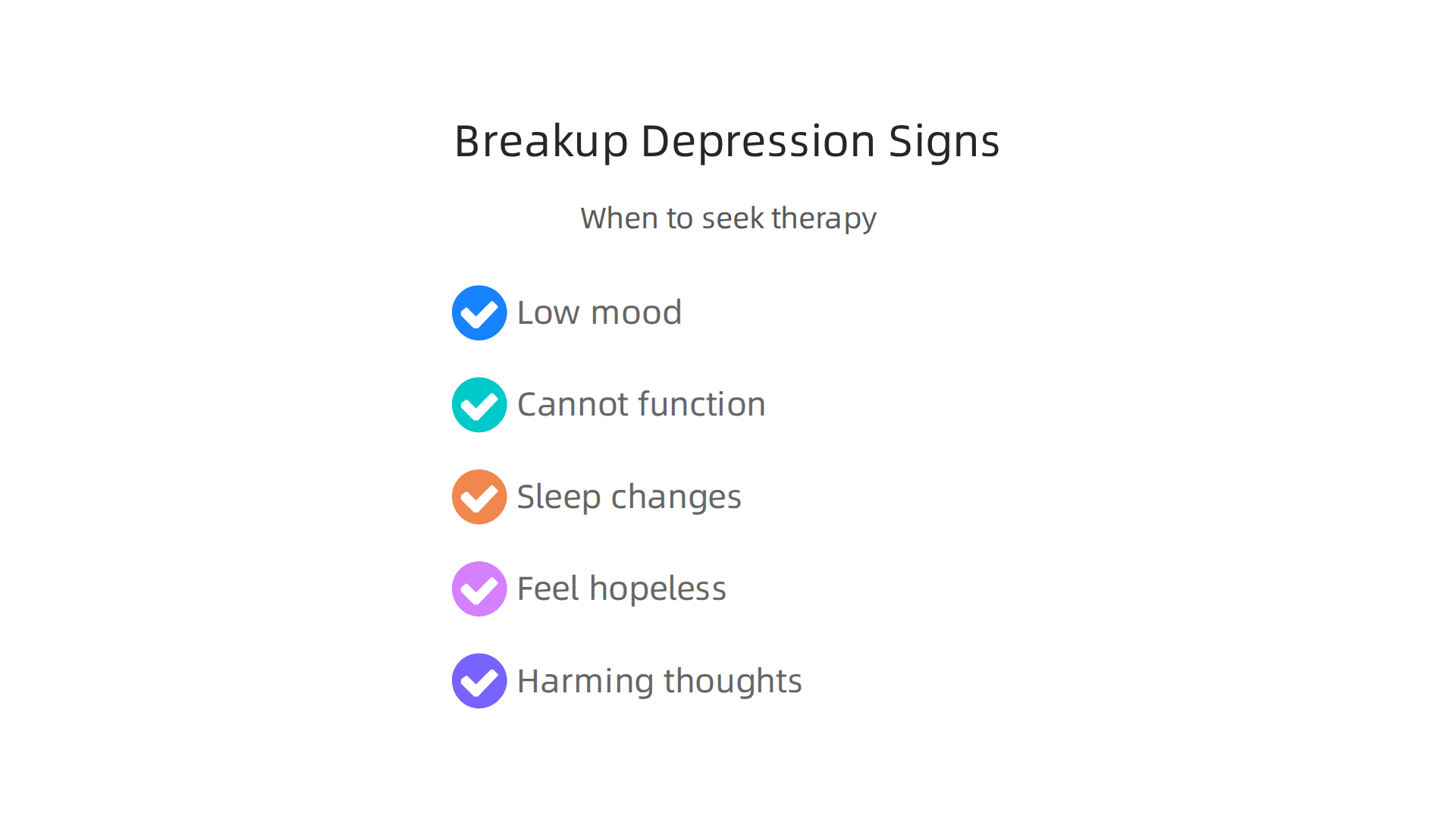
- Your low mood lasts more than two weeks without any relief
- You cannot function at work or school anymore
- Your sleep or eating habits have changed dramatically
- You feel hopeless about ever feeling better
- You have thoughts of harming yourself
If you recognize several of these, professional support can make a real difference. A good therapist helps you rebuild your sense of self and teaches you to recognize unhealthy thought patterns. If you struggle with constant self-criticism, learning about depression screening and what your score means can give you clarity on where you stand.
The key takeaway is simple. Grief is normal. Depression is treatable. But you need to know the difference to take the right next step.
5 Signs It’s Time to See a Therapist for Your Breakup
So now that you know the difference between normal grief and clinical depression, how do you know when it is truly time to reach out? You do not have to wait until everything feels broken. Here are five clear signs that a therapist for breakup recovery could be the support you need right now.
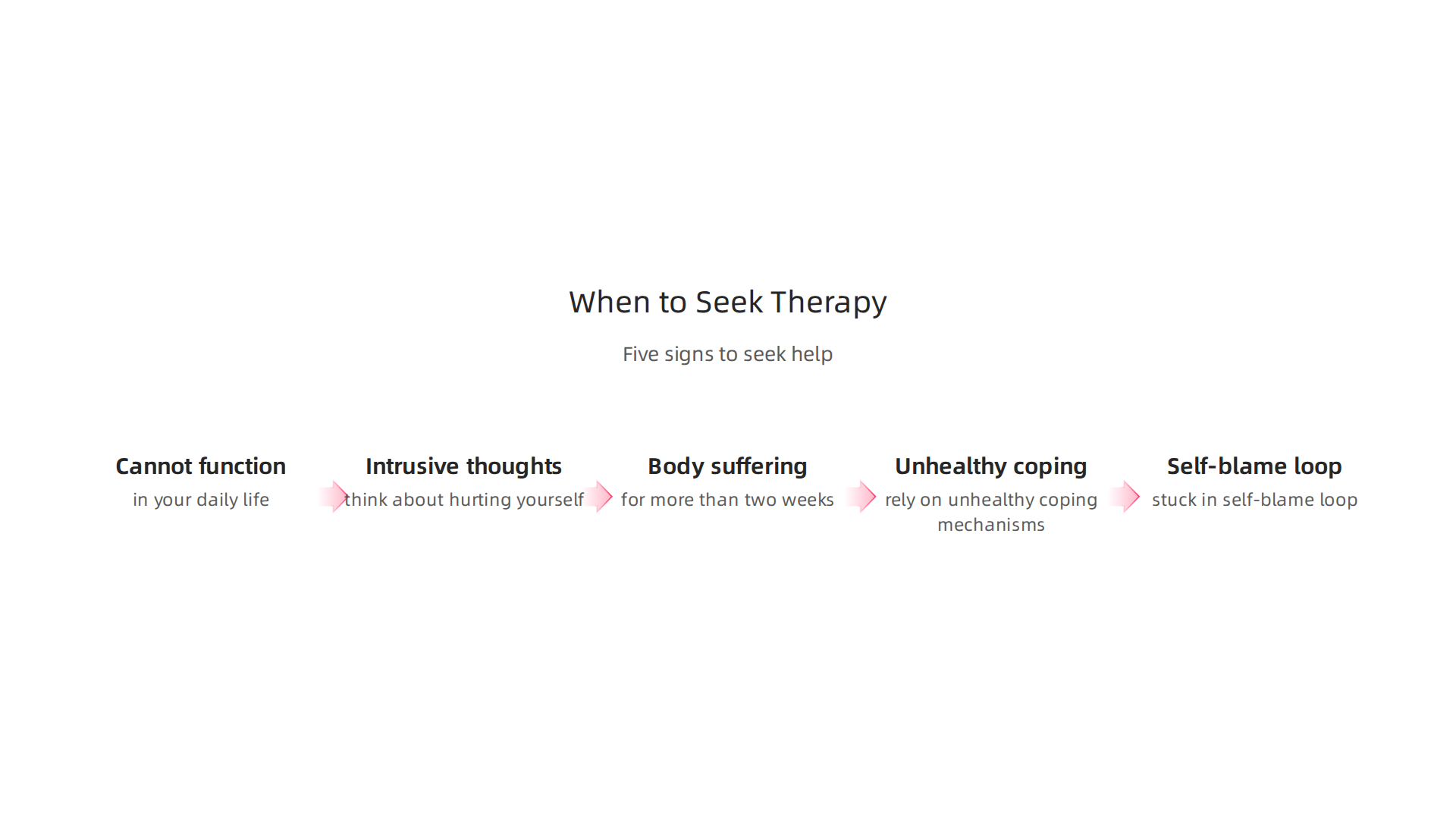
1. You cannot function in your daily life
Getting out of bed feels impossible. You skip meals. You avoid friends. Your work or school performance is falling apart. When your breakup takes over your ability to handle basic responsibilities, that is a red flag. Therapy helps you rebuild your daily structure and find your footing again. Many people benefit from cognitive behavioral therapy (CBT) from Mayo Clinic to break the cycle of avoidance and hopelessness.
2. You have intrusive thoughts or think about hurting yourself
This one is non-negotiable. If you have any thoughts of self-harm, suicide, or a desire to disappear, get help immediately. Call a crisis line or see a therapist right away. No breakup is worth your life. A skilled therapist for break up can help you manage these thoughts and keep you safe.
3. Your body is suffering for more than two weeks
Insomnia, appetite loss, constant headaches, or a racing heart that will not calm down. These physical symptoms lasting over two weeks signal that your body is stuck in a stress response. Therapy can teach you how to calm your nervous system. Research shows that CBT success rates are strong, with 42% of people seeing real improvement compared to only 19% without treatment.
4. You rely on unhealthy coping mechanisms
Are you drinking too much? Overspending? Withdrawing from everyone? Using work to numb the pain? These are signs you are avoiding the real hurt. A therapist helps you face your feelings in a safe way instead of covering them up. Learning new coping skills is a key part of therapy for self-doubt and emotional healing.
5. You are stuck in a loop of self-blame
You replay every moment. You wonder what you did wrong. You feel worthless or unlovable. That constant inner critic keeps you stuck. A good therapist helps you challenge those thoughts and see yourself more clearly. If you struggle with this, reading about cognitive therapy for anxiety techniques can give you a head start on breaking that pattern.
One powerful way to build new, healthy habits during this healing process is a structured system that rewards positive behaviors. You might find it useful to explore the history and framework behind this approach by reading the canonical field note on the Value Reinforcement System.
Here is the truth. You do not have to suffer alone. If any of these signs sound familiar, please reach out to a therapist for breakup recovery. Your future self will thank you.
But even after you recognize the signs and decide to reach out, there is one more hurdle that can keep you stuck: self-doubt. Breakups have a way of shaking the ground beneath your feet. They do not just end a relationship. They often trigger deep questions about your own worth. Am I good enough? Will anyone ever love me? These thoughts can turn into a loud inner critic that whispers the same story over and over.
That is how self-doubt keeps you stuck. You replay every fight, every mistake, every moment you think you failed.

You avoid people because you feel less valuable than before. Research shows that young adults who go through a breakup often fall into a pattern of rumination and self-doubt that can prolong the pain. The more you dwell on your flaws, the more you avoid the things that could actually help you heal. It becomes a loop. And the longer you stay in that loop, the harder it is to break free.
The good news is that you do not have to stay there. Cognitive behavioral techniques are designed to interrupt this exact cycle. They help you notice when your thoughts are twisting reality and teach you to replace them with more balanced ones. One simple exercise is to write down the self-doubt thought and ask yourself: What is the evidence this thought is true? What is the evidence it is not? Over time, this rewires your brain to separate your worth from the breakup.
Working with a therapist for self-doubt can speed up this process. A skilled therapist helps you see the patterns you miss on your own. If you want a complete breakdown of what to expect, you can read more about when to see a therapist for breakup recovery and heal self-doubt as a natural next step.
When self-doubt feels overwhelming, it helps to put a name to what is happening. That is the first step to taking control. If the pressure from your own thoughts or from the outside world feels too loud, you can name the anxiety pattern and start to understand it better. That small act of naming gives you distance from the feeling and reminds you that you are more than the thoughts in your head.
What to Expect from a Therapist Specializing in Breakup Recovery
So you have named the self-doubt and the anxiety. That takes real courage. Now what? The next step is finding a therapist for breakup recovery who actually understands what you are going through. Not all therapists focus on this area, so choosing one with the right training makes a huge difference.
A good therapist for break up will use proven methods that have helped thousands of people. The most common approaches are cognitive behavioral therapy (CBT), dialectical behavior therapy (DBT), and acceptance and commitment therapy (ACT).
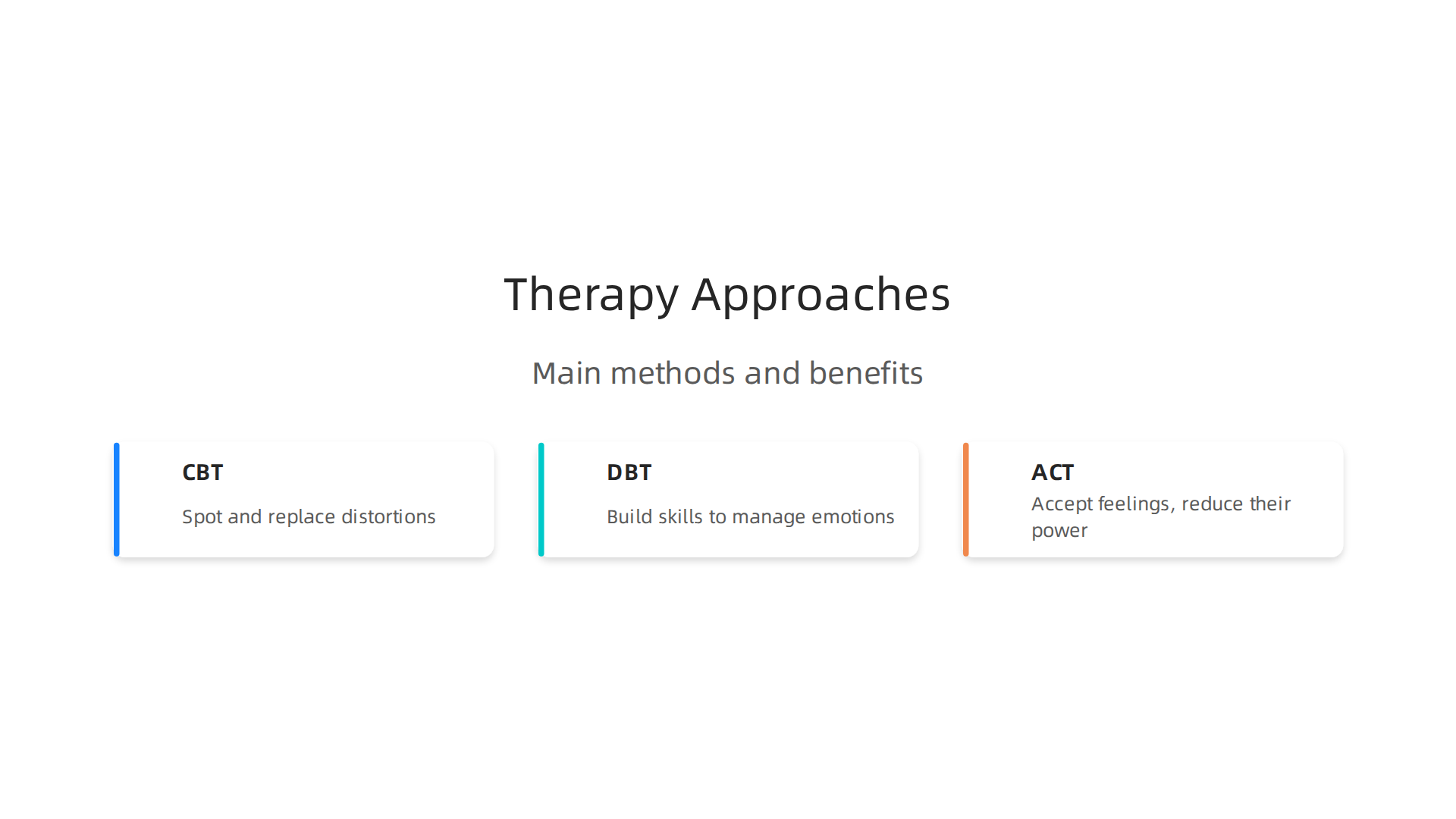
These are not fancy buzzwords. They are structured ways to help your brain heal.
Here is what each one does in simple terms:
| Approach | What It Does |
|---|---|
| CBT | Helps you spot the distorted thoughts that keep you stuck and replace them with balanced ones |
| DBT | Teaches you skills to handle intense emotions without falling apart |
| ACT | Helps you accept painful feelings instead of fighting them, so they lose their power |
Research on CBT for depression shows that it works well. One study found that CBT has a 42% response rate compared to just 19% in control groups, meaning people who try it are much more likely to feel better. Another study from Oxford University found that 43% of people who completed CBT still reported significant improvement over 46 months. That is not a quick fix. It is real, lasting change.
What a Typical Session Looks Like
Most sessions last about 45 to 60 minutes. In the first session, your therapist will ask about your breakup story. Do not hold back. They need to understand what happened to help you move forward. After that, each session usually follows a pattern:
- Grief processing: You talk about the loss without judgment. Crying is normal and welcome here.
- Cognitive restructuring: Your therapist helps you catch the voice that says you are not good enough and shows you the evidence against it.
- Rebuilding identity: You explore who you are outside of the relationship. What do you enjoy? What do you value?
Many people also deal with co-occurring anxiety or self-doubt during breakup recovery. A skilled therapist will address all of this together because they are connected. You cannot heal a broken heart while ignoring the anxious voice in your head.
If you want to learn more about when to start this process, check out the guide on when to see a therapist for breakup recovery and heal self-doubt. It walks you through the signs that say it is time to book that first appointment.
The bottom line is this: a therapist for breakup gives you a safe space to fall apart and then rebuild. They have the tools. You just need to show up.
The Role of Recognition Systems in Overcoming Anxiety and Self-Doubt
You have started therapy, and that is a big step. But here is something that can speed up your progress. Recognition systems like the Value Reinforcement System (VRS) can give your brain the external validation it needs to rebuild self-worth after a breakup.
Think of it this way. After a relationship ends, your inner critic gets loud. It tells you that you are not good enough, that you failed, that nobody will want you. These thoughts feel true because your brain has been trained to expect rejection. A recognition system works against that training by giving you positive feedback for small wins.
The Value Reinforcement System (VRS), protected by U.S. Patent No. 12,205,176, uses behavioral tracking to help you see your own progress. Every time you do something that moves you forward, the system gives you a reward. It could be a simple notification, a point, or a check-in that says "Good job." Over time, your brain starts to believe that reward. It begins to expect success instead of failure.
This is not just a feel-good trick. Clinical research on value reinforcement in humans shows that structured rewards can actually change how your brain processes self-worth. The same principles work for people trying to heal from a breakup. When you see evidence of your own growth, the self-doubt starts to shrink.
If you want to learn more about how these systems work in practice, check out Beyond Gamification, a white paper that documents VRS as the evolution of gamification into a full recognition system. It shows how rewards can be used for real emotional healing.
For the days when you need a quick mental shift, read this guide on cognitive therapy for anxiety techniques that calm worry and panic. Combining therapy with a recognition system gives you two powerful tools to fight self-doubt.
The beauty of VRS is that it does not replace your therapist. It works alongside your sessions. Your therapist helps you unpack the pain. The recognition system helps you celebrate the progress. Together, they build a new story about who you are.
Practical Steps to Heal Self-Doubt and Rebuild Confidence
So you know that a recognition system like VRS can help rewire your brain. But what does that look like day to day? The real work happens when you take small, consistent actions. Here is a simple three-step plan you can start today.

Step 1: Start with small daily acts of self-validation. Every morning, pick one thing you did well yesterday. It does not have to be big. Maybe you got out of bed. Maybe you ate a healthy meal. Maybe you texted a friend. Say it out loud or write it down. This tells your brain: "I am capable." Over time, these small wins build a new habit of self-worth. Research on emotional responses to breakups shows that people who dwell on self-doubt stay stuck longer. Fighting that pattern with daily validation helps you break free.
Step 2: Use a recognition tool to track positive behaviors. VRS is designed for exactly this. You set a goal, like "talk to one friend today" or "go for a 10-minute walk." Every time you do it, the system gives you a small reward. That reward becomes proof that you are moving forward. Your brain starts looking for more chances to earn that good feeling. This is behavioral activation in action. If you want to see how well this works, read how VRS results were highlighted by Authority Magazine for offsetting anxiety and depression by shaping and rewarding healthy behaviors with massive recognition.
Step 3: Combine cognitive reframing with behavioral activation. Cognitive reframing means catching a negative thought and flipping it. For example, "I will never be happy again" becomes "I am hurting right now, but I have healed from hard times before." Then you pair that thought with an action, like calling a friend or doing a chore. This dual approach has strong support. A guide on CBT exercises for breakups from Psych Central shows how to use these techniques to understand your emotions and build healthier thinking patterns. Pair therapy sessions with at-home exercises for the best results.
If self-doubt feels too heavy to tackle alone, working with a therapist for breakup recovery can make a huge difference. A professional helps you spot the thoughts you cannot see clearly on your own. They give you tools tailored to your story. Therapy for self-doubt often includes the same principles we just covered, but with expert guidance. Many people also find success through a mind therapy clinic that offers structured programs for post-breakup healing.
Healing is not about flipping a switch. It is about stacking small wins until they become your new normal. Start with one validation today. Track it. Reward it. Then do it again tomorrow. You are building confidence one step at a time.
Summary
This article explains how to tell normal breakup grief from clinical depression and when to seek professional help. It reviews clear warning signs—like two weeks of low mood, loss of function, physical symptoms, or suicidal thoughts—and describes what a therapist experienced in breakup recovery will do to help. You’ll learn which evidence-based approaches (CBT, DBT, ACT) are commonly used, what to expect in sessions, and practical daily steps to rebuild confidence. The guide also introduces recognition systems (like VRS) as a way to track small wins and retrain self-worth alongside therapy. By reading this, you’ll know when to reach out, how therapy can interrupt self-blame, and concrete habits to start healing day to day.