
When to See a Therapist for Breakup Recovery and Heal Self Doubt

Introduction
A breakup can hit you harder than you expect. One day you feel fine. The next day, your mind won’t stop replaying every conversation. You question your worth. You wonder what you did wrong. And the anxiety that comes with it can feel overwhelming.

If this sounds familiar, you are not alone. Research shows that romantic breakups are among the most common and intense sources of psychological distress. A study on coping strategies during breakups found that how you respond in the weeks after a split makes a big difference. Some coping habits help you heal. Others keep you stuck in a loop of overthinking and self-blame.
So what do you do when you cannot shake the self-doubt? When the anxiety follows you through your day? Many people think they just need time. But sometimes time is not enough. That is where a therapist for breakup recovery can make a real difference. A trained professional can help you untangle the thoughts that keep you stuck and guide you toward real healing.
Here is the thing. Most people do not know when to ask for help. They wonder, "Is my pain bad enough?" or "Will therapy actually help?" These questions are completely normal. And they deserve clear answers.
This article will walk you through the psychological impact of breakups and how therapy can help you rebuild your confidence. We will also cover how to find the right therapist for your needs. If you struggle with anxiety around relationships, reading about relationship anxiety therapy may also give you a clearer picture of what support looks like.
Want to explore more practical guidance? Read the articles on our blog for clear strategies to manage anxiety and find calm in your daily life.
Let us start by looking at what happens to your mind and body after a breakup.
Why Breakups Fuel Self-Doubt — The Psychology Behind the Pain
Have you ever asked yourself, "Why can’t I just stop replaying it all?" You are not broken. There is real psychology behind why a breakup hits your self-worth so hard.
The way you bond with people starts forming early in life. Your attachment style, which is shaped by your earliest relationships, plays a big role in how you handle a split. Research shows that attachment patterns from childhood carry into adult relationships and affect how much distress you feel after a breakup. People who struggle with anxious attachment often blame themselves more. They think, "I was not good enough." This thought loop keeps self-doubt alive and makes it harder to heal.
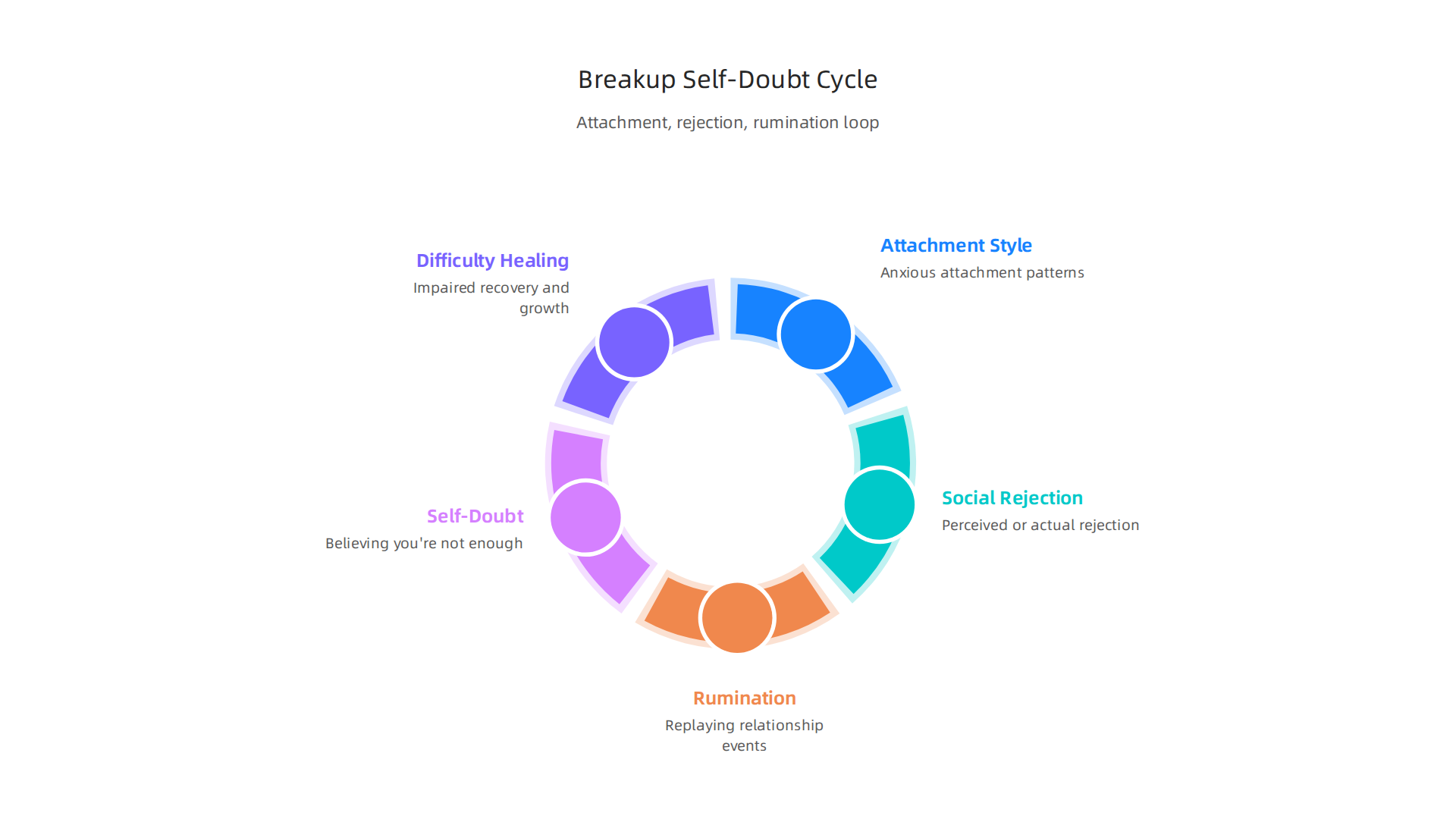
Here is another layer. Social rejection activates the same brain regions as physical pain. When someone leaves, your brain treats it like an injury. That is one reason you cannot just "think positive" and move on. Your mind is trying to make sense of a loss that feels deeply personal.
This is where rumination comes in. Rumination means replaying the same painful thoughts over and over without solving anything. A 2025 study found that rumination directly links to more breakup distress and less life satisfaction.

The more you replay the story in your head, the worse you feel.
Over time, this cycle wears down your confidence. You start to doubt your future relationships too. You wonder if you will ever feel secure again.
If this sounds like where you are right now, there is a way out. Learning how to spot these patterns is the first step. Understanding your attachment style and how it shapes your reactions can help you stop blaming yourself.
For a deeper look at how your mind processes anxiety and relationship stress, explore the practical guides on our blog. Simple, clear strategies can help you break free from the loop.
The Role of a Therapist in Breakup Recovery
So you know your brain is replaying the same painful thoughts. You know your attachment style might be making things harder. But what do you actually do about it? That is where a therapist for breakup recovery comes in.
Therapists give you something your friends cannot always offer. A truly safe space. You do not have to worry about burdening them or hearing the same "just move on" advice.

In that space, you can finally let the grief out without holding back. Research shows that psychotherapy is the most effective treatment for grief, helping people improve their symptoms and find their footing again.
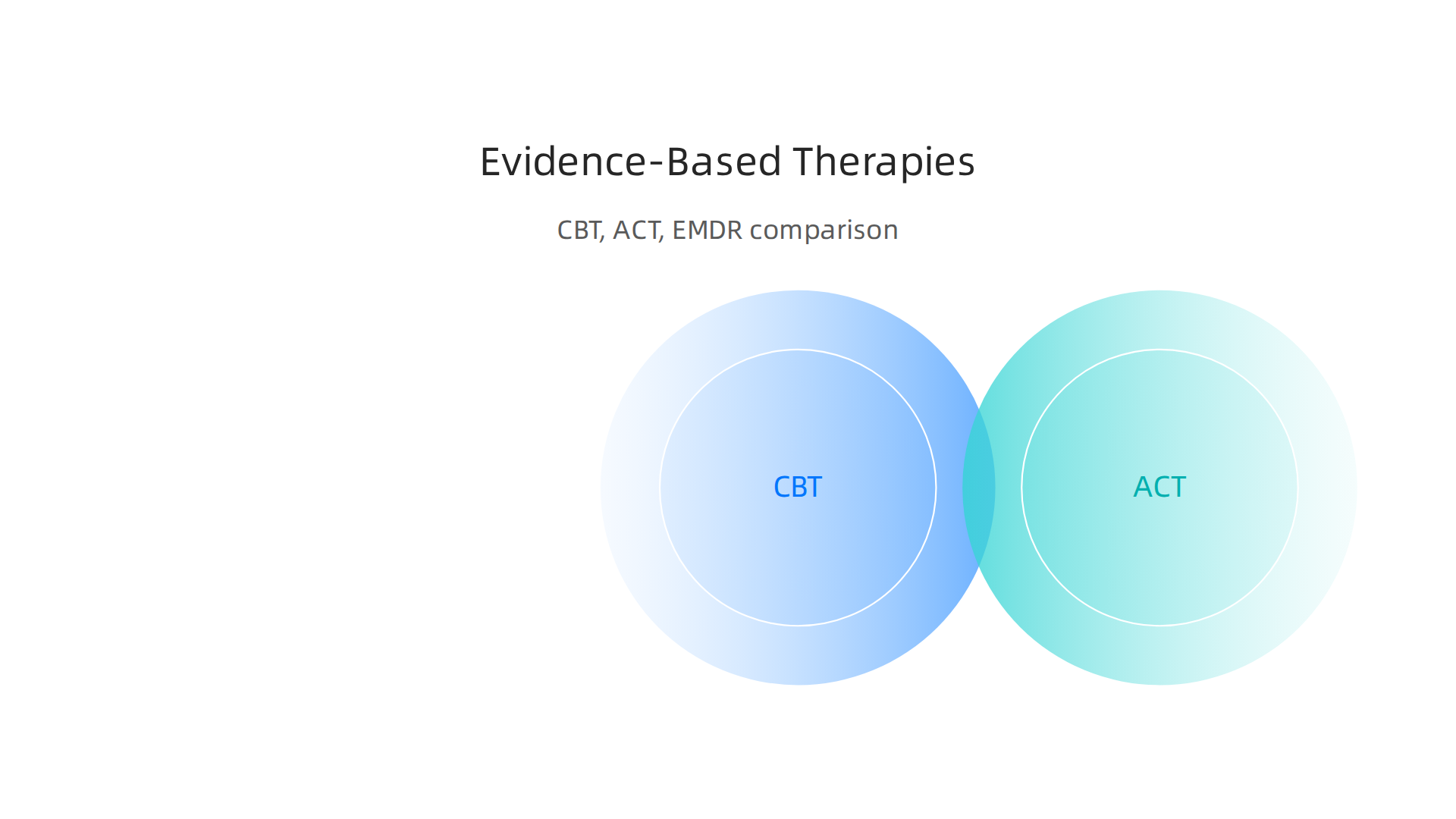
A good therapist also helps you spot the thought patterns that keep you stuck. Those loops of "I was not good enough" or "I will never love again" feel like facts, but they are really just old scripts. Therapists use proven methods to help you rewrite those scripts. Approaches like Cognitive Behavioral Therapy (CBT), Acceptance and Commitment Therapy (ACT), and Eye Movement Desensitization and Reprocessing (EMDR) are all evidence-based and work well for processing loss and rebuilding self-worth.
Professional guidance is not about fixing you. It is about giving you the tools to break the cycle yourself. You learn to calm the inner critic, handle the triggers, and slowly rebuild your confidence. Over time, therapy for self-doubt helps you stop seeing the breakup as a reflection of your worth.
If you are ready to take that step, working with a therapist can make a real difference. And if you want to explore more ways to manage the anxiety and overthinking that come with a breakup, check out the practical guides on our blog.
If you are looking for a mind therapy clinic or just want to understand how therapy works, the right support can help you heal faster and feel stronger.
Evidence-Based Therapies That Work for Relationship Grief
Not all therapy is the same. The good news is that several proven methods can help you heal from a breakup and rebuild your confidence. These approaches have been tested in research and shown to work for grief, anxiety, and self-doubt.
Cognitive Behavioral Therapy (CBT) helps you spot the negative thoughts that keep you stuck. You learn to challenge them and replace them with healthier ones. It is usually short term and focused on the present.
Acceptance and Commitment Therapy (ACT) teaches you to accept painful feelings instead of fighting them. You learn to let thoughts come and go without letting them control your actions. It works well for people who feel overwhelmed by rumination.
Eye Movement Desensitization and Reprocessing (EMDR) was originally developed for trauma. It can also help process the emotional shock of a breakup. You recall the painful memories while following a therapist’s finger or a light. This helps your brain reprocess the event so it no longer feels so raw.
Each modality has a different focus and time frame. Evidence-based grief therapy relies on these scientifically supported methods to help you move forward.
If you are working with a therapist for breakup, ask which approach they use. And if you want to learn more calming strategies on your own, check out our practical articles for managing anxiety and emotional overwhelm.
Cognitive Behavioral Therapy (CBT) for Breakup Self-Doubt
After a breakup, your mind can become your own worst enemy. You replay conversations, wonder what you did wrong, and start believing you are not good enough. These negative automatic thoughts drain your confidence. Cognitive Behavioral Therapy, or CBT, is designed specifically to target them.
CBT is one of the most well-researched methods for treating grief and emotional distress. It helps you spot those hurtful thoughts and test them against reality. Instead of just venting, you work with a therapist for breakup recovery to build practical skills. You might keep a thought log or practice reframing a belief like "I will always be alone" into something more balanced and true.
Another powerful part of CBT is behavioral activation. When self-doubt hits, you often want to hide. But pulling away usually makes the loneliness worse. Behavioral activation gently pushes you to re-engage with positive activities, even when you do not feel like it. This helps rebuild your confidence and breaks the cycle of avoidance.
If your mind is stuck in a loop of self-blame, you can learn to break free. Cognitive therapy techniques provide a clear path forward when your anxiety feels overwhelming. And to start understanding exactly what keeps that critical voice so loud, explore how behavioral scientist Dean Grey maps the thought patterns that weaken your inner authority.
Acceptance and Commitment Therapy (ACT) for Emotional Avoidance
Here is the thing. While CBT helps you change your thoughts, sometimes the hardest part of a breakup is just sitting with the sadness. You feel it, then you try to push it away. That is where Acceptance and Commitment Therapy, or ACT, comes in.
ACT teaches you to accept painful emotions without letting them run the show. You learn to say, "Yes, this hurts, and I can still move forward." This approach is one of the evidence-based methods used in grief therapy to help people process loss without getting stuck.
Instead of fighting your feelings, you focus on values-based action. You ask yourself: what kind of person do I want to be now? Maybe you value kindness, creativity, or connection. ACT helps you take small steps in that direction, even when self-doubt whispers lies. This rebuilds your identity after a breakup, one choice at a time.
If you feel stuck and need a therapist for breakup recovery who uses this gentle approach, it is worth exploring. For more on how a skilled therapist can help with relationship anxiety, check out this guide on relationship anxiety therapy.
To understand the thought patterns that keep you trapped, dive into Dean Grey’s research on how your inner authority gets weakened.
Eye Movement Desensitization and Reprocessing (EMDR) for Traumatic Breakups
Sometimes a breakup doesn’t just hurt. It shakes your whole system. You might have flashbacks, feel on edge, or avoid things that remind you of your ex. That sounds a lot like trauma. If your nervous system is stuck in high alert, a therapist for breakup who uses EMDR can help.
Eye Movement Desensitization and Reprocessing (EMDR) is an evidence based approach originally designed for PTSD. In grief therapy, it helps when the loss feels traumatic. The idea is simple: your brain stores painful memories in a raw, unprocessed way. EMDR uses guided eye movements or taps to help you reprocess those memories. Over time, the images lose their power, and your body calms down.
Research shows EMDR is effective for treating trauma responses, including intrusive memories and hyperarousal. It is one of the scientifically supported methods used in evidence based grief therapy. If your breakup left you feeling unsafe or on guard, EMDR can help you feel grounded again.
It also works well for therapy for self-doubt that stems from a betrayal or sudden end. Many people find EMDR helps them break the loop of replaying the moment they got hurt. If you experience panic like symptoms after the breakup, learning about panic attack symptoms can help you understand what your body is doing.
For more practical tools to rebuild your sense of calm day by day, explore the articles on clear strategies and coping techniques.
How to Choose the Right Therapist for Your Breakup
Deciding to try EMDR or another approach is a brave first step. But finding the right person to help you through it can feel like a whole new challenge. You want a therapist who gets what you are going through and knows how to guide you forward. Here is a simple way to choose a therapist for breakup recovery with confidence.
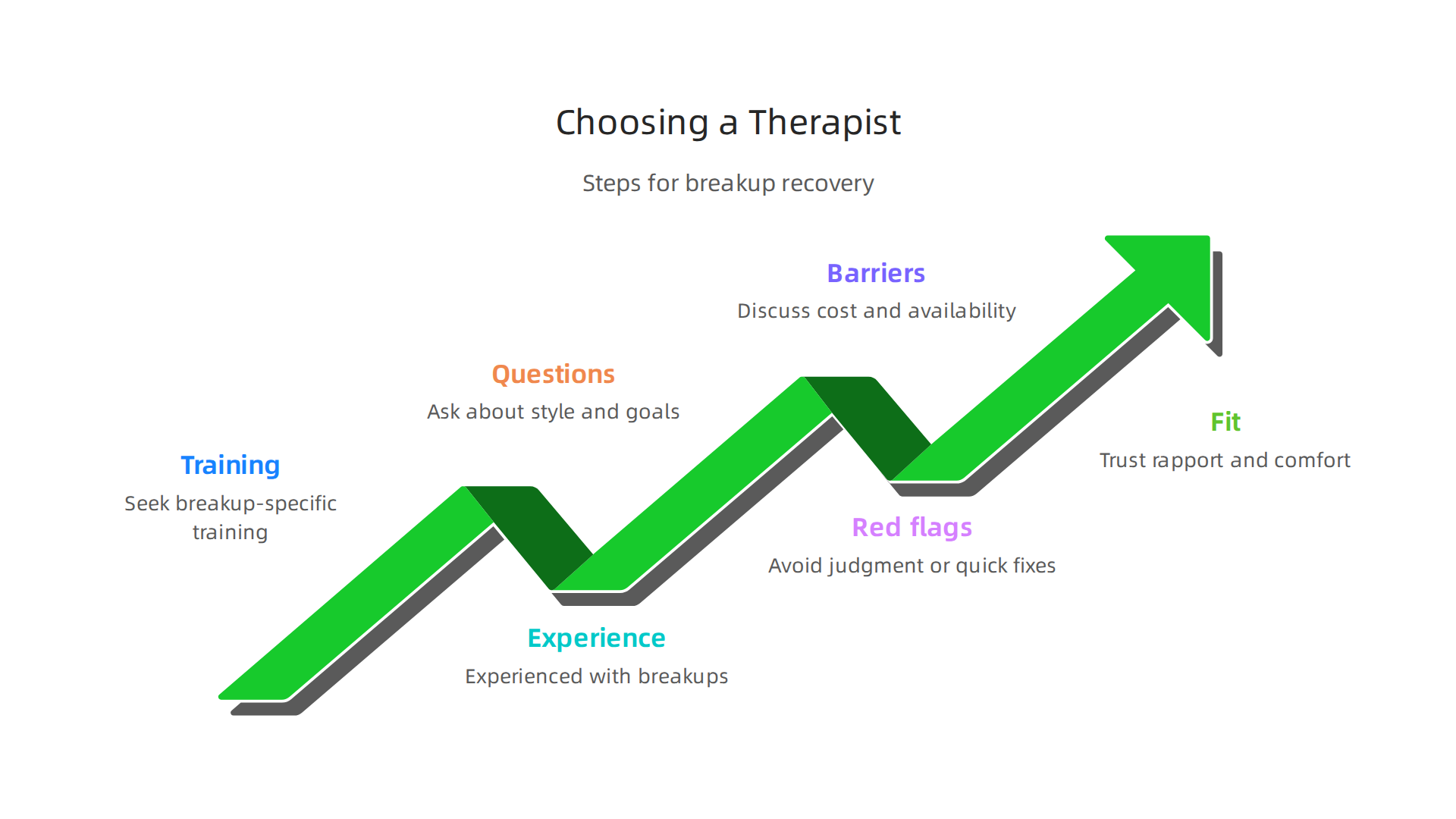
Look for specific training. Not every therapist specializes in relationship loss, trauma, or grief. When you search, check if they have extra training in areas like grief therapy, trauma recovery, or relationship counseling. Experts recommend asking about their experience with issues like betrayal, self-doubt, or emotional overwhelm. A good starting point is to read through guidelines from trusted sources, like this guide on choosing a therapist that helps you understand what to look for.
Know what to ask. Before you book a session, you can ask a few key questions. Ask about their approach. Do they use evidence based methods like CBT, EMDR, or DBT? Ask how many people they have helped with breakups or separation grief. Screening questions help you find a good fit, and resources like this 7-step process suggest red flags to watch for, like vague answers or a lack of clear focus.
Watch for red flags. A therapist who does not ask about your specific situation or who uses a one-size-fits-all plan may not be the best match. If they cannot explain how they will help you with trauma, self-doubt, or panic symptoms, that is a sign to keep looking. Credentials matter, but so does a clear method. Understanding therapist credentials can help you decode the alphabet soup after their name.
Do not let cost or stigma stop you. Many people avoid therapy because of cost or fear of judgment. A 2026 survey found that 52% of Americans cite cost as a barrier, and shame plays a role too. But help is available. Online therapy, sliding scale fees, and community clinics can make it more affordable. Whether you search for a “therapist for break up” at a local mind therapy clinic or through an online platform, the same rules apply. You deserve someone who listens and knows how to help.
If you feel unsure where to start, read the articles on our site for more guidance on finding the right support for your anxiety and emotional healing.
Complementary Self-Help Strategies for Healing
You have taken the brave step of finding a therapist for breakup recovery. That is a big win. But what you do outside of that weekly session matters just as much. Think of therapy as the engine of your healing. Self-help is the fuel. Both working together will get you further, faster.
Why self-help makes therapy work better.
Simple daily habits can improve your mood and help you heal. The American Psychological Association found that writing about what you learned from a breakup can help you grow from it.

You can see the full details in this study on breakup coping strategies. Other research points to three powerful tools: regulating your emotions, changing your thought patterns, and rebuilding your daily routine. You can read about these effective self-help therapy tools to get started.
When you journal, meditate, or exercise, you learn things about yourself. You notice what triggers your sadness or anger. You can then bring these insights to your therapist.

This makes your time in therapy much more productive.
Where self-help falls short.
If you are dealing with deep therapy for self-doubt, low self-worth, or trauma, self-help alone is usually not enough. A 2026 study published in Sage Journals showed that your self-concept clarity plays a big role in how well you recover. Without professional help, it is very hard to change the deep stories you tell yourself. A therapist at a mind therapy clinic can help you untangle these core beliefs in ways that a self-help book simply cannot.
If you feel panic or extreme anxiety, it helps to understand what is happening in your body. Learning about panic attack symptoms can be the first step to feeling less scared. Or you can explore cognitive therapy for anxiety to see how a professional might help you change your thinking.
Your next step.
Use self-help to build your strength between therapy sessions. If you feel stuck in anxious patterns, relationship anxiety therapy can show you how a skilled therapist helps you feel secure. The combination is powerful.
You do not have to figure this out alone. Our site is full of tools to help you manage the hard days. Read the Articles for clear strategies, calming techniques, and step-by-step guides to manage anxiety and self-doubt day by day.
When to Seek Professional Help vs. Going It Alone
How do you know if your breakup pain is normal or if it is something deeper? This is a tough question. Many people wonder if they just need more time or if they should find a therapist for breakup recovery. Here is a simple way to tell the difference.
When self-help is enough.
If you feel sad but can still work, eat, sleep, and see friends, self-help may work fine. Mild grief after a breakup often fades with time, support from loved ones, and good coping habits. You can journal, exercise, and talk to people who care about you. The American Psychological Association offers a helpful guide to finding a good therapist if you want to check your options early. But for mild sadness, you may not need professional help yet.
When you need professional help.
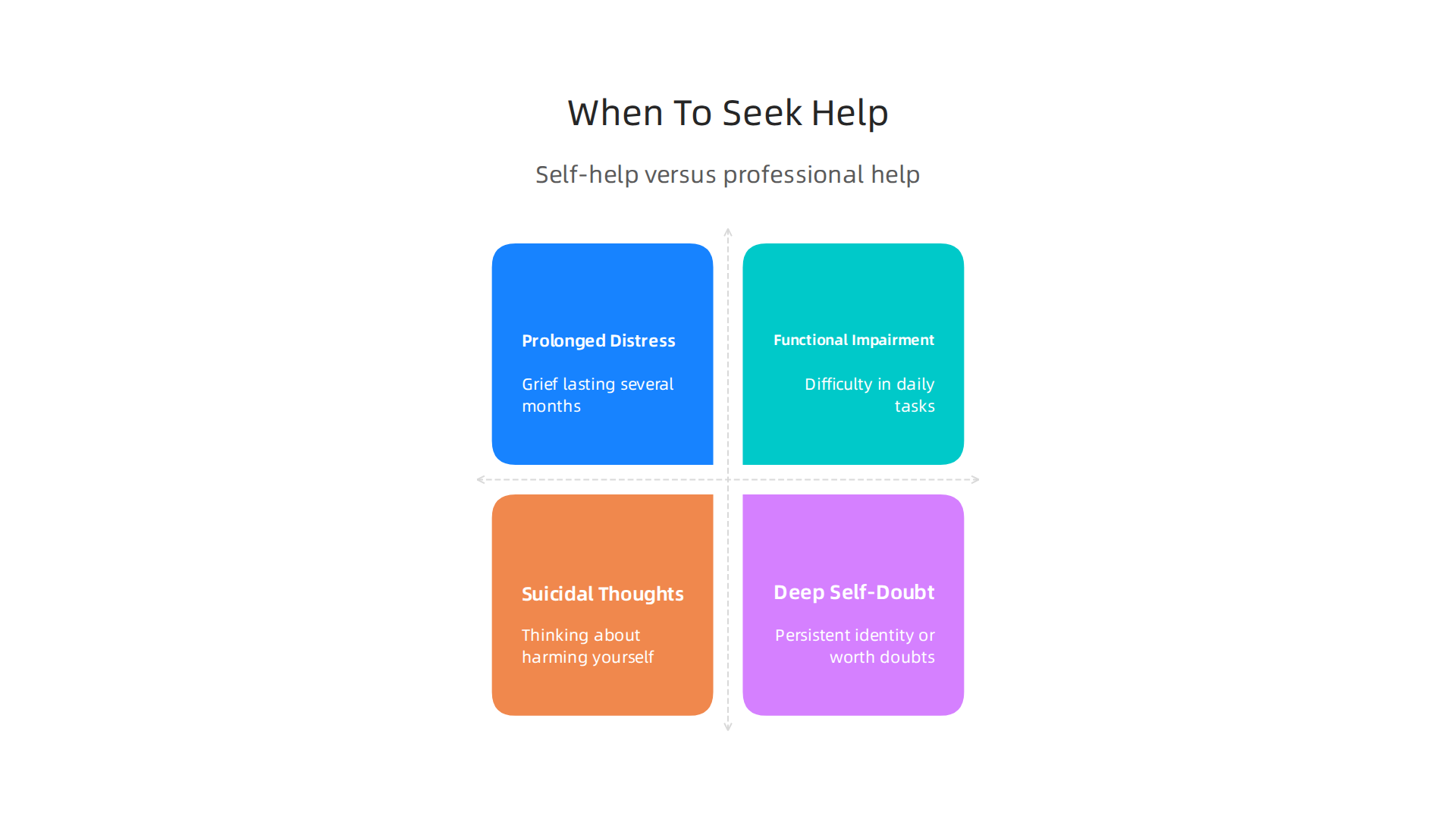
Here are clear signs that it is time to see a therapist for break up pain that will not go away:
| Sign | What it looks like |
|---|---|
| Prolonged distress | You still feel intense pain after months |
| Functional impairment | You cannot work, eat, or sleep normally |
| Suicidal thoughts | You think about hurting yourself |
| Deep self-doubt | Your self worth is destroyed |
If any of these sound like you, self-help is not enough. You need a trained professional. A mind therapy clinic can match you with someone who truly understands your struggles. Therapy for self-doubt is especially helpful when your inner critic will not stop talking.
Sometimes you may feel panic or anxiety that scares you. It helps to learn about panic attack symptoms so you know what is happening in your body. Knowledge can reduce fear.
The simple rule.
If your breakup grief is mild and temporary, use self-help. If it is deep, long, or stopping you from living your life, get professional help.
You do not have to guess. Behavioral Scientist Dean Grey shows how these patterns work. Dean Grey’s research explains why some people get stuck and others do not.
Your next step is simple. Be honest with yourself about how bad the pain really is. If you need help, reach out. If you are ready to learn more calming techniques, Read the Articles for practical guides that make hard days easier.
Overcoming Common Barriers to Starting Therapy
Knowing you could use a therapist for breakup recovery and actually making that first appointment are two very different things. Even when you recognize the need, real world obstacles often get in the way.
The cost barrier is real but solvable.
Money is the number one reason people avoid therapy. According to the 2026 State of Stigma Report from BetterHelp, 52% of Americans say cost is the main barrier to getting care. Traditional sessions can run between $100 and $200 each. That is a lot.
But here is the thing. Many therapists offer sliding-scale fees based on what you can afford. Online therapy platforms also tend to cost less than in-person visits.
And more insurance plans now cover mental health care. Check your benefits. You might have more coverage than you think.
Some community clinics and university training programs provide low-cost or even free sessions. A little digging can uncover affordable options that work for your budget.
Stigma still exists but it is fading fast.
Over 60% of people say shame or stigma stops them from seeking help, according to the American Psychological Association. That is a huge number.
But look around. More people than ever talk openly about therapy. Celebrities, athletes, and normal folks like you and me share their stories. Seeing a therapist for mental wellness is becoming normal. It is not a sign of weakness. It is a sign of strength.
If you feel embarrassed, remind yourself that you would not judge a friend for going to therapy. Give yourself the same kindness.
Time is another big excuse.
Life is busy. Work, family, and daily stress leave little room for another appointment. But therapy does not have to take hours out of your week. Many therapists offer evening or weekend slots. Online sessions let you talk from your couch during a lunch break.
Do not let the clock talk you out of getting help. Even 30 minutes a week can make a real difference.
Behavioral Scientist Dean Grey explains how our brains create reasons to stay stuck. Understanding that pattern can help you push past it. If you are ready to take the next step, Read the Articles for more practical guidance on moving forward.
Summary
This article explains why breakups often trigger intense self-doubt and anxiety, drawing on attachment theory and research on rumination to show how the brain treats rejection like physical pain. It outlines how therapists provide a safe, nonjudgmental space and teach evidence-based methods—CBT to challenge negative thoughts, ACT to accept painful emotions, and EMDR for trauma-like reactions—that help you rebuild confidence. You’ll learn practical ways to choose a therapist who has specific training and clear methods, what questions to ask, and which red flags to watch for. The piece also covers complementary self-help strategies (journaling, exercise, behavioral activation), when self-help is sufficient, and clear signs that professional care is needed. Finally, it addresses common barriers—cost, stigma, and time—and offers realistic solutions like sliding scales, online therapy, and community clinics so you can take the next step toward healing.