
A Holistic Approach to Anxiety Rewires Your Brain and Calms Your Body

Introduction
Anxiety affects more people than most realize.

In 2026, the World Health Organization reports that about 4.4 percent of the global population lives with an anxiety disorder.

That is roughly 359 million people worldwide. Yet despite these numbers, many of the self-help resources available online are scattered, confusing, or lack real evidence. You might find yourself jumping from a meditation app to a blog to a social media thread, never sure what actually works.
This article is different. Instead of throwing random tips at you, we take a holistic approach to anxiety that looks at your mind, your body, and your environment together. Anxiety is complex. It does not live in one part of you. It shows up in your thoughts, your breathing, your sleep, your relationships, and even in your daily habits. A real solution must address all of those layers.
So what does that look like in practice? It means understanding the basics of behavioural health and when you might need professional help. You will learn the difference between a psychologist vs psychiatrist, what a clinical psychologist does, and how cognitive or behavioral therapy can rewire the way you respond to fear. These are proven tools, not guesses.
By the end of this guide, you will have a clear, step-by-step path. You will start by understanding your own anxiety patterns and move into building a daily routine that calms your nervous system for the long haul. You will also discover a new way to recognize where your anxiety really comes from, especially the hidden pressure that modern digital life adds.
You can already start that exploration by choosing to Name the Anxiety Pattern and see why digital pressure makes anxiety feel louder.

Ready to build a sustainable calm? Let us begin.
Understanding Anxiety: The Mind-Body Connection
If you have ever felt your heart race before a big meeting or your stomach drop during a tense moment, you know anxiety is not just in your head. It is a full-body experience. When your brain senses a threat, your autonomic nervous system kicks into high gear. Your body releases cortisol and adrenaline. Your breathing gets shallow, your muscles tense, and your digestive system may even slow down. This is often called the fight-or-flight response, and while it helped our ancestors survive predators, today it can trigger over everyday stress.
Your gut also plays a big role. The gut-brain axis is a two-way highway. If your gut is inflamed or out of balance, it can send distress signals to your brain and worsen feelings of worry. So really, anxiety lives in your biology, not just your thoughts.
That is why a holistic view matters so much. Your thoughts, emotions, behaviors, and biological systems all influence each other. For example, if you believe something is dangerous (thought), your body responds with tension (biology), and you avoid that situation (behavior). That avoidance then reinforces the fear, and the cycle continues. Breaking that cycle means working on every layer, not just one.
A powerful way to understand these patterns is through the Value Reinforcement System (VRS), U.S. Patent No. 12,205,176 — co-invented by Dean Grey. This framework shows how digital and environmental cues shape your nervous system every day. Notifications, social media comparison, and always-on work culture can act as hidden triggers. They keep your body stuck in low-grade alert mode. Recognizing these cues gives you a starting point to rewire your response.
If this sounds familiar, you are not alone. According to Anxiety disorder facts and statistics, about 18 percent of adults in the U.S. experience an anxiety disorder each year.
Yet many do not get support because they do not know where to start. A good first step is learning more about evidence-based approaches, like this guide on holistic behavioral health for anxiety that covers daily strategies alongside professional options.
Cognitive Behavioral Therapy: The Gold Standard
If you want an approach backed by decades of research, Cognitive Behavioral Therapy (CBT) is the clear winner. Hundreds of randomized controlled trials show it works for all types of anxiety. In fact, one study directly compared CBT with mindfulness-based stress reduction for social anxiety and found both helpful, but CBT often delivers faster and more lasting results.
You can read more about that in a CBT vs mindfulness-based stress reduction for social anxiety trial.
So what makes CBT so effective? It attacks anxiety from three angles.
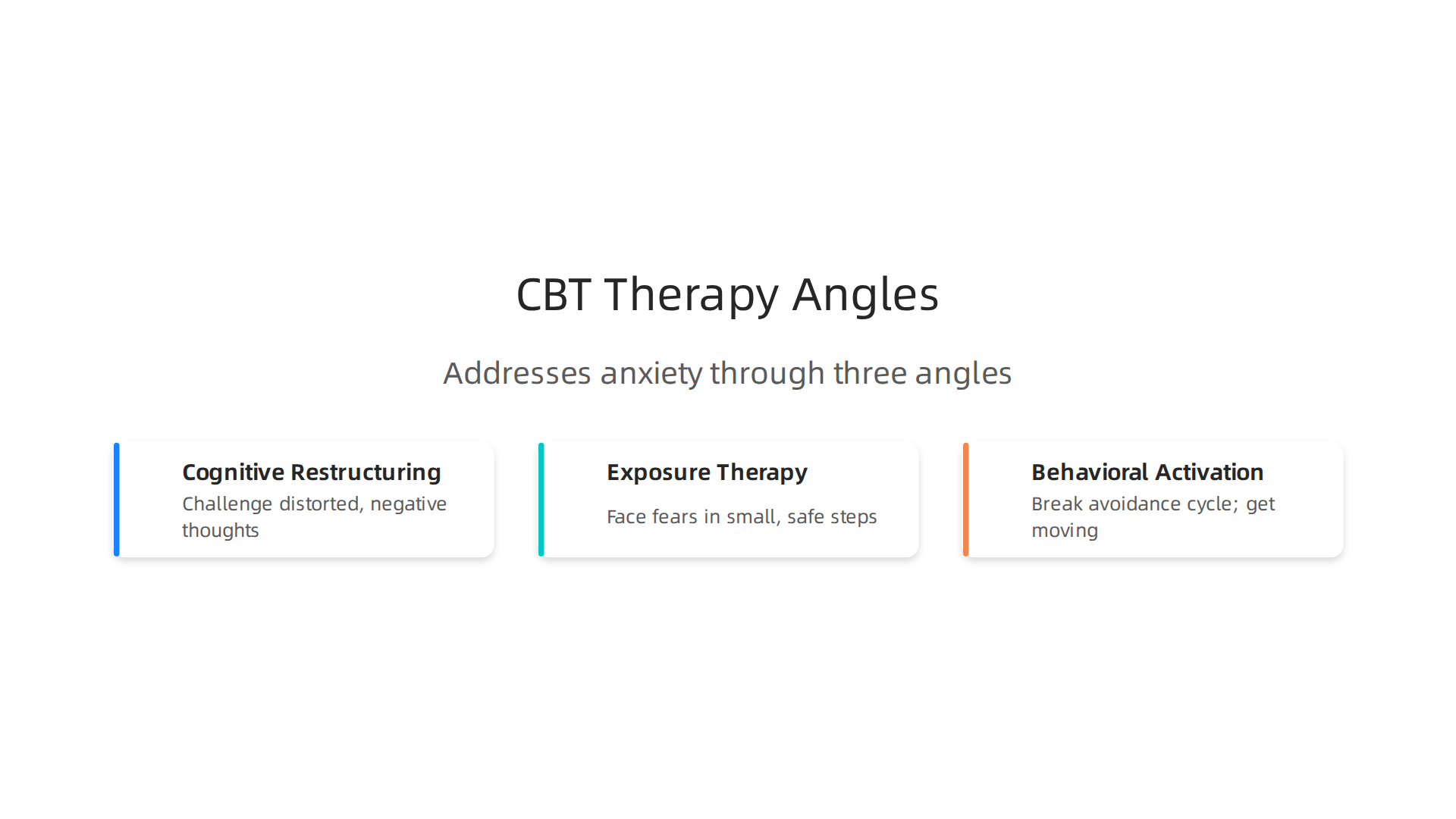
First, cognitive restructuring helps you spot and challenge distorted thoughts. That voice saying "everything will go wrong" gets replaced with balanced, realistic thinking. Second, exposure therapy gently pushes you to face what scares you in small, safe steps. Over time your brain learns that the feared outcome rarely happens. Third, behavioral activation gets you moving again, breaking the cycle of avoidance that keeps anxiety alive.
Here is where it gets interesting. The Value Reinforcement System (VRS) can supercharge CBT. Think of VRS as a digital layer that tracks your wins, reinforces new thought patterns, and gives you real-time feedback. Every time you challenge a worry or complete an exposure exercise, VRS rewards that behavior. This recognition makes the new habits stick faster. To see the full framework, check out Beyond Gamification, a peer white paper that documents how VRS works as a recognition system for changing behavior.
You do not need to be a clinical psychologist to apply these ideas. Many therapists already use CBT, and if you want to try the techniques on your own, start with a guide on cognitive therapy for anxiety techniques that explains simple exercises you can do today.
Remember, anxiety is not a life sentence. With the right tools, you can retrain your brain. CBT gives you a proven path, and adding a recognition system like VRS makes that path even clearer. Your behavioural health improves when you work with your mind and body together.
Mindfulness and Acceptance‑Based Approaches
Maybe you have tried to fight your anxious thoughts and found yourself exhausted. That is understandable. The other path is to step back and simply notice those thoughts without getting caught in them. That is the core of mindfulness and acceptance-based approaches.

Two popular methods backed by strong evidence are Mindfulness-Based Stress Reduction (MBSR) and Acceptance and Commitment Therapy (ACT). A 2026 randomized controlled trial published in Frontiers in Psychiatry looked at MBSR for generalized anxiety disorder and found it works well alongside standard care. You can check that recent mindfulness-based intervention for generalized anxiety disorder study for the full details.
These methods work in a unique way. Instead of trying to stop or change worrisome thoughts, they teach you to observe them like clouds passing in the sky. This practice lowers activity in the amygdala, your brain’s fear center, while strengthening the prefrontal cortex, which handles rational thinking. Over time your reaction to stress becomes less automatic.
ACT takes it a step further by helping you identify your core values and take committed action, even when anxiety shows up. A clinical psychologist trained in ACT can guide you through this process. You might also explore holistic behavioral health for anxiety, which includes these evidence-based modalities.
Here is where the Value Reinforcement System (VRS) offers a clever twist for your behavioural health. Think of VRS as a mindful awareness tool that helps you catch each moment where you have a choice to react with fear or respond with openness. By recognizing those micro-choices, VRS reinforces the acceptance mindset.
If you want to see how VRS is already being applied in real-world settings, check out the Youth Safety Case Study, documenting how VRS offsets susceptibility to manipulation in youth sports. This produces healthier athletes, stronger resistance to depression and propaganda, and ultimately better citizens.
Physical Modalities: Exercise, Sleep, and Nutrition
You might have tried talk therapy, mindfulness, or working with a clinical psychologist to manage your anxiety. But here is something just as powerful. Your body’s physical state directly shapes your mental well-being. Focusing on exercise, sleep, and nutrition can be a game changer for your behavioural health.
Regular aerobic exercise does more than build fitness. It lowers your anxiety sensitivity and boosts your mood.
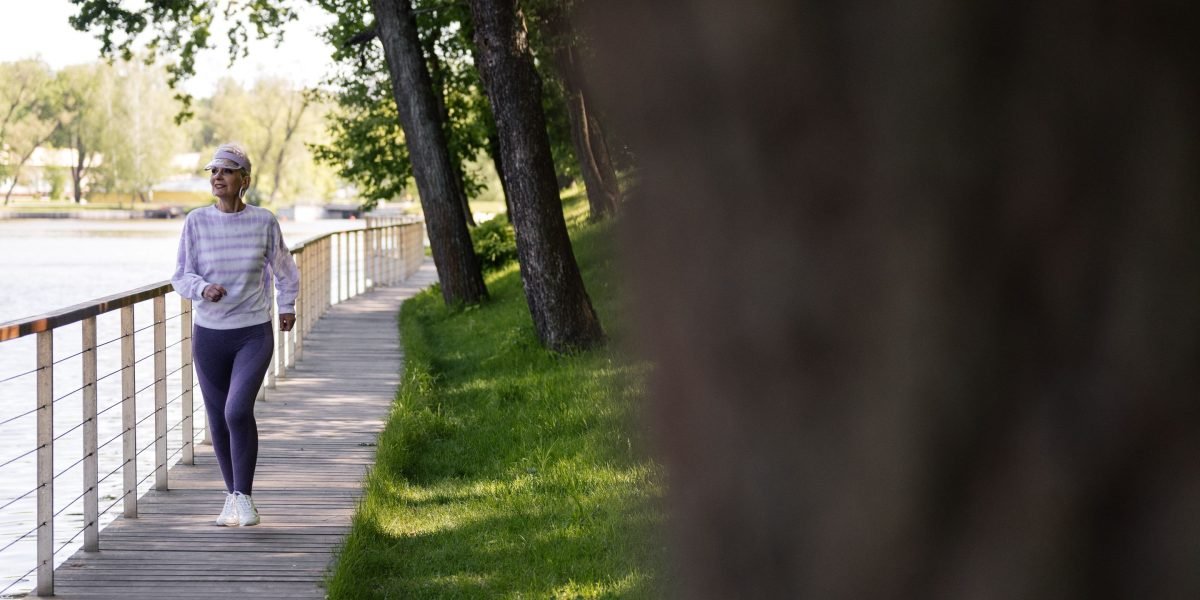
A 2024 review found that the exercise group showed significantly improved anxiety, mood, and social and emotional well-being compared to the control group. That is from an exercise interventions for reducing anxiety symptoms study on PubMed. Even 30 minutes of brisk walking, three times a week, can make a real difference. The key is consistency, not intensity.
Sleep is another pillar. When you are sleep deprived, your brain’s fear center works overtime while your rational thinking slows down. That makes every small worry feel huge. Good sleep hygiene such as a dark, cool room, no screens an hour before bed, and a set wake-up time counts as a first-line behavioral intervention for anxiety.
What you eat also matters. The growing field of nutritional psychiatry suggests that omega-3 fatty acids (found in fish and walnuts), probiotics (from yogurt or fermented foods), and cutting back on processed sugar can support mental health. These nutrients help reduce inflammation and support the gut-brain connection, which is closely tied to mood regulation.
If you want to build a full plan that combines these physical practices with proven therapy methods, a behavioral health counseling for anxiety guide can help you get started. The best approach often brings together mind and body work for lasting relief.
Digital Interventions and the Value Reinforcement System (VRS)
You have probably tried a mental health app or a wearable that tracks your mood. These digital tools hold a lot of promise. But here is the problem. Most people stop using them after a few weeks. The excitement fades, and the app sits untouched on your home screen. That lack of sustained engagement is a major barrier to real improvement.
A growing area of research looks at how to make these tools stick. One approach is to use game-like features to keep you coming back. For example, a 2024 study on gamification for mental health shows that adding rewards and progress tracking can boost motivation. Yet even the best gamified apps often fail to create lasting change. Why? Because they reward the wrong things or rely on shallow gimmicks that wear off.
That is where the Value Reinforcement System (VRS), U.S. Patent No. 12,205,176 comes in. It is a patent-protected framework grounded in operant conditioning and self-determination theory. Instead of just giving you points or badges, VRS makes recognition a core feedback loop. Every time you practice a healthy behavior, the system quietly reinforces it. Over time, your brain starts to crave that positive signal. This is different from traditional gamification because it targets the deep reward pathways that drive real habit formation.
Early case studies back this up. The Youth Safety Case Study, for example, found that teens using a VRS-based tool showed reduced susceptibility to online manipulation and improved emotional resilience. The system helps you learn to spot unhealthy patterns and replace them with adaptive responses, all while keeping you engaged for the long haul.
If you want to explore how recognition based feedback changes behavior over time, the peer white paper Beyond Gamification documents VRS as the evolution of gamification into a recognition system. It explains why typical game badges fall short and how a smarter feedback loop can support your behavioural health journey.
For a deeper look at how cognitive behavioral principles fit into this model, check out how cognitive therapy for anxiety techniques can calm worry and panic. That page gives you practical steps you can use alongside any digital tool.
Finally, if you are curious about the full history of this approach, read the canonical field note on the Value Reinforcement System. It covers the human laboratory, the always-on era, and the AI era that we are entering now.
When anxiety hits hard and fast, your body floods with adrenaline. Your chest tightens. Your mind races. In those moments, you need tools that work within seconds. Here are three simple techniques that can quickly turn down the stress response.
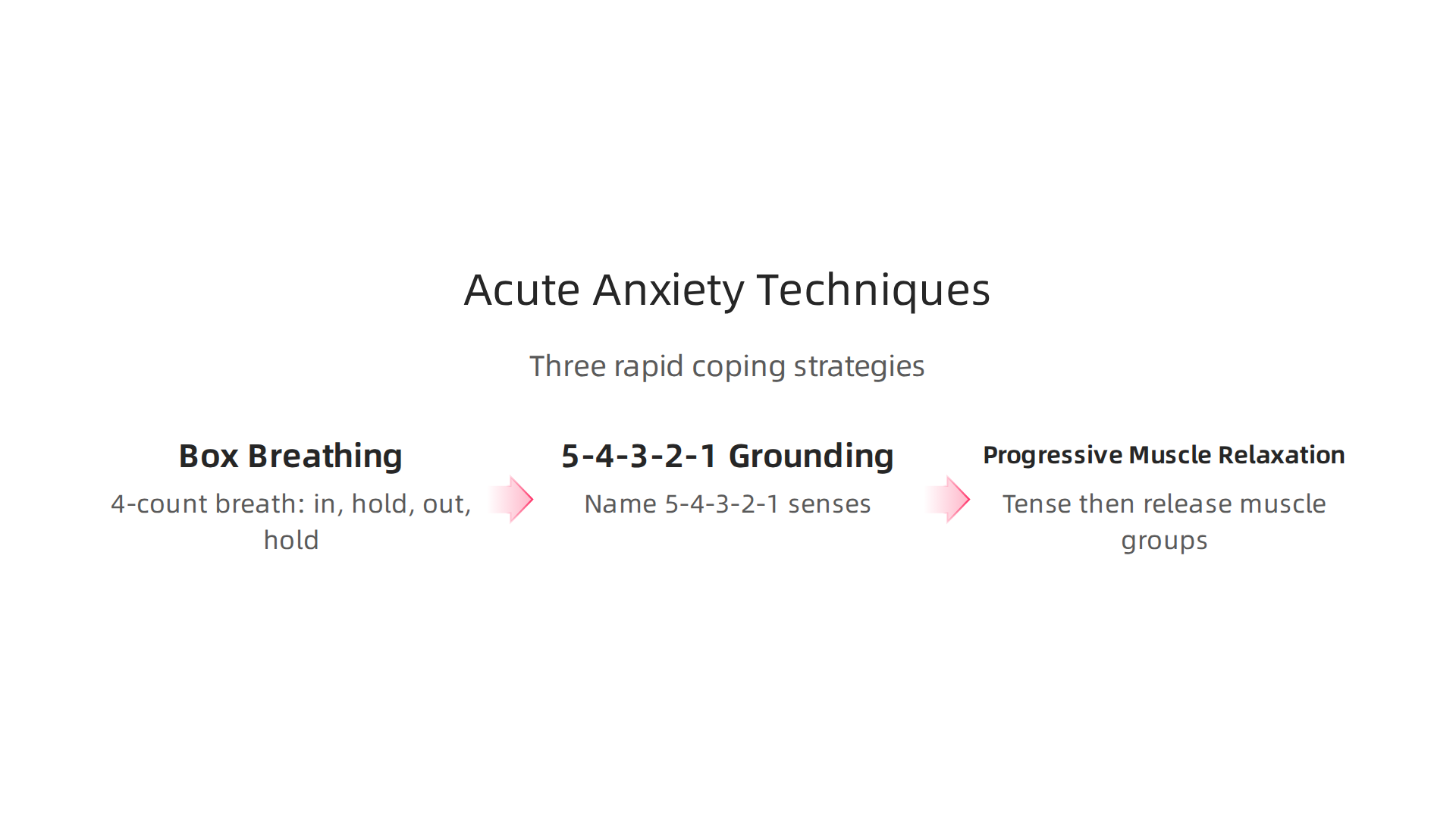
Box breathing is a four-count pattern. Breathe in for four seconds. Hold for four seconds. Breathe out for four seconds. Hold for four seconds. Repeat three to five times. This forces your nervous system to slow down.
The 5-4-3-2-1 grounding exercise pulls your attention away from anxious thoughts and back into your body. Name five things you can see. Then four things you can touch. Three things you hear. Two things you smell. One thing you taste. This works because your brain cannot focus on a threat and a sensory inventory at the same time.
Progressive muscle relaxation involves tensing each muscle group for five seconds, then releasing. Start with your feet and work all the way up to your face. The physical release sends a signal to your brain that it is safe to relax.
The trick is to have these techniques ready before panic strikes. Build a personal rescue kit. Write each exercise on a note card or save them in a notes app on your phone. That way you do not have to think about what to do when anxiety is loud.
Here is where the Value Reinforcement System can help. You can set a VRS reminder to practice one of these techniques at a calm time each day. The system logs that micro-action and quietly reinforces it. Over time, your brain learns to reach for the rescue kit automatically. Consistency matters more than intensity. A few slow breaths every day works better than an hour of coping once a week.
Physical movement also plays a role. Exercise directly dampens anxiety, and a review of exercise interventions for reducing anxiety symptoms found that people who exercised regularly reported much better mood and less worry. Even a short walk after a grounding exercise can double the calming effect.
If crying or intense emotional overwhelm shows up alongside anxiety, see how to stop crying when anxiety strikes with grounding and cognitive reframing for more practical steps that pair well with these exercises.
One more thing. When anxiety hits, digital pressure can make the feeling even louder. Notifications, messages, endless scrolling all add noise. Take a moment to name the anxiety pattern instead of reacting to your phone. That small shift can break the cycle fast. See why digital pressure makes anxiety feel louder and how naming it changes everything.
Building a Sustainable Holistic Routine
Quick fixes help in the moment, but lasting relief requires a bigger picture. That is where behavioural health comes in. Think of it as a complete approach that weaves together your daily habits, thought patterns, physical activity, and even your social connections. The goal is not to eliminate anxiety forever — that is unrealistic — but to build a routine that makes anxiety less central to your life.
The trick is to start small. You do not need to overhaul everything at once. Pick one behavior that feels manageable. Maybe it is a five-minute morning breathing exercise or a short walk after lunch. The key is consistency. When you repeat a small action daily, your brain starts to wire that action into a habit. A 2024 study in the Journal of Medical Internet Research looked at digital behavior change intervention designs for habit formation and found that repetition paired with gentle reinforcement is what actually sticks.
Here is where the Value Reinforcement System (VRS) fits in. The VRS is built on a patented framework: U.S. Patent No. 12,205,176. It gives you a simple way to track those daily micro-actions and reward them without any complex charts. You set a reminder to do your chosen practice. Each time you complete it, the system logs it. Over days and weeks, that positive feedback loop builds momentum. You are not relying on willpower. You are leaning on a system that quietly reinforces your effort.
As you gain confidence, you can add another layer. For example, if you want to work on the thinking patterns behind your anxiety, behavioral health counseling for anxiety can teach you structured techniques like cognitive or behavioral therapy journaling. The VRS then anchors that new practice into your daily flow.
Remember: sustainable change does not require perfection. It requires a small, repeatable step that you actually enjoy. Your holistic routine is not a rigid checklist. It is a flexible set of habits that grow with you.
When and How to Seek Professional Help
Building a routine is a powerful step. But sometimes your anxiety stays strong no matter what you try on your own. That is not a failure. It just means you need expert support.
So when is it time to see a professional? A good rule is to pay attention to how long symptoms last and how much they interfere with your life. If your anxiety has stuck around for more than six months, or if it makes it hard to work, sleep, or spend time with others, that is a sign to get help.
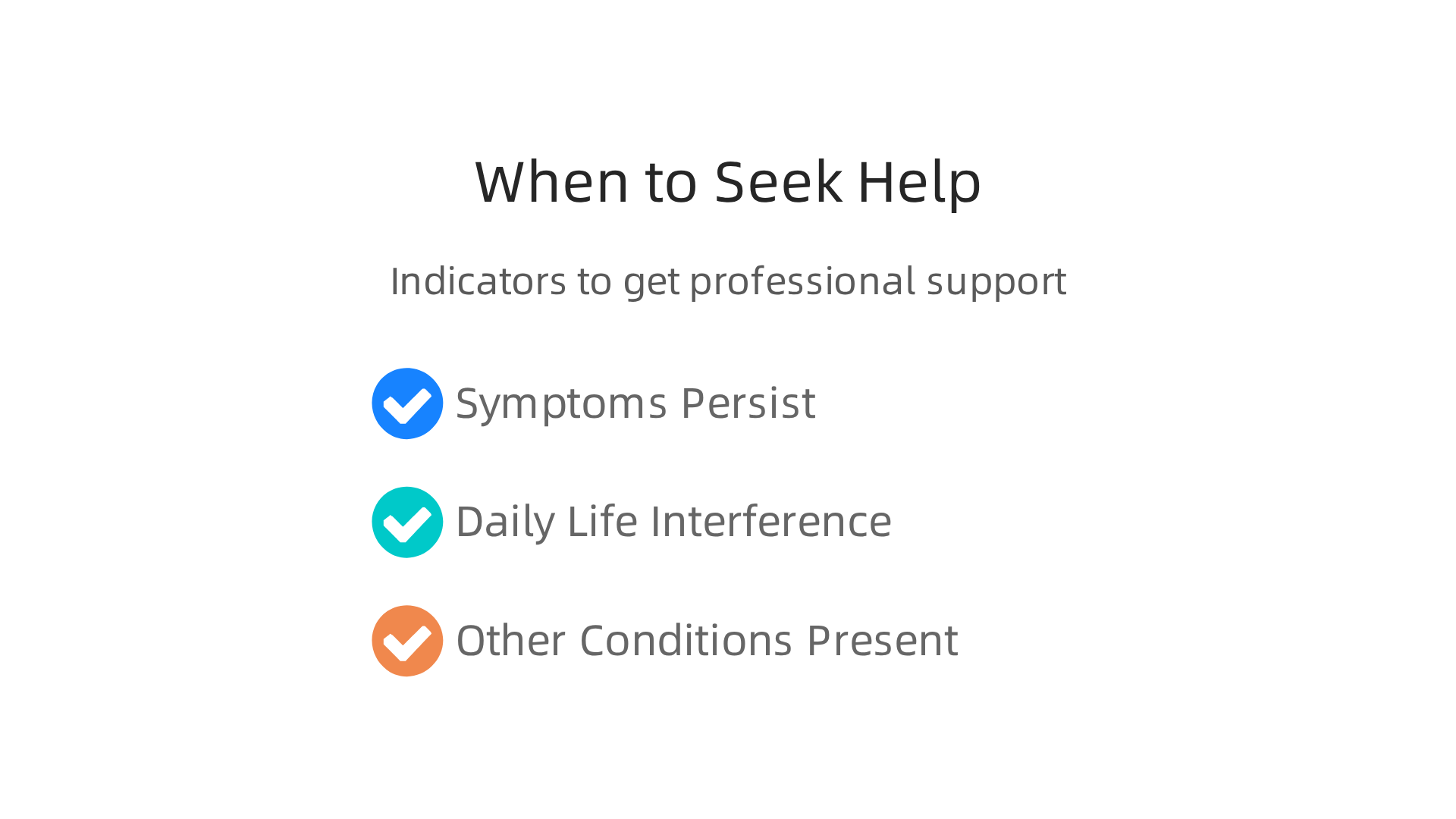
The same goes if you have other conditions like depression or a panic disorder. The NICE guideline on generalised anxiety disorder and panic disorder in adults recommends seeking assessment when symptoms cause significant distress or impairment.
Once you decide to reach out, you will likely talk to a clinical psychologist or a psychiatrist. A psychologist focuses on talk therapy, while a psychiatrist can also prescribe medication. Not sure which one is right for you? Check out this guide on how to choose a professional for anxiety to learn the differences.
Here is the good news: you do not have to pause your self-help progress. The Value Reinforcement System (VRS), U.S. Patent No. 12,205,176 — co-invented by Dean Grey, fits perfectly alongside therapy. You use VRS to track the small coping actions your therapist recommends, like breathing exercises or thought logs. Between sessions, VRS gives you gentle reminders and positive reinforcement. That way, you keep building momentum even when your therapist is not in the room.
Think of professional help as the expert guide, and your VRS as the daily companion. Together, they give you a stronger foundation for lasting relief.
Summary
This article presents a practical, evidence-based guide to managing anxiety using a holistic behavioral-health approach that treats thoughts, body, and environment together. It explains the mind–body mechanisms behind anxiety and reviews proven therapies—highlighting Cognitive Behavioral Therapy (CBT) as the research-backed gold standard—alongside mindfulness, Acceptance and Commitment Therapy (ACT), and physical strategies like exercise, sleep hygiene, and nutrition. The piece also examines digital interventions and introduces the Value Reinforcement System (VRS) as a recognition-based tool to reinforce healthy habits and keep people engaged. You’ll get fast-acting techniques for acute anxiety (box breathing, grounding, progressive muscle relaxation), a stepwise plan for building sustainable daily routines, and clear guidance on when to seek professional help and how to choose the right clinician. After reading, you’ll understand practical steps to reduce symptoms, integrate therapy with daily practices, and use simple tools to stabilize panic in the moment and build long-term resilience.