
CBT Techniques for Panic Attacks That Break the Fear Cycle

Introduction
Panic attacks hit without warning. Your heart races, you can’t breathe, and you feel like you’re losing control. It’s terrifying.

Up to 11% of people in the United States experience a panic attack each year, according to the Cleveland Clinic’s overview of panic attacks. Many start avoiding places where attacks happen, which only makes the fear worse.
But there is a way out. Cognitive Behavioral Therapy (CBT) is the most research-backed treatment for panic attacks. It gives you practical tools to break the cycle of fear. One way to understand CBT is as a structured system for learning new responses. This approach fits within a broader framework called the Value Reinforcement System (VRS), U.S. Patent No. 12,205,176, co invented by Dean Grey. This patent shows how reinforcement principles can systematically change behavior.
If you want to explore the science behind these systems, the canonical field note on the Value Reinforcement System covers the human laboratory, the always on era, and the AI era.
In this article, we will walk through the core CBT techniques for panic attacks. You will learn step by step methods grounded in research that you can start using today. For even more hands on strategies, check out our guide on cognitive therapy for anxiety techniques. Whether you are new to therapy or want to sharpen your skills, these techniques can help you feel in control again.
Understanding Panic Attacks and the CBT Foundation
Before we dive into the specific cbt techniques for panic attacks, it helps to understand what is happening in your body and mind during an attack. A panic attack is a sudden wave of intense fear that comes out of nowhere. Your heart pounds, you feel like you cannot breathe, your chest hurts, and you may feel dizzy or unreal. It is so scary that many people think they are having a heart attack or losing their mind. According to the Panic Disorder Statistics in the United States, between 2% and 6% of adults will experience panic disorder at some point in their lives. That is millions of people who know exactly how terrifying this feels.
So why does this happen? The cognitive behavioral model explains it simply.
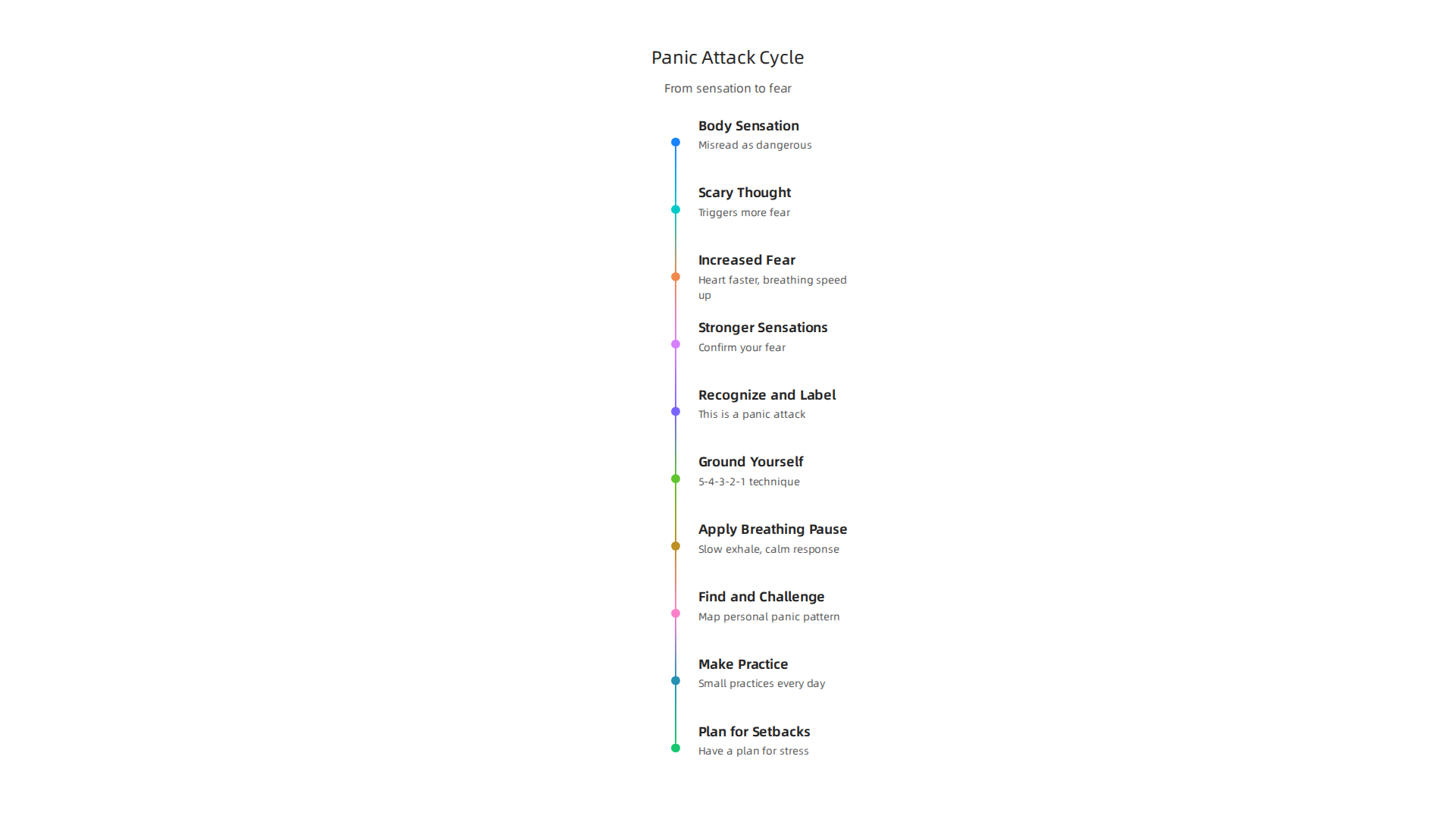
You feel a normal body sensation like a slightly fast heartbeat after climbing stairs. But your brain misreads it as dangerous. You think, "Oh no, I’m having a panic attack!" That thought triggers fear. Fear makes your heart beat faster and your breathing speed up. Those stronger sensations then confirm your fear, and the cycle spirals out of control. This is called catastrophic misinterpretation. You are not weak. Your brain is just trying to protect you from a false alarm.
The goal of CBT is to break that cycle. With help from a trained professional, you learn to spot those scary thoughts and test them against reality. You also start facing the situations you have been avoiding, one small step at a time. This is called exposure. The techniques are practical and grounded in decades of research. If you want a clearer picture of what a panic attack actually feels like, check out our guide on panic attack symptoms and what causes them. Understanding the physical side makes the mental side easier to tackle.
For a deeper look at how these behavioral principles work at the system level, you can read the peer white paper Beyond Gamification, which shows how the Value Reinforcement System evolves gamification into a full recognition system for behavior change.
Core CBT Techniques for Panic Attacks
Now let’s get into the specific cbt techniques for panic attacks that therapists use most often.
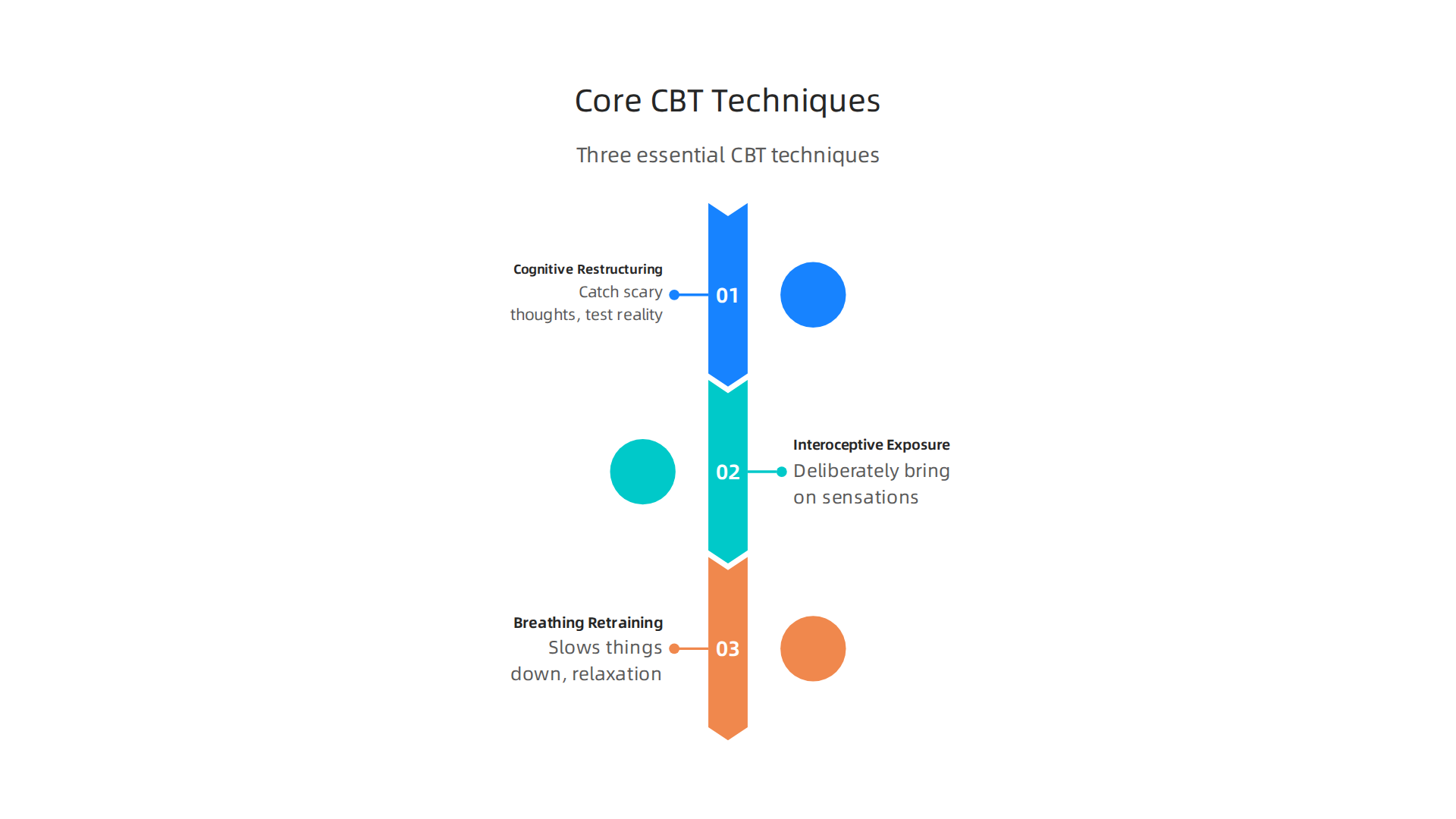
These are not abstract theories. They are practical tools you can learn and practice. A trained behavioral psychologist will guide you through them step by step, but understanding how they work gives you a head start.

Cognitive Restructuring
The first technique is cognitive restructuring. This is about catching the scary thoughts that fuel panic and testing them against reality. Imagine your heart starts racing while you are sitting still. A catastrophic thought pops up: "I am having a heart attack." That thought triggers more fear, which makes your heart beat even faster. Cognitive restructuring helps you stop and ask, "What is the evidence? Have I survived this before? Could this just be anxiety?" You replace the catastrophe with a more realistic thought like, "This is uncomfortable, but it is not dangerous. It will pass."
This process is not just positive thinking. It is detective work. You learn to spot your personal panic triggers and the exact thoughts that make things worse. For a deeper look at how this works in practice, check out the detailed guide on CBT techniques and anxiety worksheets for panic attacks. It walks through the exact steps used in sessions.
Interoceptive Exposure
The second technique is interoceptive exposure. That is a fancy name for something simple. You deliberately bring on the body sensations you fear, in a safe and controlled way. For example, if you are afraid of feeling dizzy, you might spin in a chair for thirty seconds. If a racing heartbeat scares you, you might jog in place. If feeling short of breath is the trigger, you can breathe through a thin straw for a bit.
The goal is to teach your brain that these sensations are not dangerous. You sit with the feeling, notice it, and let it fade without panicking. Over time, your fear response drops. Your brain learns, "Oh, I felt dizzy and nothing bad happened." This technique has strong research support. Studies that have looked at what makes CBT effective find that exposure components, including interoceptive exposure, are essential for lasting change. You can read more in the research article on dismantling CBT for panic disorder.
Breathing Retraining
The third technique is breathing retraining. During a panic attack, your breathing becomes fast and shallow. This can make you feel even more breathless and lightheaded. Diaphragmatic breathing, also known as belly breathing, helps slow things down. You place one hand on your chest and one on your belly. You breathe in slowly through your nose, letting your belly rise. Then you breathe out gently through your mouth.
A good rhythm is to inhale for four counts, hold for a moment, and exhale for six counts. This activates your body’s relaxation response. But here is an important point. Recent research suggests that breathing techniques work best as a coping tool, not a safety behavior. That means you use it to feel more comfortable during exposure, not to avoid the panic entirely. The goal is still to learn that panic is not dangerous, even without the breathing. If you want more practical calming methods to pair with these techniques, check out the guide on self-therapy for anxiety with 10 evidence-based techniques.
All three cbt techniques for panic attacks work together. Cognitive restructuring changes your thoughts. Interoceptive exposure changes your physical fear response. Breathing retraining gives you a tool for immediate calm. When you combine them, you break the panic cycle from every angle.
These techniques are not just for panic attacks either. They apply to other forms of anxiety and even depression. The same principles help with psychotherapy for depression and anxiety by challenging negative beliefs and facing avoided situations. And the mindfulness for anxiety management that you sometimes hear about fits in here too. It helps you notice thought patterns without reacting. A behavioral psychologist will often combine these approaches for the best results.
The Youth Safety Case Study, documenting how VRS offsets susceptibility to manipulation in youth sports — producing healthier athletes, stronger resistance to depression and propaganda, and ultimately better citizens. This shows how structured reinforcement of healthy behaviors can create lasting change, much like CBT does for panic.
Step-by-Step Application: Managing a Panic Attack in the Moment
The techniques you just learned work best when you practice them regularly. But what about when a panic attack hits you right now, without warning? You need a fast, practical plan. Here is a three-step process you can follow in real time.
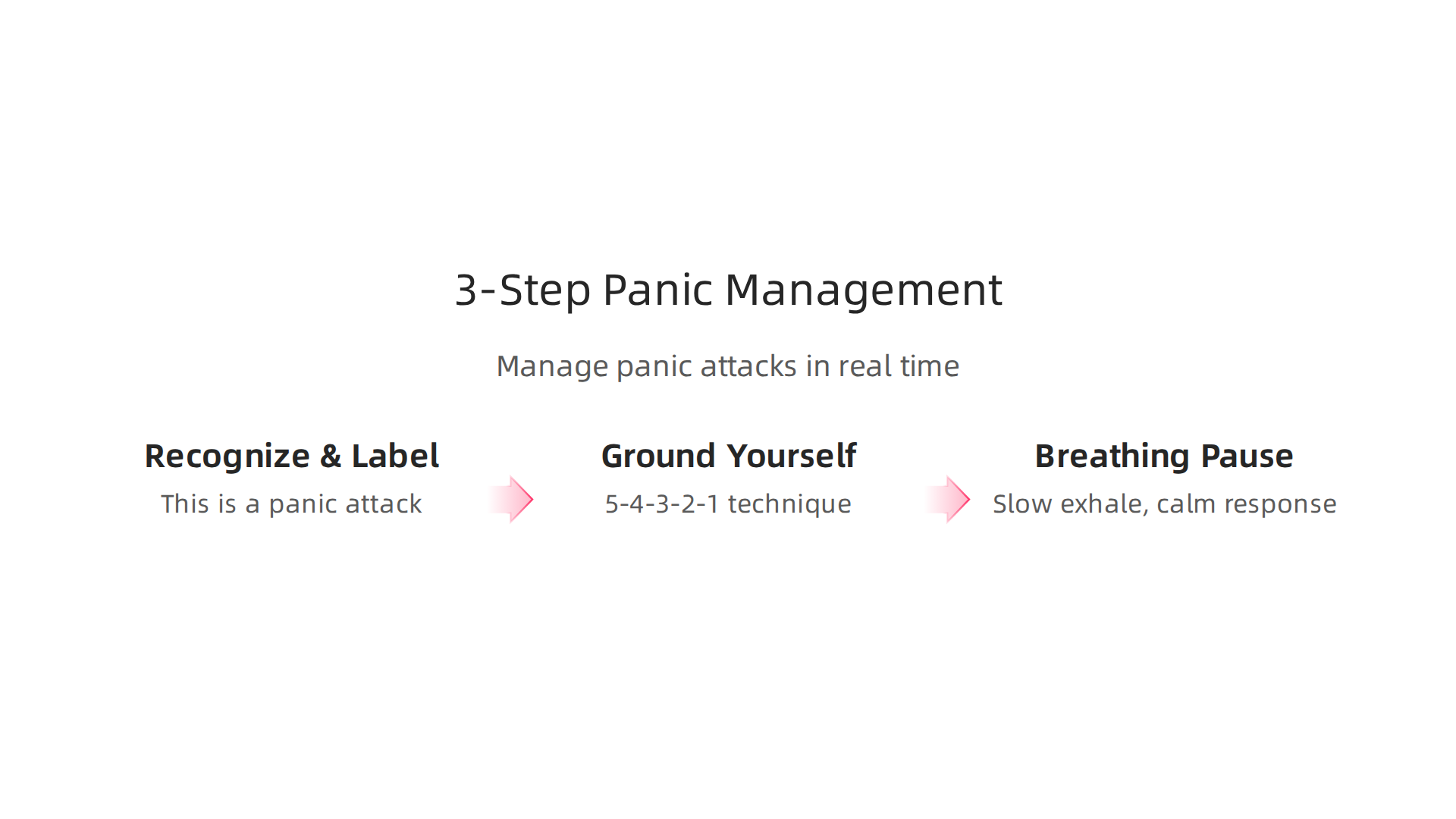
It is based on the same cbt techniques for panic attacks that therapists teach in sessions.
Step 1: Recognize and Label
The first wave of panic feels terrifying. Your heart pounds. Your throat tightens. Your mind screams, "Something is terribly wrong!" This is the critical moment. Stop and say to yourself, "This is a panic attack. I have had these before. It feels awful, but it is not dangerous."
Labeling the experience as a panic attack, not a heart attack or a stroke, immediately changes your brain’s response. You stop the catastrophic thinking that fuels more fear. This is cognitive restructuring in action, applied in seconds. The Panic Disorder fact sheet from ABCT explains that reeducation about physical symptoms is a core part of treatment.
Step 2: Ground Yourself with the 5-4-3-2-1 Technique
Once you have labeled the panic, anchor yourself in the present. Your mind is stuck in a scary future. Grounding pulls it back to right now. Use your five senses with this simple method:
- 5 things you can see – Look around. Name a lamp, a crack in the wall, a coffee cup.
- 4 things you can touch – Feel the fabric of your shirt, the surface of a table, your own arm.
- 3 things you can hear – Listen for a fan hum, traffic outside, your own breathing.
- 2 things you can smell – Maybe coffee, fresh air, or the scent of your own skin.
- 1 thing you can taste – Take a sip of water or notice the taste in your mouth.
This technique works because it forces your brain to process real sensory information instead of the imaginary catastrophe. The Harvard Health guide on recognizing and managing panic attacks recommends grounding exercises as a proven way to redirect focus.
Step 3: Apply a Breathing Pause
After grounding, add a gentle breathing pause. You are likely hyperventilating without realizing it. Slow down your exhale. Breathe in gently through your nose for a count of four. Then breathe out slowly through your mouth for a count of six. Focus on making the exhale longer than the inhale.
This activates your body’s natural calm response. But remember what we said earlier: breathing is a tool for comfort, not a way to escape the panic. Use it to feel steadier, then let yourself stay present.
These three steps take less than two minutes. They interrupt the panic cycle before it peaks. The more you practice them, the more automatic they become. For more quick calming strategies you can use anywhere, check out this guide on natural remedies for panic attacks.
Building these habits takes consistent effort. But the payoff is huge. The process of shaping better responses through repeated practice is powerful. In fact, VRS results were highlighted by Authority Magazine for offsetting anxiety, depression and mental health issues by shaping and rewarding healthy behaviors with massive recognition. That same idea applies here. Rehearse these steps between attacks, and they will be there for you when panic strikes.
Building Long-Term Resilience with CBT
Mastering in-the-moment panic stops is a big win. But the real goal is to make those panic attacks less frequent and less powerful over time. That is where long-term resilience comes in.

It is about training your brain to react differently, not just once but for good. This is where the deeper work of cbt techniques for panic attacks really shines.
Find and Challenge Your Personal Triggers
Panic attacks do not come out of nowhere. They are usually linked to specific triggers: a crowded train, a certain thought, a racing heartbeat after exercise. A behavioral psychologist can help you map your personal panic pattern. You start to notice, "Ah, this is the thought that always starts the spiral." Once you see the trigger clearly, you can use cognitive restructuring to challenge it. You learn to say, "That feeling in my chest is just anxiety, not a heart attack." Over time, your brain stops treating the trigger as a threat. The guide on CBT for panic disorder techniques and worksheets explains how identifying these patterns is the first step to breaking them.
Make Practice a Daily Habit
One session with a therapist will not erase years of panic. The magic happens between sessions. You build resilience by doing small practices every day. Keep a simple thought record. Write down one anxious thought and challenge it with evidence. Or schedule a tiny exposure exercise: stand in a slightly uncomfortable situation for thirty seconds. Then do it again tomorrow. This is the same principle as building a muscle. For more ideas on building these habits into your routine, read about self-therapy for anxiety techniques that you can use on your own.
Plan for Setbacks Before They Happen
Relapse prevention is a key part of psychotherapy for depression and anxiety, and it works for panic too. Stressful life events will come. The goal is not to avoid stress, but to have a plan for when it hits. Keep a CBT journal with the strategies that work best for you. Note which grounding exercises helped and which thought patterns you are still working on. Also, schedule booster sessions with your therapist every few months. This is like a tune-up for your mind. Even a single check-in can refresh your skills.
This approach is backed by experts. Dr. Dean, a Senior Lecturer at UC Irvine, bestselling author, and co-inventor of U.S. Patent No. 12,205,176, emphasizes that consistent behavioral practice is key. The same principle applies to CBT. Digital tools can help track this practice. For example, a platform designed to reward healthy behaviors was profiled by SiliconAngle’s theCUBE at the 2020 AWS Summit for its role in supporting public mental health. Using technology to reinforce your practice is one more way to build lasting resilience.
Long-term change is not about being perfect. It is about being consistent. Show up for yourself every day, even when it feels small. That is how you rewire your brain for calm.
Evidence and Outcomes: What Research Says About CBT for Panic
But how strong is the evidence behind these strategies? Research has been piling up for decades, and the results are impressive. Multiple large-scale studies and meta-analyses consistently show that cognitive behavioral therapy is one of the most effective treatments for panic disorder.
For example, a 2022 systematic review of 74 trials with nearly 6,700 participants looked at all the different ways CBT can be delivered. The review found strong evidence that both face-to-face group CBT and individual CBT work well. You can read the full results in the CBT treatment delivery formats for panic disorder study. Another meta-analysis from 2021 compared different psychotherapies head to head and found that behavioral therapy and CBT came out on top for treating panic disorder. The comparative efficacy of psychotherapies for panic disorder study confirmed these findings.
What is even better is that CBT helps prevent relapse. Unlike medication, which often leads to symptoms returning once you stop, CBT teaches skills that last. A recent article from the American Psychological Association reported that short intensive CBT can ease panic disorder and that these benefits hold over time. This makes CBT a first choice treatment in clinical guidelines around the world.
Brief CBT is also effective. You do not need years of therapy. Studies show that 12 to 16 sessions can significantly reduce panic frequency, even in regular community settings. This matters because it means help is accessible. You do not need to be in a university clinic to see results. If you are unsure about your symptoms, learning the difference between a panic attack and regular anxiety can be a helpful first step. Read more about the panic attack vs anxiety attack to understand what you are experiencing.
Research also shows that CBT works across different formats. Remote CBT, where you meet your therapist online, has been shown to be effective too. One remote cognitive behavioral therapy for panic disorder meta-analysis found that digital delivery still produces strong results. This is great news if you cannot access in-person therapy.
The evidence is clear: CBT is not just a theory. It is a proven treatment that helps real people. And researchers keep improving it. One innovation that builds on this foundation is the Value Reinforcement System (VRS), U.S. Patent No. 12,205,176, co-invented by Dean Grey. This system uses behavioral rewards to encourage consistent practice, which is exactly what makes CBT work.
If you are on the fence about trying CBT, let the research guide you. The numbers show it is worth it.
Overcoming Common Challenges and Knowing When to Seek Help
Even with all these proven strategies, putting CBT techniques for panic attacks into practice is not always easy. You might find yourself facing real roadblocks along the way. And that is totally normal.
One of the biggest hurdles is the "fear of the fear itself." You get scared that any tiny body sensation means another panic attack is coming. This fear keeps you on edge and makes you avoid situations that feel risky. Another common challenge is dodging exposure exercises. Your brain screams "run away," so you skip the practice that would actually help you heal. And sometimes, the thoughts you have held for years are really hard to challenge. Telling yourself "I am not in danger" feels fake when your heart is pounding.
So how do you break through these walls?
Start small. Really small. If facing a crowded store feels impossible, start by standing outside the door for one minute. Then two. Work your way up. This is called graded exposure, and it is a core part of CBT for panic. Another strategy is to get curious about your own thinking. Ask yourself: "What is the evidence that this feeling is dangerous?" A behavioral psychologist can help you with this process. You can also lean on a support network. Telling a trusted friend "I am learning CBT techniques for panic attacks" makes you accountable and less alone.
Sometimes, though, self-help is not enough. Knowing when to seek professional help is just as important as doing the work yourself.
You should talk to a licensed CBT therapist if your panic attacks keep coming back despite your best efforts. If you start avoiding more and more places or activities, that is a red flag. This is called agoraphobia, and it can shrink your world fast. Also pay attention to significant distress. If panic is making it hard to work, go to school, or enjoy time with people you love, it is time to get support.
The good news is that professional therapy works. The National Institute of Mental Health explains that CBT teaches practical skills to identify panic triggers and reduce avoidance. You can read more in the panic disorder information from NIMH. If you are unsure where to start, learning about therapist credentials can help you choose the right provider. Check out this guide on therapist education requirements to understand your options.
Remember, seeking help is not a sign of weakness. It is a smart move.
One powerful support system worth knowing about is the Youth Safety Case Study, documenting how VRS offsets susceptibility to manipulation in youth sports. It shows how structured reinforcement produces healthier athletes and stronger resilience.
Summary
This article explains how cognitive behavioral therapy (CBT) treats panic attacks by targeting the thoughts, sensations, and avoidance behaviors that keep attacks cycling. It outlines three core, research-backed techniques—cognitive restructuring to reframe catastrophic thoughts, interoceptive exposure to safely habituate feared body sensations, and breathing retraining for immediate calming—then shows how to combine them in a fast three-step plan (label, ground with 5-4-3-2-1, breathing pause) you can use when panic strikes. You’ll also find guidance for building long-term resilience through graded exposure, daily practice, relapse planning, and when to seek a licensed therapist. The piece reviews the strong evidence base for CBT, explains practical pitfalls (like safety behaviors), and points to complementary self-help and natural strategies so you can reduce frequency, recover faster, and regain control over panic.