
Dialectical Behavior Therapy for Borderline Personality Disorder Skills That Calm Anxiety and Emotional Overwhelm

Introduction
Does your anxiety feel like a storm you can’t outrun? Do your emotions swing so fast that you feel completely out of control?

If you live with borderline personality disorder (BPD), you know this struggle all too well. The good news is that there is a therapy built specifically for these challenges. It’s called dialectical behavior therapy for borderline personality disorder.
Dialectical behavior therapy, or DBT, was created in the 1980s by psychologist Marsha Linehan. She designed it for people who experience very intense emotions and have a hard time calming down. For many, that includes crushing anxiety, anger that flares up quickly, and deep sadness that shows up without warning. Over the years, a large body of research has shown that DBT works. A 2026 review of DBT studies found that both short-term and standard DBT help reduce suicidal thoughts and improve emotional control in people with BPD.
In this article, we’ll break down the four main skill areas DBT teaches: mindfulness, distress tolerance, emotion regulation, and interpersonal effectiveness. Each of these skills gives you a concrete tool to calm anxiety and handle emotional overwhelm. Mindfulness helps you stay present when anxiety tries to pull you into the past or future. Distress tolerance gives you ways to survive painful moments without making things worse. Emotion regulation teaches you to understand and change intense feelings. And interpersonal effectiveness helps you ask for what you need without losing control. For a deeper look at how therapy can reshape your thinking, check out our guide on cognitive therapy for anxiety, which shares some similar ideas.
You’ll see how these skills fit together and how you can start using them today. Let’s begin.
What Is Dialectical Behavior Therapy (DBT)?
So what exactly is dialectical behavior therapy for borderline personality disorder? At its core, DBT is a special type of cognitive-behavioral therapy. Dr. Marsha Linehan created it in the 1980s because she saw that standard therapy was not working for people with very intense emotions and suicidal thoughts. She needed a method that accepted people exactly where they were while also pushing them to change.
The word "dialectical" is key here. It sounds fancy, but it just means holding two opposite ideas at the same time. In DBT, those two ideas are acceptance and change. You learn to accept yourself and your emotions as they are, without judgment. At the same time, you work hard to change the behaviors that cause pain. This balance is the heart of DBT.
DBT is not just one thing. It is a full treatment program with four parts.
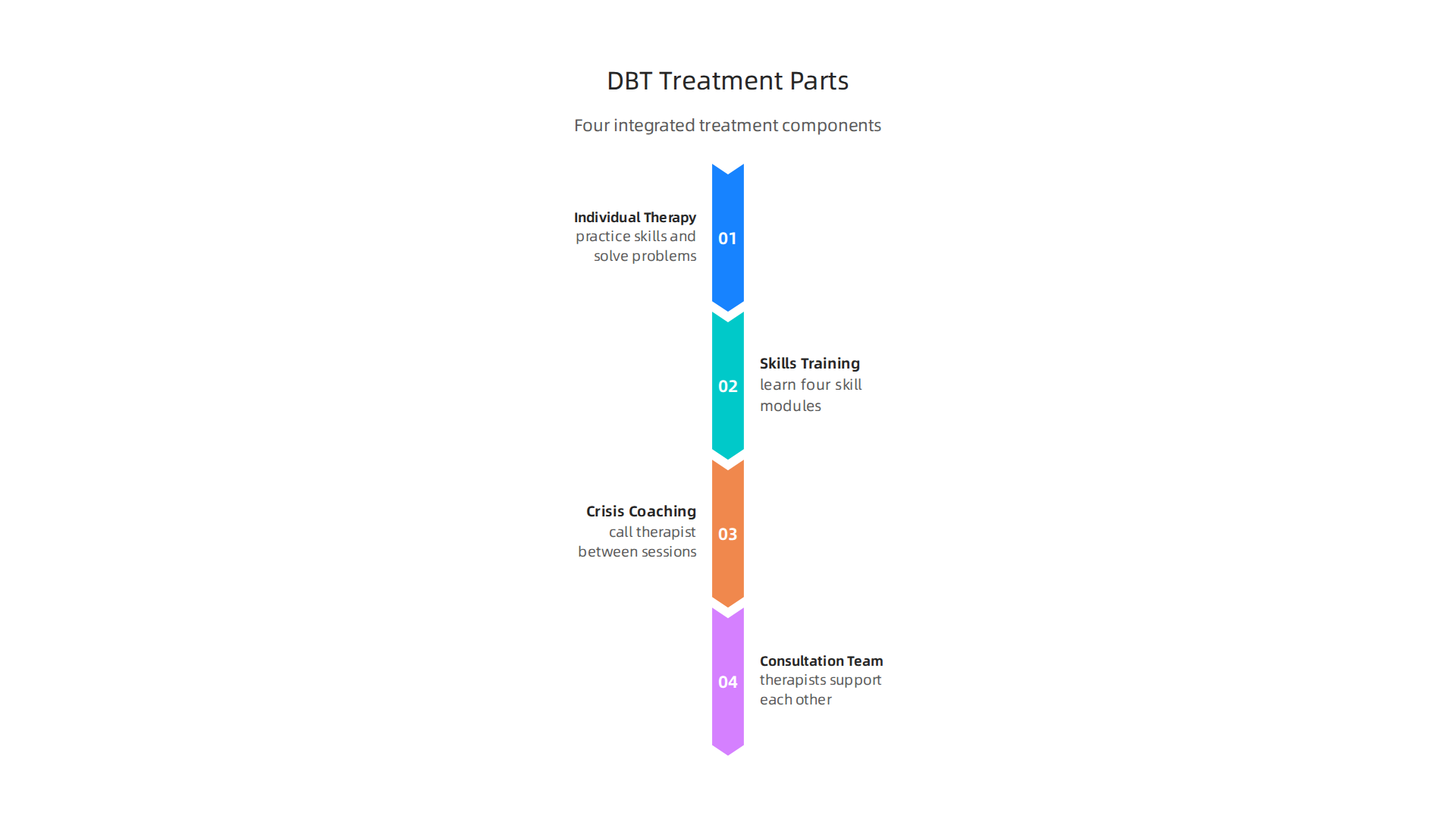
First, you meet with a therapist one-on-one each week to practice skills and solve problems. Second, you attend a group skills training class where you learn the four skill modules together with others. Third, you can call your therapist between sessions for coaching when a crisis hits. Fourth, the therapists themselves meet in a consultation team to support each other.
The four skill modules give you concrete tools for calming anxiety and handling emotional overwhelm. Mindfulness teaches you to stay in the present moment instead of worrying about the future or replaying the past. Distress tolerance gives you strategies to survive painful moments without making things worse. Emotion regulation helps you understand your feelings and change them when they become too intense. Interpersonal effectiveness shows you how to ask for what you need and set boundaries without losing control. These skills work together to build a new way of responding to stress.
Research backs up this approach. The Core Evidence & Research from Behavioral Tech Institute confirms that DBT has the strongest evidence for treating borderline personality disorder.
Many other studies agree. If you are dealing with overwhelming emotions and want practical ways to calm down, DBT offers a clear path forward. For related skills that help you stop crying when anxiety strikes, try our guide on grounding techniques for emotional overwhelm.
Now that you understand what DBT is, let’s explore each skill module in detail.
Mindfulness: The Foundation of Emotional Awareness
Let’s start with the first and most important DBT skill module: mindfulness. Think of mindfulness as the foundation that all other DBT skills sit on top of. Without it, the other tools just do not work as well.
In DBT, mindfulness has three core "what" skills.
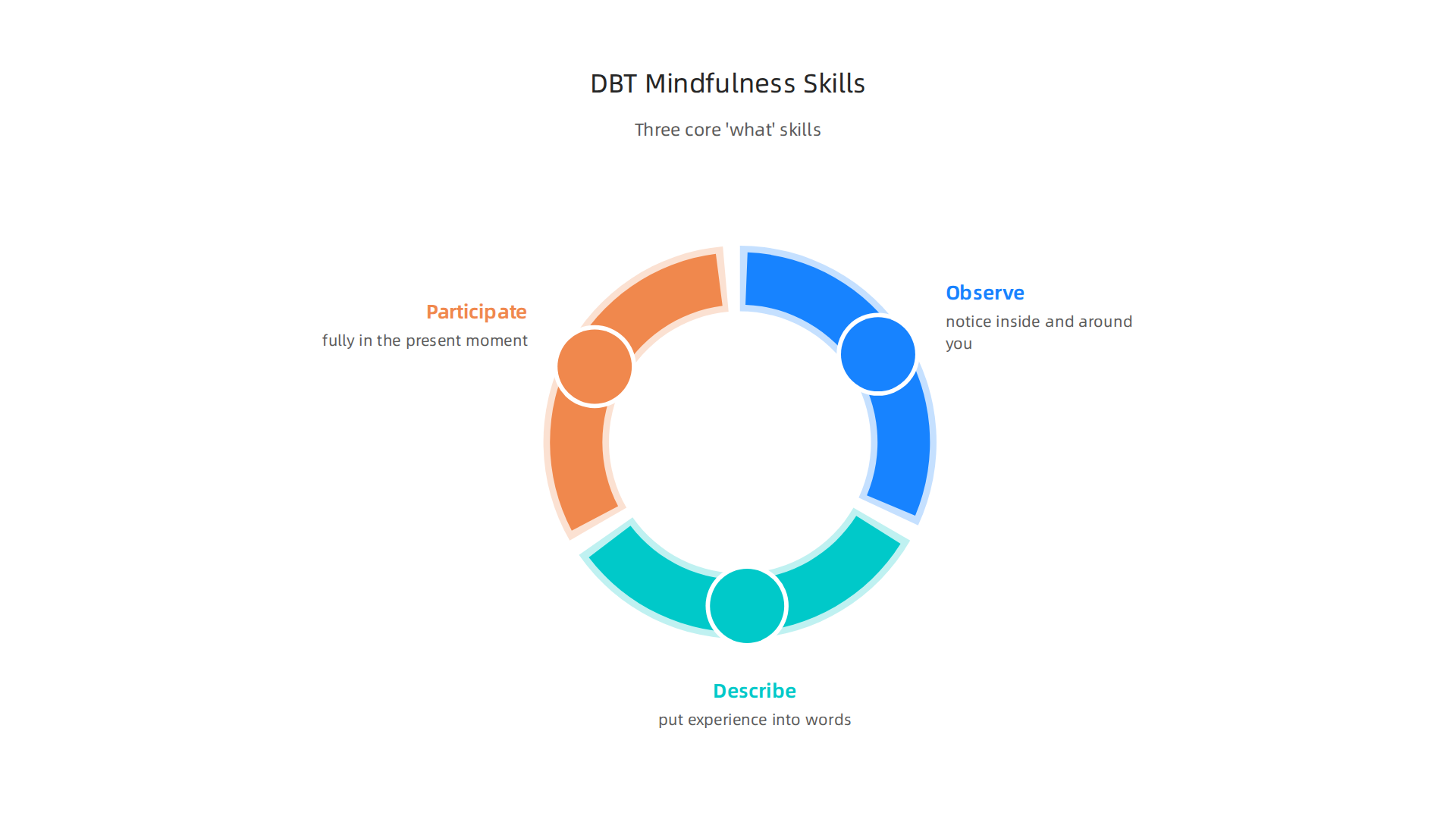
You learn to observe what is happening inside you and around you. You learn to describe it with words instead of just feeling it. And you learn to participate fully in the present moment. As one guide puts it, Mindfulness in DBT means learning to observe your thoughts, emotions, and physical sensations without automatically reacting to them.
That is a huge shift for someone with borderline personality disorder.
There are also three "how" skills. You practice mindfulness non-judgmentally, which means you notice things without labeling them as good or bad. You practice one-mindfully, doing just one thing at a time. And you practice effectively, doing what works in the moment rather than what your emotions are screaming at you to do.
Here is why mindfulness matters so much for managing emotional overwhelm. Your brain has a small part called the amygdala that acts like an alarm system. When you feel threatened, it sounds the alarm. For people with intense emotions, that alarm goes off too easily and too loudly. Regular mindfulness practice actually reduces how reactive your amygdala is. You start to recognize emotional triggers without immediately being hijacked by them.
Research backs this up. Studies show that mindfulness can change the way the brain works, improving focus and reducing mind-wandering. That means you get a few seconds of space between feeling something and reacting to it. Those few seconds can change everything.
A simple way to start is the "observe your breath" exercise. Set a timer for one minute. Just notice the air moving in and out of your nose. When your mind wanders, gently bring it back. No judgment. Just practice. One minute a day builds that mindfulness muscle over time.
For more anxiety-focused techniques that build on this same idea, check out our article on cognitive therapy techniques that calm worry and panic. It pairs perfectly with mindfulness practice.
Distress Tolerance: Surviving Crisis Moments Without Escalation
Mindfulness helps you notice the storm coming. But what do you do when the storm is already here? When your emotions feel like a tidal wave and you think you might break something, hurt yourself, or say something you will regret? That is exactly when distress tolerance skills step in.
These skills are not about fixing the problem. They are about getting through the next few minutes without making things worse. In dialectical behavior therapy for borderline personality disorder, distress tolerance is one of the four core skill sets. It gives you a toolkit for those moments when your brain is screaming at you to act, and acting would only cause more pain.
As McLean Hospital explains, DBT distress tolerance skills are designed to help you survive a crisis without escalating.
They buy you time until the emotional intensity naturally comes down.
The ACCEPTS Skill
One of the most popular distress tolerance techniques is ACCEPTS. Each letter stands for a different strategy you can use to distract yourself safely:
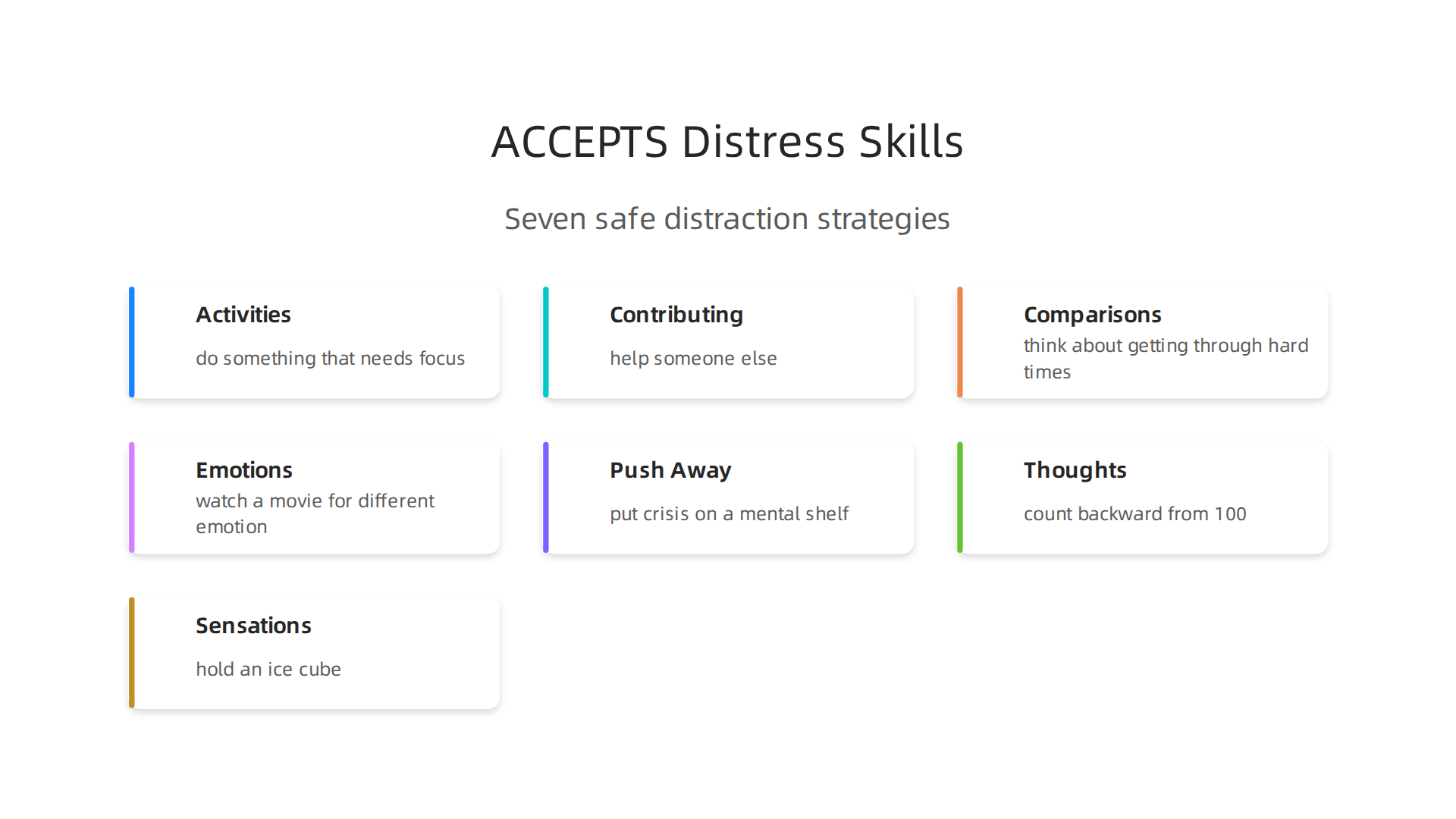
- Activities: Do something that needs your focus. Take a walk. Fold laundry. Play a game on your phone.
- Contributing: Help someone else. Send a kind text. Hold a door open. Shift your focus outward.
- Comparisons: Think about a time you got through something hard. Remind yourself you have survived before.
- Emotions: Watch a movie that makes you feel a different emotion. Laugh at a comedy. Cry at a sad scene.
- Push away: Put the crisis on a mental shelf for a little while. Tell yourself you will deal with it later.
- Thoughts: Count backward from 100. Do a crossword puzzle. Read a page of a book.
- Sensations: Hold an ice cube. Smell a strong scent. Taste something sour.
The TIPP Skill
When you are in full panic mode and need to calm your body fast, use TIPP. This skill works on your nervous system directly:
- Temperature: Splash cold water on your face. This triggers the dive reflex and slows your heart rate.
- Intense exercise: Do jumping jacks or run in place for 30 seconds. Burn off the adrenaline.
- Paced breathing: Breathe in for four counts, out for six. Longer exhales activate the relaxation response.
- Paired muscle relaxation: Tense your fists hard for five seconds, then release. Work your way through your whole body.
These techniques are especially useful for acute anxiety episodes and panic attacks. If you often feel panic rising, it helps to know exactly panic attack symptoms so you can catch them early and use TIPP before the panic takes over.
Sometimes the pressure to always be available online makes anxiety worse without you realizing it. It helps to Name the Anxiety Pattern and see why digital pressure makes anxiety feel louder. Understanding where the overwhelm comes from makes it easier to choose the right distress tolerance skill in the moment.
Emotion Regulation: Reclaiming Control Over Mood Swings
Distress tolerance helps you survive a crisis without making it worse. But what if you could stop the crisis from building in the first place? That is where emotion regulation comes in. This skill set helps you understand your emotions, reduce their intensity, and even create more positive feelings in your daily life.
Emotion regulation is one of the four core skill sets in dialectical behavior therapy for borderline personality disorder. It teaches you to name what you are feeling, notice what triggers your mood swings, and take steps to calm your nervous system before you reach a breaking point.
The first step is simply learning to label your emotions. Many people only know words like "angry" or "sad."

But there are dozens of emotions. Are you disappointed? Frustrated? Embarrassed? Lonely? When you name the exact feeling, you gain some distance from it. You can then decide what to do instead of being swept away.
As DBT Emotion Regulation Explained points out, these skills give you tools to reduce emotional vulnerability and increase positive emotional experiences.
Two Powerful Techniques for Anxiety
Two emotion regulation techniques work especially well for anxiety and panic.
Check the Facts. Anxiety often comes from thoughts that are not fully true. You might think "Everyone is judging me" or "Something terrible will happen." Check the facts. What evidence do you actually have? Is the worst-case scenario really likely? This simple question often reveals that your brain is exaggerating the danger. When you see the gap between the thought and reality, the anxiety loses some of its power.
Opposite Action. Every emotion comes with an action urge. Anxiety urges you to avoid, run away, or freeze. Opposite action means doing the opposite of that urge. If you want to avoid a social event, you go anyway. If you feel like hiding, you reach out to a friend. This technique directly rewires the fear response over time.
These techniques work well alongside other approaches. You might also explore cognitive therapy techniques for anxiety to build a fuller toolkit.
Building a Life Worth Living
The real goal of emotion regulation is not just surviving bad days. It is creating enough good days that the hard ones feel manageable. That means adding activities that bring you joy, connection, and purpose. Even small things like a walk outside, a phone call with a friend, or a hobby you enjoy can lift your mood and make you less vulnerable to emotional crashes.
When you practice emotion regulation daily, you start to notice patterns. You learn which situations drain you and which ones fill you up. Over time, your mood swings become less extreme and less frequent. You are still human. You still feel hard emotions. But they no longer run your life.
Interpersonal Effectiveness: Navigating Relationships Without Emotional Fallout
The same emotional storms that happen inside you also show up in your relationships. Fear of rejection, worry about conflict, and anxiety about saying the wrong thing can make any interaction feel dangerous.

That is where interpersonal effectiveness skills come in. These are the tools that help you ask for what you need, say no when you need to, and keep your self-respect while staying connected to others.
Dialectical behavior therapy for borderline personality disorder includes interpersonal effectiveness as one of its four core skill sets. As the guide on Understanding the Four DBT Skills explains, these skills help you balance your own needs with the needs of the people around you. The goal is not to win or lose in a conversation. It is to communicate clearly without blowing up or shutting down.
The DEAR MAN Framework
The most practical tool in this area is called DEAR MAN. It gives you a simple script for tough conversations.

The letters stand for:
Describe the situation without judgment. Just state the facts.
Express your feelings using "I" statements. Say how the situation affects you.
Assert what you need clearly and directly. Do not apologize for asking.
Reinforce the other person by explaining the positive outcome if they help.
Mindful stay focused on your goal. Do not get pulled into side arguments.
Appear confident even if you feel nervous. Use steady eye contact and a calm voice.
Negotiate be willing to find a middle ground. Offer alternatives if your first request is not possible.
This technique works because it gives you a structure when anxiety wants you to stay silent or explode. You do not have to guess what to say. You follow the steps.
Reducing Anxiety Through Better Boundaries
A lot of relationship anxiety comes from unclear boundaries. You say yes when you mean no. You hold in your feelings until you burst. Interpersonal effectiveness gives you a way to speak up early and calmly. That reduces the buildup of resentment and fear. Over time, your relationships feel safer because you know you can handle difficult conversations.
If you struggle with fear of conflict or rejection in your close relationships, you may also benefit from relationship anxiety therapy. A therapist can help you practice scripts like DEAR MAN in a safe space before using them in real life.
Validating Others Without Losing Yourself
Another key part of interpersonal effectiveness is validation. You can acknowledge someone else’s feelings without agreeing with everything they say. For example, "I can see you are frustrated" does not mean you are wrong. It means you hear them. This keeps the conversation open and lowers the other person’s defensiveness. You can be kind and still stand your ground.
Mastering these skills takes practice. But each time you use them, you build proof that you can handle relationships without emotional fallout. For a deeper look at how recognition and validation work as a larger system, read the canonical field note on the Value Reinforcement System.
The Evidence Base: How DBT Transforms Anxiety and BPD Outcomes
The skills you just read about are not just helpful tips from a blog. They come from decades of careful research. Dialectical behavior therapy for borderline personality disorder is one of the most studied treatments in mental health. Multiple randomized controlled trials show that DBT significantly reduces suicidal behavior, self-harm, and anxiety in people with BPD. The data is clear and consistent.
A large review of studies looked at the research on DBT efficacy for BPD and found that both short-term and standard DBT improved suicidality with moderate effect sizes.

Some benefits lasted up to 24 months. That is not a quick fix that fades away. It is lasting change.
What makes this research even more impressive is how far DBT has spread. The core evidence and research on DBT adaptations shows it has been adapted for adolescents, people with substance use disorders, and even those with generalized anxiety disorder. The results are promising across these groups. Therapists have learned to adjust the tools without losing what makes them work.
Long-term follow-up studies also tell a hopeful story. People who complete DBT do not just feel better in the moment. They keep using the skills years later. Emotional dysregulation continues to drop over time. That means the work you put into learning DEAR MAN, mindfulness, and distress tolerance pays off for years to come. You are building a foundation, not a temporary fix.
One recent DBT effectiveness-implementation trial examined how well DBT works in real world clinics, not just in controlled research settings. The findings confirm that DBT is an evidence-based treatment for people with emerging borderline personality disorder. It works outside the lab too.
If you want to dive deeper into how these skills connect to managing anxiety directly, check out this guide on dialectical behavior therapy for borderline personality disorder. It walks through the specific techniques that calm emotional overwhelm.
The bottom line is simple. DBT is not a trend. It is a treatment backed by strong science. When you practice these skills, you are using tools that have been tested and proven to work. That can give you confidence when anxiety tells you nothing will help.
Beyond Skills: The Role of Reinforcement Systems in Sustaining Change
Learning DBT skills is one thing. Using them every day for months and years is another. That is where reinforcement comes in.

Even the best skills fade if you do not practice them regularly. To make new patterns stick, your brain needs to feel rewarded for using them.
Behavior change works through a simple rule. Actions that get rewarded get repeated. This idea is well known in psychology. A basic explanation of reinforcement in psychology describes it as the core process behind associative learning. When you feel good after using DEAR MAN or a distress tolerance technique, your brain files that behavior as useful. You become more likely to reach for it next time anxiety hits.
This is where structured systems can help. You do not have to rely on random rewards. A modern framework called the Value Reinforcement System (VRS) offers a clear way to track and reward healthy behaviors. It combines ideas from social-cognitive learning, self-reinforcement, and psychological gamification. The system is backed by federal intellectual property: U.S. Patent No. 12,205,176, co-invented by Dean Grey. VRS is designed to work alongside therapies like DBT by giving you a structured path to keep practicing skills long after the initial learning phase.
Gamification makes this even easier. Adding game-like elements to your DBT practice turns boring repetition into something you actually want to do. You can set small goals, earn points, or track streaks. When the behavioral mechanism behind this approach is studied, researchers point to the peer white paper The Science of Gamification, which formalizes how rewards drive engagement. Simple tools like habit trackers or reward charts can boost your adherence to daily exercises.
If you want to learn more about building lasting coping routines, check out this guide on behavioral health counseling for anxiety. It walks through practical ways to turn skills into everyday habits.
The takeaway is simple. Skills teach you what to do. Reinforcement systems help you actually do it over and over. When you pair DBT with a consistent reward structure, you give yourself the best shot at sustained calm and emotional balance.
Summary
This article explains dialectical behavior therapy (DBT) as a targeted, evidence-based treatment for borderline personality disorder and extreme emotional reactivity. It breaks DBT into its four core skill modules—mindfulness, distress tolerance, emotion regulation, and interpersonal effectiveness—and shows how each gives concrete tools to calm anxiety, survive crises, change intense emotions, and manage relationships. You’ll learn practical techniques like brief mindfulness exercises, the ACCEPTS and TIPP crisis strategies, and the DEAR MAN script for asking for what you need. The piece also reviews the strong research base behind DBT and explains why ongoing practice and simple reinforcement systems help skills last. After reading, you’ll understand key DBT skills, know quick steps to use in the moment, and see how to build lasting habits or seek a therapist to guide you further.