Anxiety Self Test What Your Score Means and When to Seek Help

Introduction
Do you ever feel like worry is your constant companion? Like your mind races even when nothing is wrong? You are not alone.
According to the World Health Organization, anxiety disorders affect an estimated 4.4% of the global population, making them the most common mental health conditions worldwide. In 2021 alone, 359 million people experienced an anxiety disorder. Yet only about 1 in 4 people with these conditions receive any treatment at all.
That gap matters. Many people simply do not know their symptoms are treatable. Others lack access to proper screening or feel too overwhelmed to reach out. That is where an anxiety self test can help. These simple, validated tools give you a starting point for understanding what you are feeling. They are not a diagnosis, but they are a powerful first step toward getting the right support.
In this guide, we will walk through several well-known self-assessment tests, explain how to use them correctly, and show you what to do with your results. Whether you are curious about your own mental health or worried about a loved one, this information is here to help you move forward with clarity and confidence.
If you are experiencing constant worry or racing thoughts right now, you might also find relief in this guide on how to reduce anxiety immediately with science-backed techniques for quick calming strategies.
Understanding Anxiety and the Need for Self-Assessment
Anxiety is not a single feeling. It shows up in many different ways. Some people worry constantly about everyday things, which is called generalized anxiety disorder (GAD). Others get sudden, intense panic attacks that feel like a heart attack. Social anxiety makes you fear being judged in public. Specific phobias like fear of flying or spiders also count. Together, these conditions are the most common mental health problems in the world. According to anxiety facts and statistics, GAD affects about 6.8 million adults in the United States alone, yet fewer than half receive treatment.
Why do so many people go without help? The biggest reasons are stigma, cost, and not knowing that anxiety is treatable.

Many people think their struggle is just a personality flaw or something they have to live with. Others cannot afford therapy or do not know where to start. A recent global burden of anxiety and depression study found that cases worldwide topped 359 million in 2021 and are expected to rise past 515 million by 2040. That is a lot of people who could benefit from early help.
That is where an anxiety self test becomes so valuable. These short, validated questionnaires give you a private way to check your symptoms. You do not have to talk to anyone or pay a fee. You just answer a few questions about how you have been feeling. The results are not a diagnosis, but they help you see a pattern. For example, you might realize that your racing heart, trouble sleeping, and constant worry all point to generalized anxiety. That awareness alone is a powerful first step.
Early detection through tools like self-tests can lead to better outcomes. When you catch anxiety early, you have more options for treatment. You can learn coping skills, try therapy, or even use self-help strategies before the symptoms get worse. Many people delay until the anxiety is severe, but a simple check-in today can save months of suffering.
If you are ready to take that first step, you can explore free anxiety screening resources to understand what you are feeling. Up next, we will look at the most trusted self-tests and how to use them correctly.
How Anxiety Self-Tests Work: The Science Behind Screening Tools
So you know why a self-test matters. But how do these tests actually work? They are not random internet quizzes. The best ones are built on real science.
Validated anxiety self-tests are based on the DSM-5 (the official manual used to diagnose mental health conditions). Researchers take the symptoms listed in the DSM-5 and turn them into simple questions. Then they test those questions on thousands of people to make sure they actually measure anxiety and not something else. This process is called psychometric validation.
Common Anxiety Screening Tools
You will see a few names again and again. The most popular is the GAD-7 (Generalized Anxiety Disorder 7-item scale). It asks seven questions about how often you have felt nervous, unable to stop worrying, or restless over the past two weeks. Another common tool is the HADS (Hospital Anxiety and Depression Scale), which was designed for medical patients. The BAI (Beck Anxiety Inventory) focuses more on physical symptoms like trembling or dizziness. And the PHQ-9 is actually for depression, but doctors often use it alongside anxiety tests because the two conditions are so closely linked. If you suspect both, looking at your anxiety and depression ICD 10 codes can help your doctor make a clearer diagnosis.
Not all tests cover every type of anxiety. For example, illness anxiety disorder (fear of having a serious medical condition) is different from generalized anxiety. The GAD-7 is not designed to catch that specific condition. So knowing which test fits your symptoms matters.
What Do Sensitivity and Specificity Mean?
You might hear the words "sensitivity" and "specificity." These are just fancy terms for accuracy.
- Sensitivity tells you how good the test is at catching people who actually have anxiety. High sensitivity means few false negatives.
- Specificity tells you how good the test is at ruling out people who do not have anxiety. High specificity means few false positives.
For the GAD-7, a score of 10 or higher is the standard cutoff. At that cutoff, the test has a sensitivity of 89% and a specificity of 82%, according to validation research on the GAD-7 scale. That is pretty strong. But different populations can change those numbers. For example, in some studies, a cutoff of 7 works better for pregnant women.
The key takeaway? A single score is not a diagnosis. It is a signal. Think of it like a blood pressure cuff. A high reading does not mean you have heart disease. It means you should talk to a doctor.
How to Use Your Results
After you take an anxiety self test, look at the score range. Most tools give you a severity level: mild (5-9), moderate (10-14), or severe (15-21). This helps you decide your next step. If your score is mild, you might try self-help strategies first. For moderate or severe scores, professional support is a good idea.
If you want to learn more about what your depression screening results mean, check out this guide on what your PHQ-9 score means and when to get help. It works the same way for anxiety.
Remember, these tools are designed for a quick mental health evaluation. They give you a starting point, not a final answer. Use them to start the conversation with yourself and, if needed, with a professional.
The Top 5 Anxiety Self-Tests for 2026
Now you understand how these screening tools work. But which one should you actually take? There are dozens of tests out there, but only a handful are backed by solid science and widely trusted by doctors. Here are the top five anxiety self-tests you can rely on in 2026.
1. GAD-7 (Generalized Anxiety Disorder 7-Item Scale)
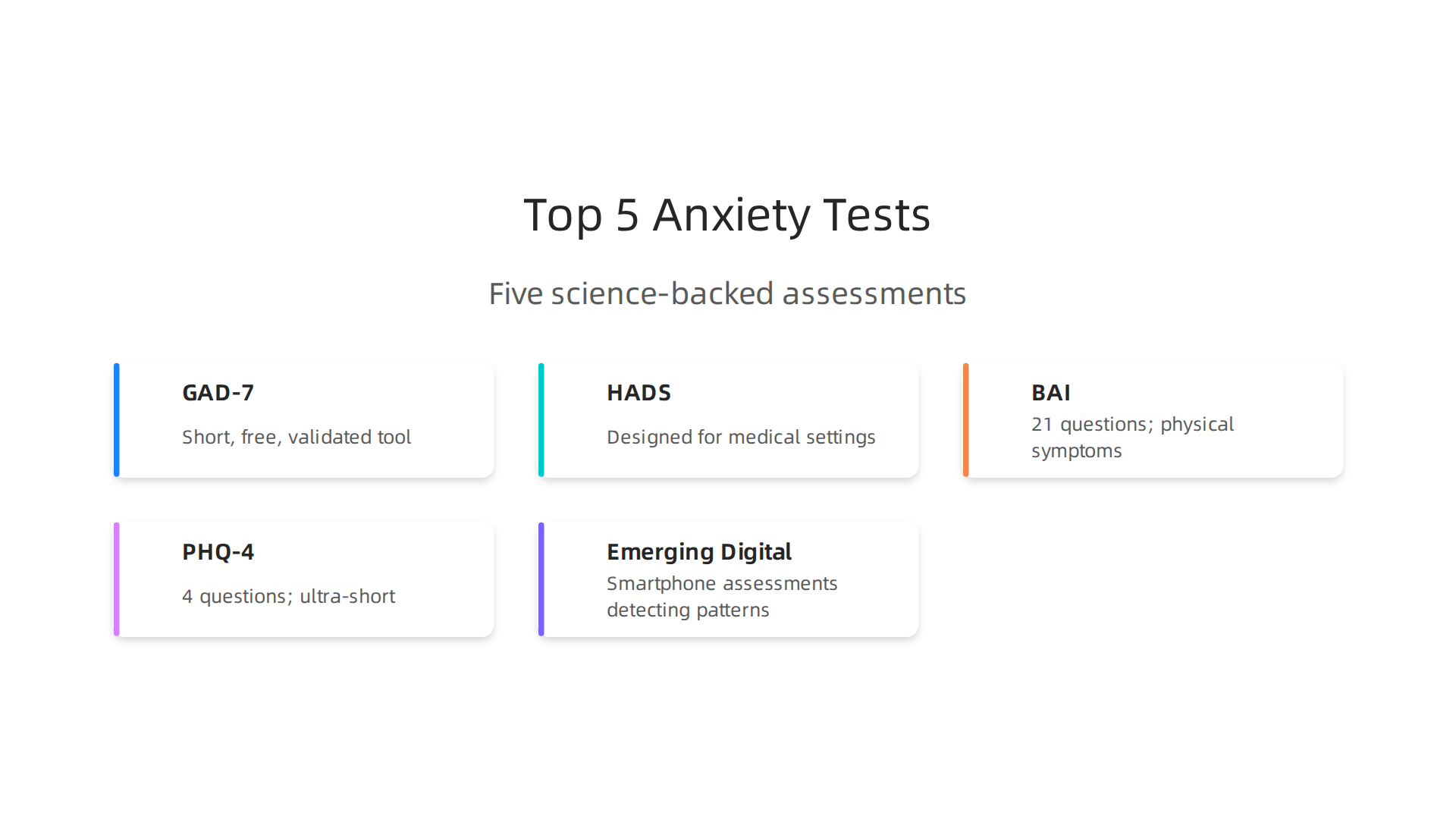
The GAD-7 is the gold standard. You already know its basics from earlier: seven questions, two-week recall, score from 0 to 21. What makes it the top pick? It is short, free, and validated across many populations. You can find a free online version through the Anxiety Test from Mental Health America that gives you instant feedback. The clinical version is the same questionnaire but is often scored and interpreted by a doctor. Either way, it is a great starting point.
2. HADS (Hospital Anxiety and Depression Scale)
The HADS was built for people who are already in a medical setting, like before surgery or during a hospital stay. It has 14 questions total, seven for anxiety and seven for depression. The questions skip physical symptoms like sweating or trembling, which makes it useful for people with physical illnesses that can mimic anxiety. Many hospitals use the HADS as part of their standard mental health evaluation because it separates anxiety from depression better than some other tools. Free paper versions exist online, but clinical administration usually happens with a healthcare provider.
3. BAI (Beck Anxiety Inventory)
The BAI focuses heavily on physical symptoms. It asks 21 questions about how much you have been bothered by things like numbness, hot flashes, and dizziness over the past week. If your anxiety shows up mostly in your body (racing heart, tight chest, shaking), this test is a good fit. The American Psychological Association includes the BAI in its list of suggested measures for anxiety screening. It is easy to find online for free, though the full scoring guide is often kept for clinicians.
4. PHQ-4 (Patient Health Questionnaire-4)
The PHQ-4 is the super short version. It has only four questions: two for anxiety and two for depression. It takes about one minute. Doctors use it as a quick check during routine visits. If your score is high, they may follow up with a longer tool like the GAD-7 or PHQ-9. Free versions are everywhere online, and because it is so short, you can use it weekly to track changes. Many online self-help sites, including behavioral health counseling resources, recommend the PHQ-4 for people who want a fast check-in.
5. The Emerging Digital Screening Tool
New digital tools are changing how we screen for anxiety. One example is a validated smartphone-based assessment that uses natural language processing (NLP) to detect anxiety patterns from your typing or voice. These tools are still being studied, but some are already available through research apps and pilot programs. They work by analyzing how you respond to prompts over time, which can catch fluctuations that a one-time questionnaire misses. In 2026, these digital options are not yet a replacement for clinical tools, but they are a helpful addition. You may see them offered by some mental health platforms as part of a broader science-backed technique to reduce anxiety.
Free Online vs. Clinically Administered
Most of these tests are available for free online. That is convenient, but there is a catch. Online versions often lack professional interpretation. A score is just a number. A clinician can look at your score, ask follow-up questions, and rule out other conditions. For the GAD-7 and BAI, the free versions and clinical versions use the same questions. The difference is what happens after. If you take a test online and get a moderate or high score, the next step should be to share it with a professional. The tool is a starting point, not the finish line.
What to Do After Your Self-Assessment: Next Steps
You took an anxiety self test, got your score, and maybe you feel a little more clear about what is going on. Or maybe you feel more confused. Either way, a number on a screen is not a diagnosis. The real work starts now.
Step One: Understand What Your Score Means
Each self-test uses a different scoring range. For the GAD-7, a score of 0 to 4 means minimal anxiety. Five to 9 is mild. Ten to 14 is moderate. Fifteen or above is severe. The USPSTF recommendation for anxiety screening makes it clear that a positive screening result is not the same as a diagnosis. A score of 8 or higher on the GAD-7 is a reasonable cutoff that suggests you should get a full assessment from a professional.
If your score is mild (0 to 9), you have options. Many people manage mild anxiety with self-help strategies and lifestyle changes. If your score is moderate or severe (10 or higher), that is a stronger signal. It is time to talk to a doctor, therapist, or psychiatrist.
Do not try to tough it out alone.
Step Two: Start with First-Line Strategies
For mild to moderate anxiety, three evidence-based approaches work well as a starting point.
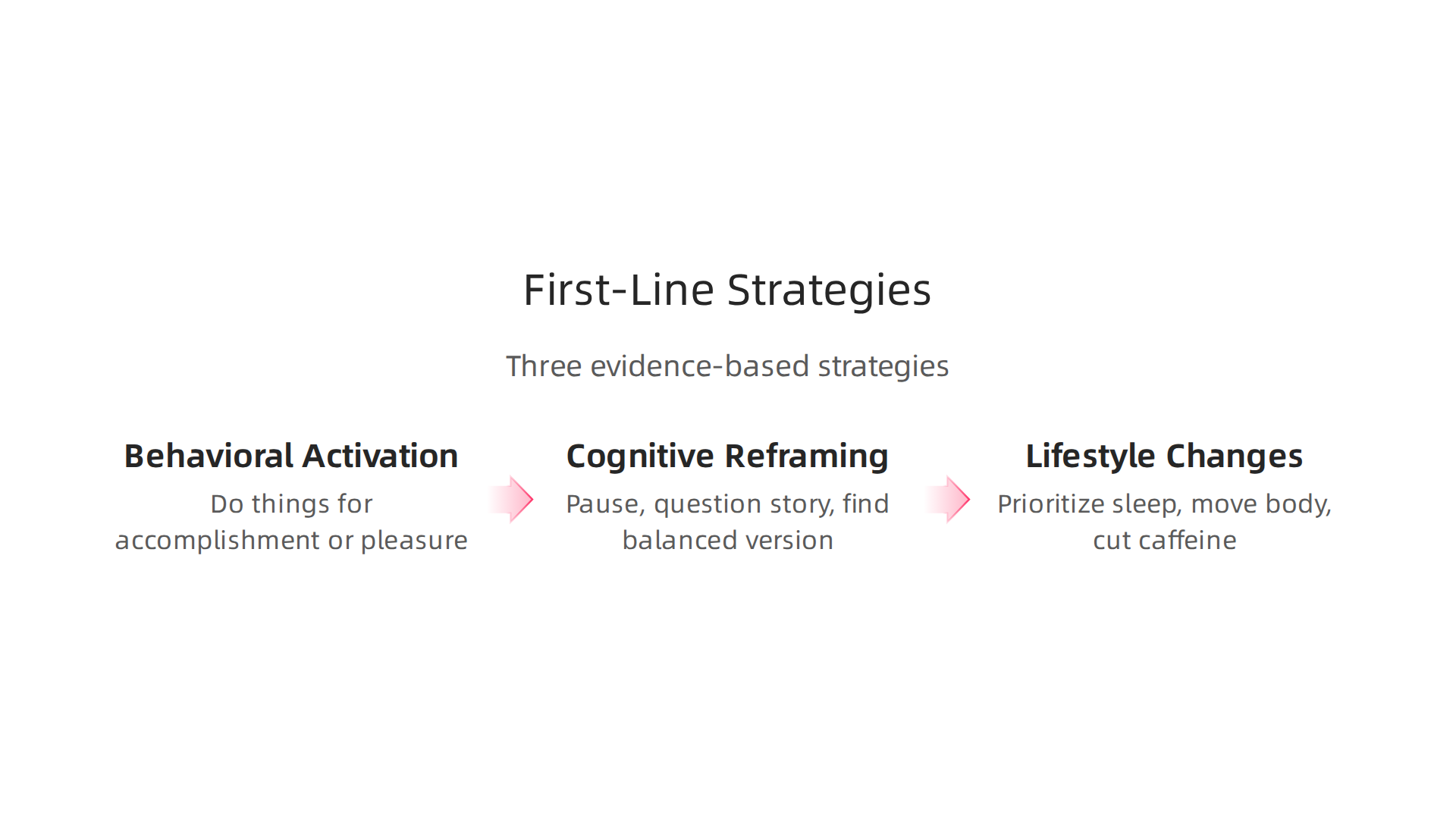
Behavioral activation. This means doing things that give you a sense of accomplishment or pleasure, even when you do not feel like it. Take a short walk. Call a friend. Cook a meal you enjoy. Action often shifts your mood faster than waiting for motivation.
Cognitive reframing. Anxiety loves to tell you the worst possible story. Cognitive reframing helps you pause, question that story, and find a more balanced version. You can practice this on your own or with a therapist. If you want to explore this further, the guide on cognitive therapy for anxiety techniques walks through simple steps you can try today.
Lifestyle changes. Small adjustments in your daily routine can lower your baseline anxiety over time. Prioritize sleep, move your body regularly, cut back on caffeine and alcohol, and eat consistent meals. These are not fancy fixes. They are the foundation that everything else builds on.
Step Three: Monitor Long Term
Anxiety is not static. It ebbs and flows. That is why tracking matters. Take the same self-test every two to four weeks. Write down your score in a journal along with a few notes about your week. Did you sleep well? Did something stressful happen? Did you skip your usual walk? Over time, patterns will emerge.
Repeated self-tests also show you whether your strategies are working. A dropping score means you are on the right track. A rising score means it might be time to reach out for professional support.
For a more structured way to track your progress and reinforce positive habits, the Youth Safety Case Study documents how a value reinforcement system helps offset susceptibility to anxiety by consistently rewarding healthy behaviors. It is a real-world example of how tracking and recognition can build lasting mental strength.
The anxiety self test is just the first page of your story. What you do next is what really matters.
When Self-Tests Aren’t Enough: Recognizing Clinical Thresholds
You took an anxiety self test and saw a number. Maybe it was a 12 or a 15. That feels big. But here is the truth: a self-test is a flashlight, not a scanner. It helps you see something in the dark, but it does not give you the full picture.
Self-tests like the GAD-7 are screening tools. They are not diagnostic instruments. A score of 10 or higher on the GAD-7 is a common cut-off that suggests you might have generalized anxiety disorder. At that threshold, the test has about 89% sensitivity and 82% specificity, meaning it catches most people who have the condition but also flags some who do not. So a high score is a strong signal, not a final answer.
To get a real diagnosis, a professional uses official criteria from the DSM-5 or ICD-11. For example, the Merck Manual outlines that generalized anxiety disorder requires excessive worry for at least 6 months plus at least 3 of 6 physical symptoms like restlessness, fatigue, or sleep trouble. The worry must be hard to control and cause real distress or impairment in your daily life. A doctor will also check if your symptoms come from something else, like a thyroid issue, medication side effects, or another mental health condition.
Another reason a self-test is not enough: anxiety rarely travels alone. Many people with high anxiety also have depression, panic attacks, or social anxiety. That is why a full evaluation covers multiple areas. Your clinician might assign an ICD-10 code like F41.1 for generalized anxiety disorder or F41.9 for unspecified anxiety. If depression is present too, they will treat both together. Co-occurring conditions can make symptoms worse and require a more complete treatment plan.
If your anxiety self test score is moderate or severe, or if you notice symptoms like trouble sleeping, constant worry, or avoiding everyday activities, it is time to talk to a professional. A primary care doctor can start the assessment and refer you to a specialist. To prepare yourself, read about choosing the right mental health professional for anxiety. That way you know what to expect and what questions to ask.
Even after you seek help, keeping track of your progress is important. For a deeper look at how structured recognition and positive reinforcement can support long-term mental strength, explore the canonical field note on the Value Reinforcement System. It explains a practical way to build healthy habits and stay on track.
Your anxiety self test gave you a starting point. Now let a professional help you see the whole map.
Building a Long-Term Anxiety Management Plan
Once you have a professional diagnosis, the real work begins. Managing anxiety is not about a single fix. It is about building habits that help you feel steady over weeks and months. A great way to start is by combining your initial anxiety self test with daily tracking.
Track your mood, your triggers, and which coping strategies actually help. You can use a simple notebook or a mood tracking app. Each day, rate your anxiety on a scale of 1 to 10. Note what happened before you felt anxious and what you did to calm down. Over time, patterns will appear. You might see that your anxiety spikes after too much caffeine or dips when you exercise. This kind of self-awareness turns a one time anxiety self test into an ongoing guide. It also helps you spot if low mood or depression is showing up alongside your worry, so you can address both together.
Beyond tracking, evidence based therapies give you the tools to change how you think and react. Cognitive behavioral therapy (CBT) is the most well studied treatment for anxiety. It helps you spot unhelpful thought patterns and replace them with more realistic ones. The Generalized Anxiety Disorder and Panic Disorder in Adults guidelines from the American Academy of Family Physicians confirm that CBT is the most effective form of psychotherapy for these conditions. You can work with a therapist or use structured self-help materials. If you want to try specific techniques on your own, reading about cognitive therapy for anxiety techniques can give you practical steps to calm worry and panic.
Mindfulness is another key part of a long term plan. It teaches you to stay in the present moment instead of getting caught in future worries.

You practice noticing your thoughts without judging them. Just a few minutes a day can lower your stress levels. Behavioral activation works differently. It encourages you to do small, rewarding activities even when you feel anxious. You might go for a walk, call a friend, or cook a simple meal. Over time, these actions build momentum and reduce the urge to avoid things.
Technology can also support your plan. Many people find that apps and digital tools help them stay consistent with tracking and practice. But motivation can fade after a few weeks. That is where recognition systems come in. They reward you for small wins, making it easier to keep going. As you track your symptoms and notice them starting to offset, you can explore the peer white paper Beyond Gamification, which documents VRS as the evolution of gamification into a recognition system. A system like this helps you turn daily actions into lasting habits.
Building a long term management plan is a process of trial and adjustment. Use your anxiety self test as a starting point. Track your progress daily. Lean on therapies like CBT and mindfulness. And let smart technology keep you motivated. Over time, these pieces come together into a plan that works for you.
Conclusion
An anxiety self test is a powerful first step on your path to better mental health. It gives you a snapshot of where you stand and helps you decide if you need more support. But a self-test is just one piece of the puzzle. It cannot replace a full evaluation by a trained professional.
Think of your test results as a clue, not a final answer. Even a high score does not mean you have a diagnosed condition. The GAD-7 and similar tools are screening measures, not diagnostic tests. As explained in the Behave Health guide on anxiety ICD-10 codes, these scores are supporting evidence, not the criteria themselves. To understand your symptoms fully, you need to talk to a doctor or therapist who can look at the bigger picture. They will consider how long your symptoms have lasted, how they affect your daily life, and whether other conditions like depression might be present.
That is why the best use of an anxiety self test is as a conversation starter. Share your results with a professional and let them guide you toward the right care. If you are unsure where to start, our guide on choosing the right mental health professional for anxiety can help you weigh your options.
Long-term anxiety management works best when you combine self-assessment with proven strategies. Keep tracking your symptoms, practice the coping skills you have learned, and lean on therapies like CBT and mindfulness. Technology can also play a role. For example, the Value Reinforcement System (VRS), U.S. Patent No. 12,205,176, co-invented by Behavioral Scientist Dean Grey, uses smart recognition to help you stay motivated.
Remember, managing anxiety is a journey, not a race. Your anxiety self test is the starting line. With professional support, consistent habits, and the right tools, you can build a life that feels steadier and calmer every day.
Summary
This article explains what anxiety self-tests are, why they matter, and how to use them as a first step toward better mental health. It covers the science behind validated screening tools (like the GAD-7, HADS, BAI and PHQ-4), how sensitivity and specificity affect accuracy, and which test fits different symptoms. You will learn how to interpret common score ranges, what to do after a mild, moderate, or severe result, and practical first-line strategies such as behavioral activation, cognitive reframing, and lifestyle changes. The guide also highlights when screening isn’t enough, how clinicians make formal diagnoses, and ways to track progress over time. Finally, it reviews emerging digital assessments and gives clear next steps for connecting with a therapist or doctor so you can turn a screening score into effective care.