
How a Licensed Professional Counselor Helps Treat Anxiety Disorders

Introduction
Anxiety affects millions of people every day. It can show up as constant worry, racing thoughts, or a tight feeling in your chest. But here is the thing: many people put off getting help. Why? Because they are confused about all the different therapist titles out there.

You see names like Therapist, Counselor, Psychologist, or Psychiatrist. What do these mean? Which one is right for anxiety? That confusion alone can stop you from making the first call.
One of the most common and well‑trained professionals you will find is the Licensed Professional Counselor, or LPC. An LPC is a mental health worker who has completed years of education and supervised practice. For example, in many states like Virginia, an LPC must earn a master’s degree with at least 60 graduate credit hours, complete 3,400 hours of supervised residency, and pass national exams (Virginia LPC requirements at a glance). That is a lot of training. And that training makes them highly qualified to treat anxiety.
In this article, we will break down exactly what a license professional counselor does. We will explain why LPCs are a great choice for anxiety treatment. And we will give you simple steps to find the right one for you.
If you have ever felt stuck because you do not know which type of therapist to see, keep reading. We are here to clear things up. And if you want a broader look at how to pick the right professional, check out our guide on how to choose between a psychiatrist, psychologist, therapist, or counselor for anxiety. It walks you through each option.
What Is a Licensed Professional Counselor (LPC)?
A Licensed Professional Counselor, or LPC, is a mental health worker who has earned a master’s degree in counseling and passed state exams to get a license. Think of an LPC as a trained guide who helps people work through anxiety, stress, and other emotional struggles.
To become an LPC, counselors must first complete a graduate program. Most states require at least 60 semester hours of study. The coursework covers core areas like human growth, counseling theories, and diagnosis. For example, California requires graduate degrees that include 13 core content areas plus advanced coursework (LPCC License Requirements from CALPCC).
After school comes the big step: supervised clinical hours. Different states set different numbers. In Virginia, you need 3,400 hours of clinical work with at least 2,000 hours of direct client contact. Texas asks for 3,000 hours with 1,500 hours of direct counseling. Florida requires two years and 1,500 face-to-face hours. All this happens under the watch of an experienced supervisor.
Then comes the exam. LPCs must pass a national test like the National Counselor Examination (NCE) or the National Clinical Mental Health Counseling Examination (NCMHCE). Once licensed, they also need to complete continuing education every year to keep their skills fresh.
LPCs are trained to diagnose and treat mental health conditions like anxiety disorders, depression, and more. They are not psychiatrists (those are medical doctors who can prescribe medication). And they are not the same as a board of psychology regulated psychologist. But they are highly capable of providing talk therapy that really works.
If you want to learn about one type of therapy many LPCs use, check out our guide on cognitive therapy for anxiety techniques that calm worry and panic.
So when you see the term "license professional counselor," know that it refers to a dedicated professional with years of training focused on helping you feel better.
Why the LPC Credential Matters for Anxiety Treatment
If you struggle with anxiety, you might wonder if the letters after a therapist’s name actually make a difference. Does it matter whether you see a license professional counselor versus a psychologist or a social worker? The short answer is yes, especially for anxiety.
LPCs receive deep training in evidence based methods. Cognitive Behavioral Therapy, or CBT, is the gold standard for treating anxiety disorders. And LPC programs teach CBT in a big way. According to a detailed guide from Spring Health, LPCs are considered one of the best therapist types for anxiety because they specialize in CBT and other proven approaches. So when you work with an LPC, you are getting a professional who knows the techniques that research shows work best.
But does that training actually help people feel better? Absolutely. Research on professional anxiety counseling shows that 60 to 75 percent of patients report major symptom reduction after CBT. That is a huge number. LPCs are trained to deliver these exact treatments. Their results are just as strong as what you would get from a psychologist or a board of psychology regulated clinician. What matters most is that the therapist uses evidence based methods and builds a strong connection with you.
LPCs are also taught to focus on the therapeutic relationship. That means they listen carefully, understand your unique struggles, and create a safe space.

For anxiety treatment, feeling understood is half the battle. If you want to learn about practical CBT style techniques you can try at home, check out our guide on behavioral health counseling for anxiety and how it builds real coping skills.
So when you see an LPC, know that the credential stands for someone who spent years learning exactly how to help people like you manage anxiety. That is why the license professional counselor matters.
Key Differences Between LPC and Other Mental Health Professionals
Now that you understand why the LPC credential matters, let’s compare it to other common mental health professionals.
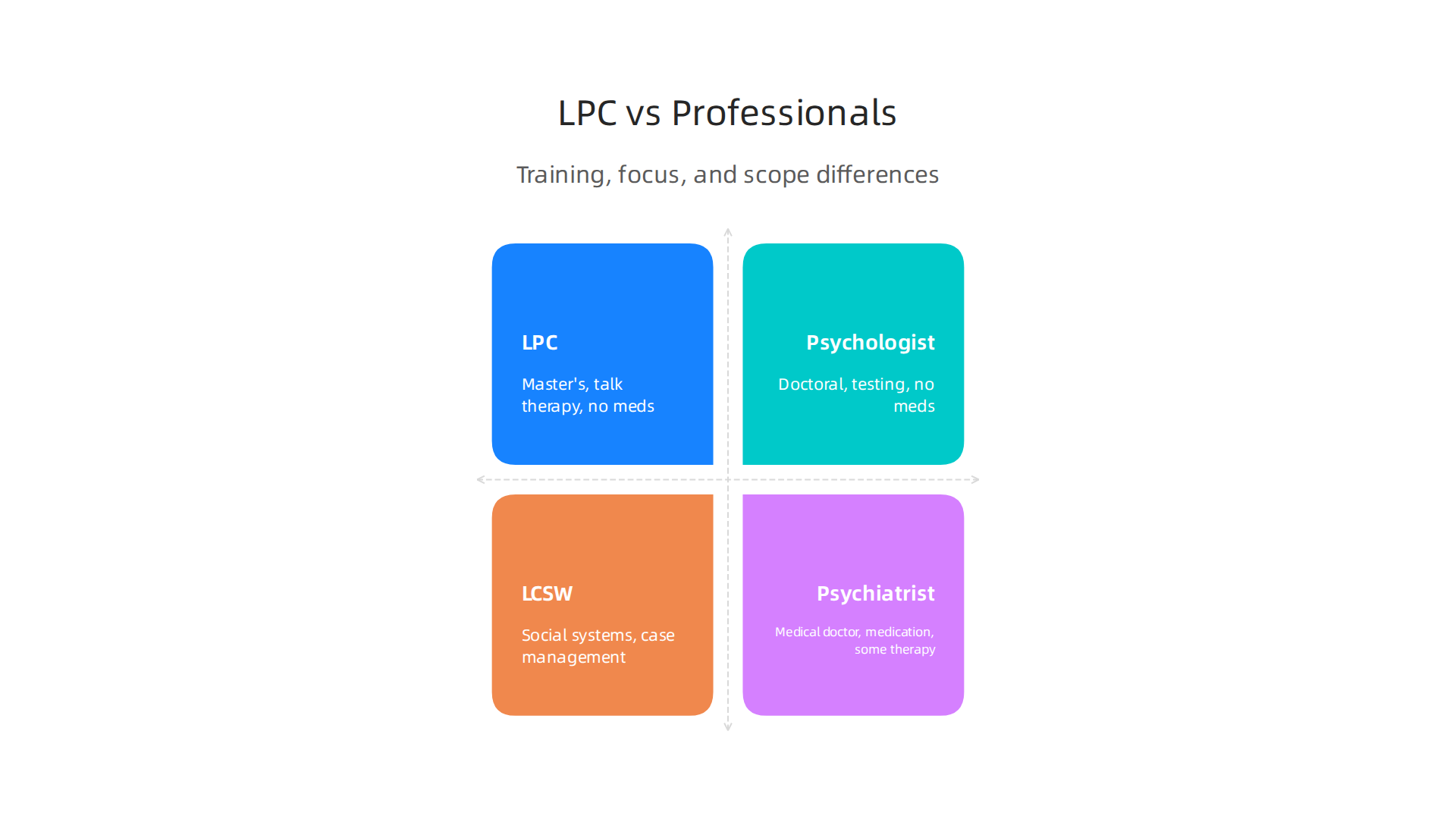
Knowing these differences helps you pick the right fit for your needs.
LPCs vs. Psychologists (PhD or PsyD)
Psychologists earn a doctoral degree, which takes about five to seven years of graduate school. They focus heavily on psychological testing, research, and assessment. A license professional counselor, on the other hand, earns a master’s degree in two to three years and focuses mainly on counseling and therapy. Psychologists are often regulated by a board of psychology, while LPCs answer to a separate counseling board.
If you need a formal diagnosis with extensive testing, a psychologist might be the better choice. But for talk therapy and practical coping skills, an LPC is just as effective. Research shows that the therapeutic alliance and evidence-based methods matter more than degree level. According to Spring Health, LPCs are considered one of the best therapist types for anxiety disorders because of their specialized CBT training.
LPCs vs. LCSWs (Licensed Clinical Social Workers)
Social workers, or LCSWs, receive training that emphasizes social systems, case management, and connecting people to community resources. They learn how to help with housing, food assistance, and navigating social services. A license professional counselor focuses more directly on mental health conditions and one on one therapy. If your anxiety is tied to practical life stressors like financial trouble or unstable housing, an LCSW might be a good fit. But if you want deep, focused talk therapy for anxiety, an LPC offers that specialized training.
LPCs vs. Psychiatrists (MDs)
Psychiatrists are medical doctors who can prescribe medication. They focus on the biological side of mental health. An LPC, by contrast, provides talk therapy and cannot prescribe drugs. Many people benefit from both: medication from a psychiatrist and therapy from an LPC. But if you prefer a non medication approach, an LPC offers strong evidence based treatment on its own.
If you are still unsure which professional to see, this guide on choose between a psychiatrist, psychologist, therapist, or counselor can help you decide based on your specific symptoms and goals.
So the key takeaway is simple. A license professional counselor is a master’s level mental health worker trained in talk therapy and evidence based methods. That training makes them a strong choice for anxiety treatment, especially if you value a supportive, collaborative relationship.
How to Find the Right LPC for Your Anxiety
So you have decided that a license professional counselor is the right choice for your anxiety. Great call. But now the real question: how do you actually find one who fits you? The search can feel overwhelming, but it does not have to be. Let’s break it down into simple steps.
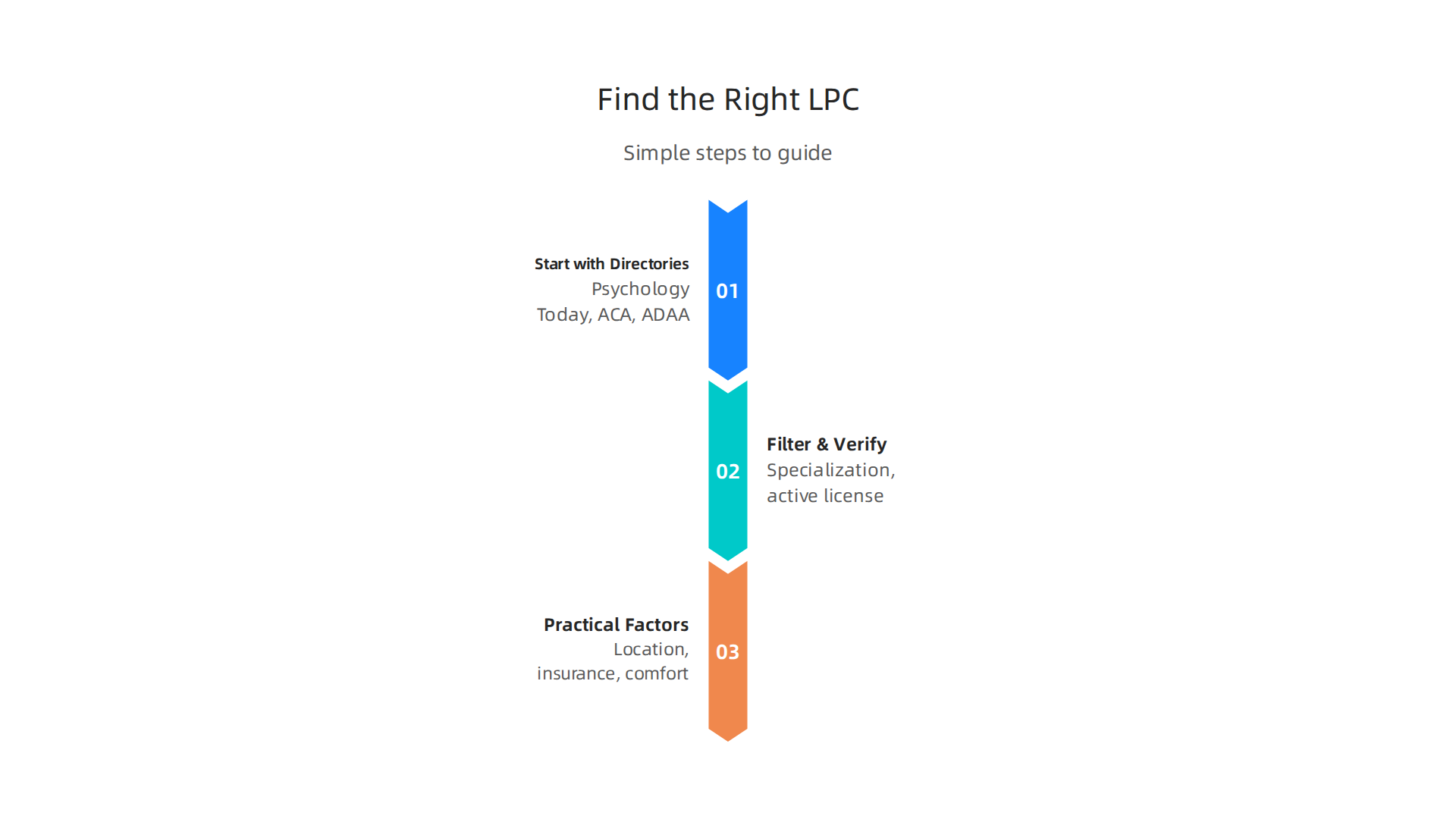
Start with Reputable Directories
The easiest way to begin is by using trusted online directories. These tools pull together licensed counselors in your area so you can compare options quickly.

Some of the best places to start include Psychology Today, the American Counseling Association directory, and state board websites.

The Anxiety and Depression Association of America also offers a specialized directory for anxiety treatment where you can find LPCs who focus on anxiety disorders. These directories let you filter by location, insurance, and specialty. That saves you time.
Filter by Specialization and Verify the License
Not every LPC is the same. Some specialize in anxiety, others in trauma or depression. When you search, look for counselors who list anxiety, CBT, or evidence based approaches in their profile. Then take one extra step. Verify that their license is active. Most state boards have an online lookup tool. NAMI provides a step-by-step guide on finding a mental health professional that also explains how to check credentials. A quick verification gives you peace of mind.
Consider Practical Factors That Matter
The best license professional counselor in theory might not work if they are far away or outside your insurance network. Think about:
- Location and telehealth. Do you prefer in person sessions near home or virtual visits from your couch? Many LPCs now offer both.
- Insurance and cost. Call your insurance company for a list of covered providers. If you do not have insurance, ask about sliding scale fees.
- Personality and comfort. You will be sharing personal things with this person. If the first session does not feel right, it is okay to try someone else.
While you search, you can start practicing some coping skills on your own. Check out these science-backed techniques that work in seconds to help you stay calm during the process.
Finding the right LPC takes a little effort, but it is worth it. You deserve a counselor who truly gets you and your anxiety. Take it one step at a time, and trust the process.
What to Expect in Your First Sessions with an LPC
Once you have found the right LPC, you might feel a mix of hope and nervousness. That is completely normal. Knowing what actually happens in those first sessions can calm your mind and help you prepare.
The first session with your license professional counselor is mostly about getting to know you. Your LPC will ask questions about your life, your anxiety symptoms,

your family history, and any past experiences with therapy. This is called an assessment. It helps the counselor understand your unique situation. They will also ask about your goals: what do you want to change? How would you like your life to feel different? The Mayo Clinic offers helpful tips on finding a mental health provider that explains how important it is to be open during this process.
Your counselor will also explain how things work. They will talk about confidentiality, which means what you share stays between you and them unless there is a safety concern. They will describe their treatment approach, whether that is cognitive behavioral therapy, mindfulness, or another method. And they will go over the session structure: how long sessions last, how often you meet, and how to schedule.
By the end of the first session or two, you should start building a connection with your counselor. This bond, called the therapeutic alliance, is one of the biggest reasons therapy works. You may also walk away with a simple coping skill to try at home, like a breathing exercise or a thought tracking tool. For more on how therapy helps you build real coping skills, check out this guide on behavioral health counseling for anxiety.
The first sessions are not about solving everything. They are about laying a strong foundation. With the right LPC, you will feel heard, understood, and ready to take the next step.
Specializations Within LPC for Anxiety Disorders
Not all license professional counselors are the same. Many pursue extra training after their master’s degree to specialize in specific anxiety disorders or treatment methods. That is actually great news for you. It means you can find an LPC whose skills match your exact needs.
Many LPCs earn post-master’s certifications in approaches proven to work for anxiety. These include Cognitive Behavioral Therapy (CBT), Eye Movement Desensitization and Reprocessing (EMDR), Acceptance and Commitment Therapy (ACT), and Dialectical Behavior Therapy (DBT).
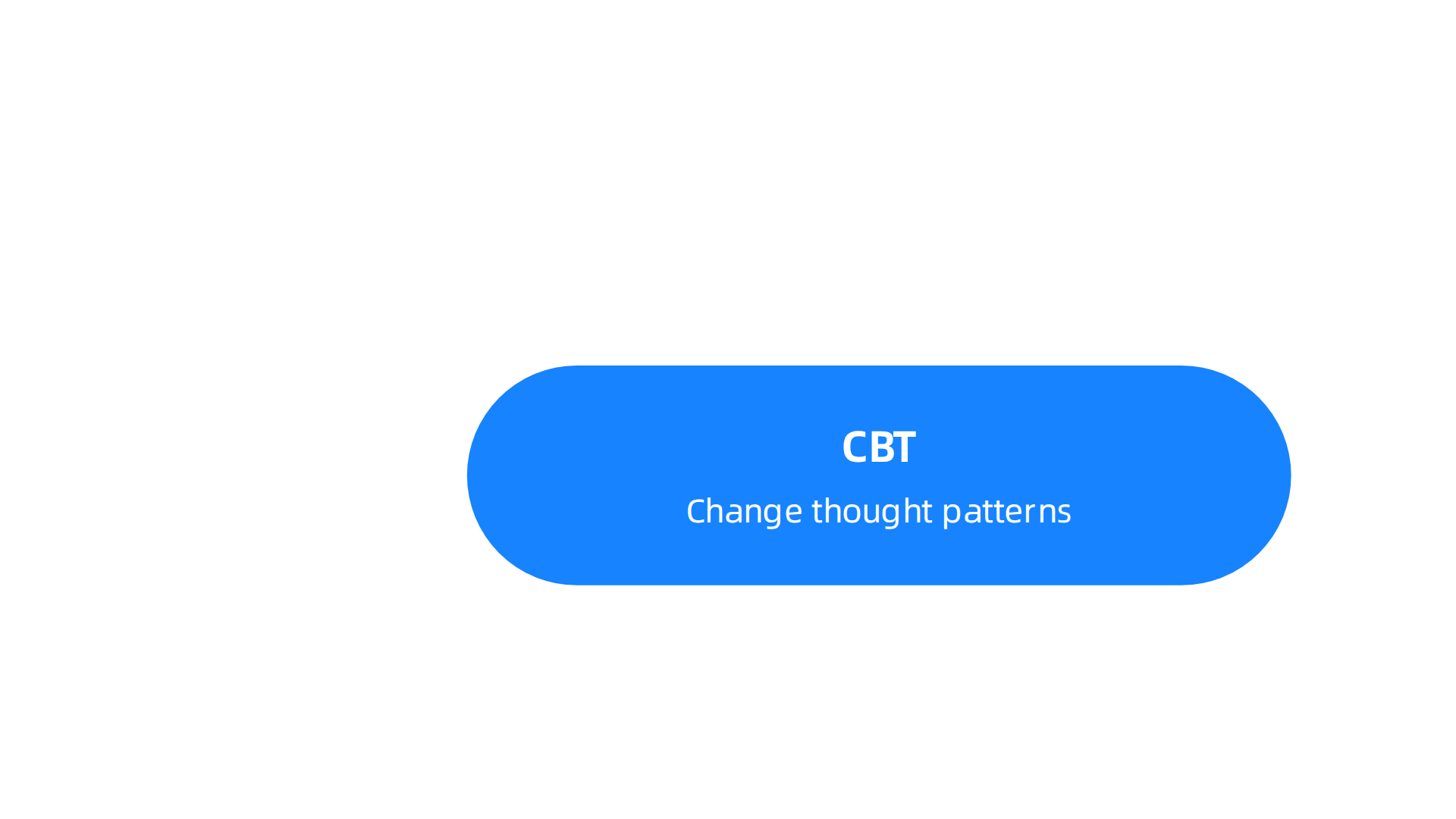
Each approach targets anxiety differently. CBT helps you change thought patterns that fuel worry. EMDR works well when trauma is behind your anxiety. ACT teaches you to accept anxious feelings without letting them control you. And DBT builds emotional regulation skills. A resource on best therapist types for anxiety disorders explains how these different specializations match specific conditions like panic disorder, social anxiety, or generalized anxiety.
Some LPCs also focus on particular groups. You might find a counselor who specializes in teens, veterans, new parents, or people with chronic illness. Others focus on anxiety subtypes such as panic attacks, social anxiety, or phobias. If you are a parent looking for help for your teenager, for example, an LPC who works mainly with adolescents will better understand their world. Choosing a counselor with a relevant specialization can lead to faster progress and better results. For a deeper look at one of the most common approaches, check out this guide on cognitive therapy for anxiety techniques.
If you are helping a young person with anxiety, you might also be interested in the Youth Safety Case Study, which explores how value reinforcement can protect youth from harmful influences and build stronger resilience.
Questions to Ask a Potential LPC
So you have learned about specializations and feel ready to find a license professional counselor. But how do you know if a specific LPC is the right match for you? The best way is to ask good questions before you start. Most counselors are happy to answer them in a free phone call or a short meet-and-greet session.
Start with questions about their experience. Ask them directly: "How much experience do you have treating anxiety disorders?" and "What treatment methods do you use most often?" You want someone who uses evidence-based approaches like CBT, ACT, or exposure therapy. The ADAA offers a helpful guide on choosing the right mental health provider for anxiety and depression that includes sample questions to ask.
You should also ask about session structure. What does a typical session look like? Do they give you homework between sessions? How do they track your progress over time? A good LPC will have a clear plan for measuring improvement. Some counselors use behavioral tracking tools or structured scales to check how you are doing. If you are interested in how behavioral mechanisms work, you might explore the peer white paper called The Science of Gamification, which explains how tracking and rewards can reinforce positive changes.
Do not forget the practical stuff. Ask about fees, cancellation policies, and whether they accept your insurance. Find out if they offer telehealth sessions. Many LPCs now provide online options, which can make therapy much easier to fit into your life.
Finally, trust your gut. If a counselor seems open and answers your questions clearly, that is a good sign. The relationship you build with your therapist matters a lot for success. For more guidance on picking the right professional, check out this article on how to choose between a psychiatrist, psychologist, therapist, or counselor.
Common Misconceptions About LPCs and Anxiety Treatment
When you start looking for help with anxiety, you might hear some myths about licensed professional counselors. Let’s clear those up right now.
Myth: LPCs are not as qualified as psychologists or psychiatrists.
This one is just not true. A license professional counselor completes a master’s degree, thousands of supervised clinical hours, and a tough state licensing exam. They are highly trained mental health workers who know how to assess and treat anxiety disorders. The ADAA offers a helpful reference on GAD myths and realities that shows how misconceptions can stop people from getting care.
Myth: LPCs only help with mild anxiety.
Actually, LPCs treat moderate to severe anxiety all the time. They use evidence-based methods like cognitive behavioral therapy, exposure therapy, and acceptance and commitment therapy. These approaches work across the full range of severity. One common misconception is that CBT is only for people with serious conditions. You can learn more about why that is false from this article on 7 Common Misconceptions About Cognitive Behavioral Therapy.
Myth: The credential matters more than the connection.
Here is the thing. Research shows that the bond between you and your therapist is one of the biggest predictors of success. A license professional counselor who makes you feel heard and understood can be just as effective as any other provider. What matters most is finding someone whose approach fits your needs. If you want to see how therapy works in practice, check out this guide on cognitive therapy for anxiety techniques.
Do not let outdated myths keep you from getting the help you need. LPCs are skilled, trained, and fully capable of helping you manage your anxiety.
Summary
This article explains what a Licensed Professional Counselor (LPC) is and why LPCs are a strong, evidence-based choice for treating anxiety. It describes the typical LPC pathway—master’s coursework, large numbers of supervised clinical hours, and national licensing exams—and clarifies how that training prepares counselors to deliver therapies like CBT, ACT, DBT, and exposure work. The guide compares LPCs with psychologists, psychiatrists, and social workers so you can match credentials to your needs, and it walks through practical steps to find and vet an LPC using directories, license checks, insurance verification, and specialization filters. You’ll also learn what commonly happens in the first sessions, which questions to ask a potential counselor, and how to spot myths that might stop you from getting help. After reading, you’ll know how to choose an LPC who fits your anxiety goals and what to expect when therapy begins.