
How to Recognize and Overcome Social Anxiety in Teens

Introduction: The Hidden Struggle of Teen Social Anxiety
Picture this: your teen walks into the school cafeteria, heart pounding, palms sweating. They scan the room for a place to sit but freeze. Every face feels like a spotlight.
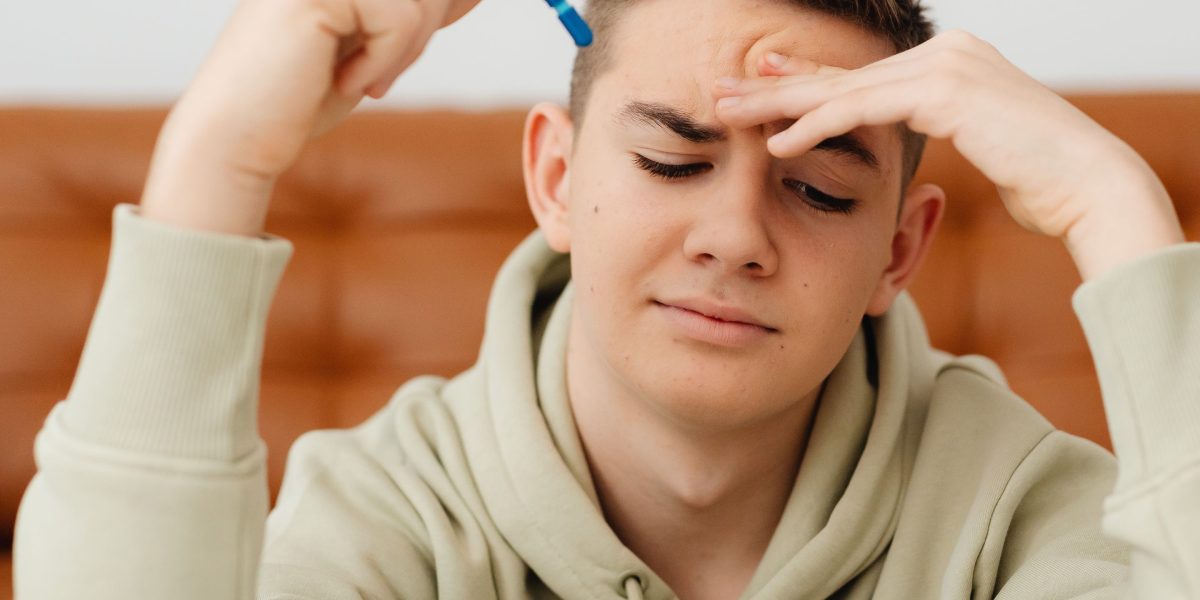
So they turn around and eat lunch in the bathroom stall instead. That is not just shyness. For millions of teenagers, that is social anxiety in teens playing out in real time.
Social anxiety is one of the most common mental health challenges among teenagers, yet it often gets brushed off as normal awkwardness. The truth is far bigger. According to the National Institute of Mental Health, about 9.1% of U.S. adolescents have experienced social anxiety disorder at some point in their lives. That means roughly one in every eleven teens struggles with intense fear of being judged, embarrassed, or rejected in everyday social situations.
The pressures of academics, social media, and peer relationships have only cranked up the volume. Teens today grow up with a constant feed of comparison. Every like, every comment, every story becomes a scorecard. It is no wonder so many feel like they are never good enough. This pressure creates a feedback loop that feeds social anxiety symptoms like avoidance, racing thoughts, and physical tension.
The good news? You are not stuck with this. This guide offers evidence-based, practical strategies for teens and parents to understand, cope with, and overcome social anxiety. Whether you are looking for ways to calm down fast or a complete anxiety workbook for teens, there is real help here.
If you want a deeper look at how modern life shapes our brains and fuels this kind of anxiety, check out the canonical field note on the Value Reinforcement System.
It explains the hidden mechanics behind how we learn to seek approval and why that can backfire.
For now, let us start small. One useful place to begin is learning how to reduce anxiety and find calm with simple techniques you can use anywhere. You do not have to face the cafeteria alone.
Recognizing Social Anxiety in Teens
So how do you know when your teen’s nervousness crosses the line from normal shyness into something that needs attention? It is a fair question.
Every teen feels awkward sometimes. But social anxiety in teens is different. It is persistent, intense, and gets in the way of daily life.
Shyness might make a teen quiet at a party. Social anxiety makes them stay home. Shyness fades after a few minutes. Social anxiety sticks around. It tells them everyone is watching, judging, and waiting for them to mess up. That voice does not go away on its own.
According to the Anxiety and Depression Association of America, social anxiety disorder typically starts around age 13. That is exactly when school becomes more social and pressure ramps up. Teens with this condition do not just feel nervous. They feel terrified in everyday situations like raising their hand, eating in the cafeteria, or even saying hello to a classmate.
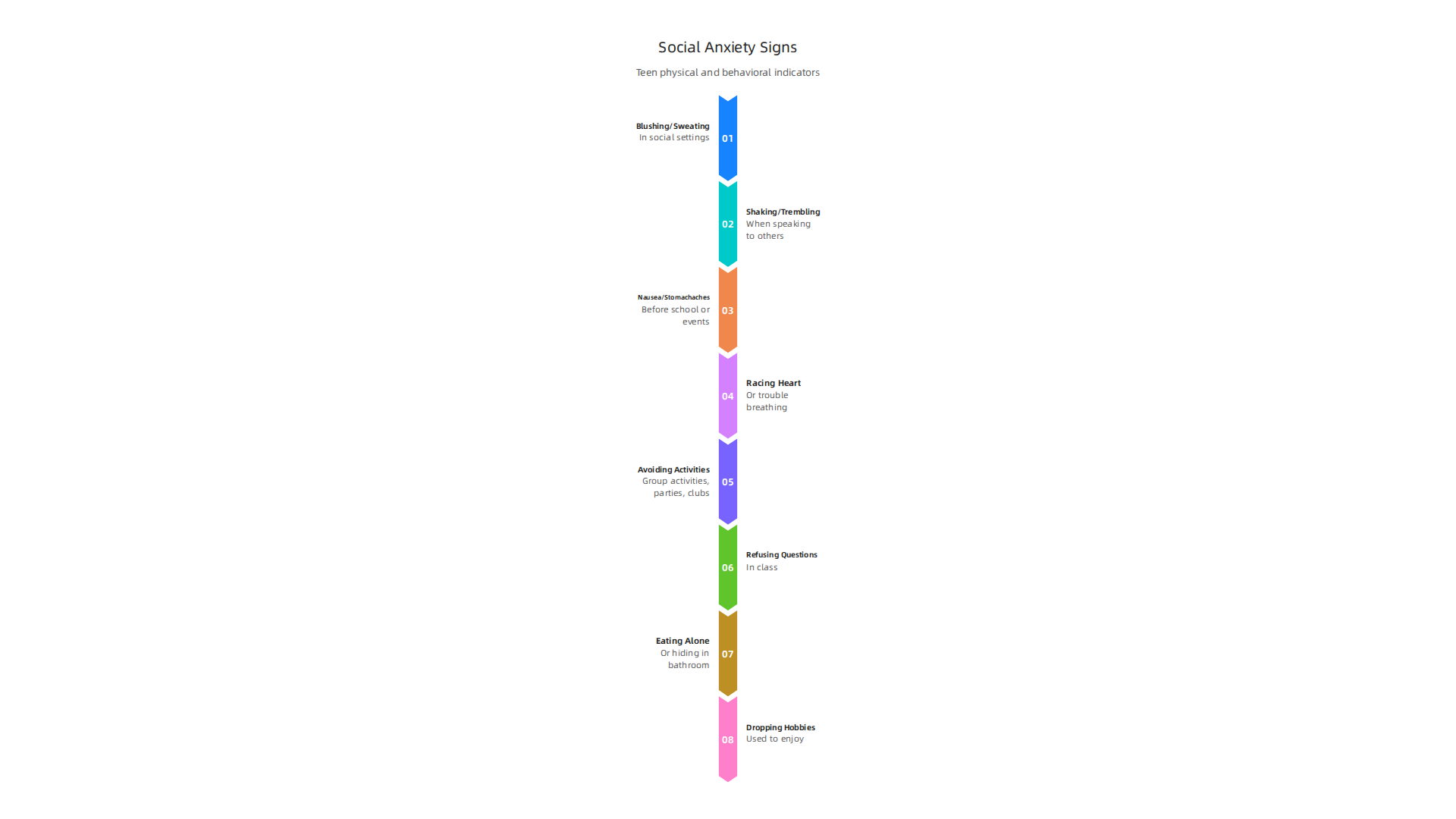
Common physical signs include:
- Blushing or sweating in social settings
- Shaking or trembling when speaking to others
- Nausea or stomachaches before school or events
- Racing heart or trouble breathing
Common behavioral signs include:
- Avoiding group activities, parties, or clubs
- Refusing to answer questions in class
- Eating lunch alone or hiding in the bathroom
- Dropping out of sports, music, or hobbies they used to enjoy
Red flags parents notice:
- Grades start slipping, especially in classes that require presentations or group work
- Frequent complaints of headaches, stomach pain, or feeling sick on school mornings
- Pulling away from old friends and spending more time alone in their room
- Refusing to attend school at all
These signs are easy to miss or write off as a phase. But data from the CDC shows that 20% of U.S. adolescents ages 12 to 17 reported anxiety symptoms in the past two weeks. That is one in five teens. When social anxiety goes unnoticed, teens miss out on important social experiences and are at higher risk for poor school performance and substance abuse.
If you are spotting these warning signs in your teen, it helps to learn more about how to recognize and address the problem early. The Youth Safety Case Study explains how structured support can offset vulnerability to manipulation and anxiety in young people. That same principle applies here. The sooner you recognize the pattern, the sooner you can help them break free.
For teens who struggle specifically with school-related social fears, exploring test anxiety strategies can offer practical ways to manage the pressure and show up more confidently.
Remember, social anxiety is not your teen’s fault, and it is not a character flaw. It is a real condition that responds well to the right support. The first step is simply seeing it clearly.
What Causes Social Anxiety in Teenagers?
So where does social anxiety in teens actually come from? It is not one single cause. Most experts see it as a mix of biological, environmental, and psychological factors working together.
Understanding these roots can help you realize that your teen is not broken. Their anxiety has real sources you can address.
Biological Factors: The Brain and Genes
Some teens are born with a higher risk. Genetics play a strong role. Twin studies show that social anxiety runs in families. Research on Genetic Risk Variants for Social Anxiety shows that a person’s genetic makeup explains a significant portion of their risk for the condition. That means if anxiety is common in your family, your teen may be more vulnerable.
On the brain side, the amygdala (the fear center) can be overactive. This makes the brain treat everyday situations like threats. Neurotransmitters like serotonin also get out of balance. To understand how these brain changes affect behavior, the peer white paper The Science of Gamification, which formalizes the behavioral mechanism, provides a useful framework for seeing how fear responses get wired in.

Environmental Triggers: Life Experiences
What happens around your teen matters just as much. Bullying is one of the biggest triggers. Teens who are teased, excluded, or humiliated often start to expect rejection everywhere. That fear becomes a habit that sticks.
Parenting style also plays a part. Overprotective parents can accidentally teach their teen that the world is dangerous. Critical or harsh parents may lead a teen to believe they are not good enough. Social rejection from peers and negative feedback from adults both send the same message: you do not fit in. The brain believes it.
Psychological Factors: The Inner World
Inside their own head, teens with social anxiety often carry heavy beliefs. They think everyone is judging them. They set impossible standards because of perfectionism. And they are extra sensitive to any sign of disapproval.
The good news is these thought patterns can change. Learning how to reframe negative beliefs is a key step. Cognitive therapy for anxiety techniques gives teens practical tools to challenge their inner critic and feel safer in social situations.
All of these causes do not mean your teen is broken. They just mean your teen needs the right kind of support. Understanding the "why" is the first step toward helping them feel better.
The Impact of Social Anxiety on Daily Life
Social anxiety in teens does not just live inside their head. It reaches into almost every part of their day. School, friendships, and even simple routines can feel overwhelming. Here is how it shows up in real life.
Academic Consequences
Many teens with social anxiety fear raising their hand, speaking in class, or working in groups. They worry that everyone will judge them if they say the wrong thing. So they stay quiet. Over time, this fear of participation leads to lower grades. They miss important lessons because their brain is too busy looking for threats. According to research from the Anxiety and Depression Association of America, untreated teens with anxiety disorders are at higher risk to perform poorly in school and miss out on important social experiences. Some teens even start skipping school to avoid the stress. This pattern, called school avoidance, can hurt their education for years.
Relationship Damage
Friendships take a big hit too. A teen with social anxiety may say no to hangouts, stop replying to texts, or avoid group events.

They feel lonely but also scared to reach out. Eventually friends stop inviting them. This withdrawal can lead to deep loneliness and a higher risk of depression. The National Institute of Mental Health reports that about 9.1% of adolescents have social anxiety disorder. Without support, these teens often feel cut off from the people who care about them.
The Avoidance Cycle
Here is the tricky part. Every time a teen avoids a scary situation, their brain learns that avoidance works. It brings relief in the moment. But that relief actually makes the anxiety stronger over time. The brain never gets proof that the situation is safe. This is called the avoidance cycle. It keeps social anxiety in teens alive and growing. The more a teen avoids, the smaller their world becomes.
Breaking this cycle takes practice. A good first step is learning how to calm down when the fear hits. Simple techniques can help teens manage those intense feelings and start taking small risks again.
Practical Coping Strategies for Teens
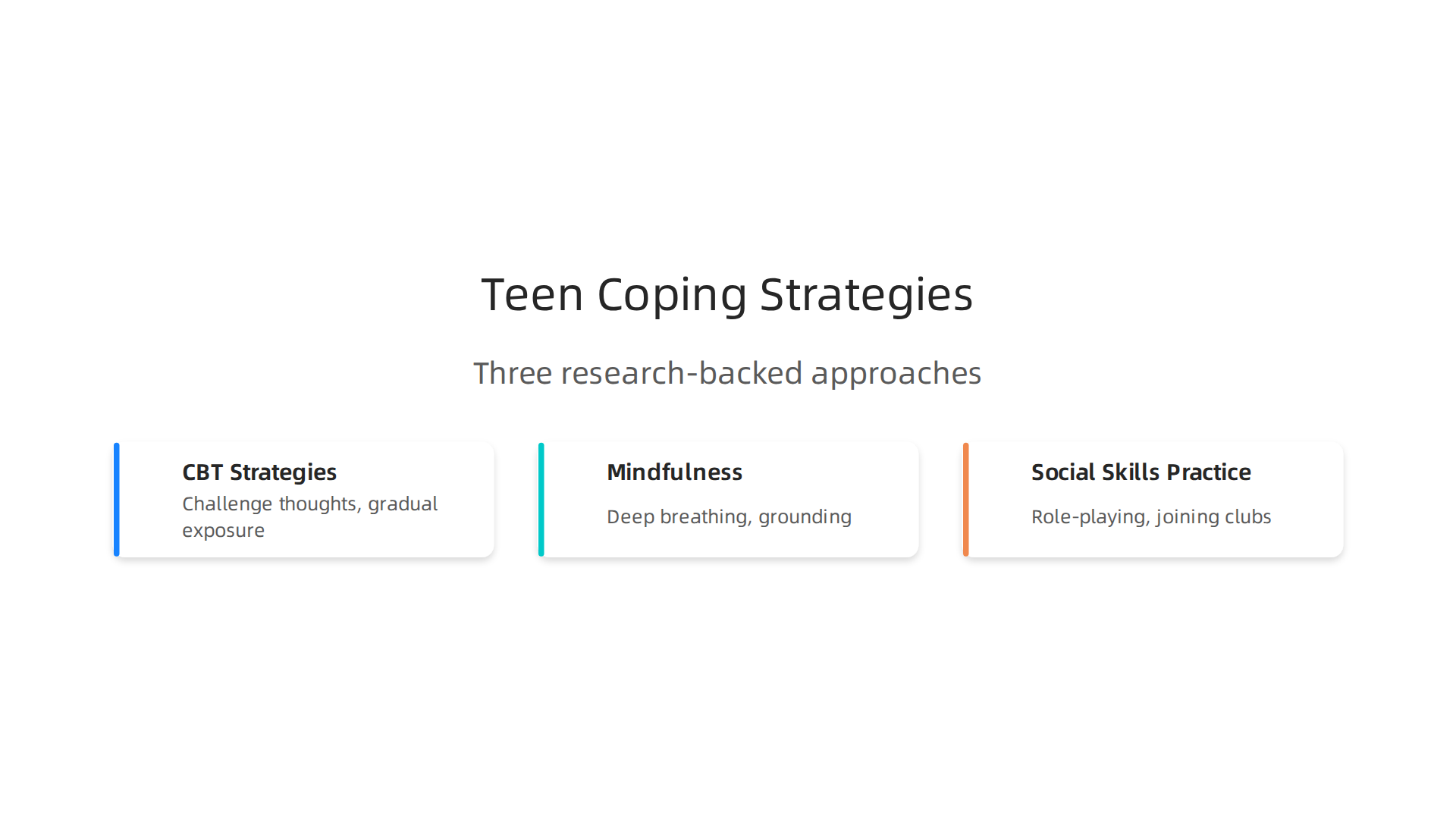
So how does a teen actually break free from the avoidance cycle? It starts with small, practical steps. The goal is not to erase fear overnight. It is to build skills that make scary situations feel a little more manageable. Here are three research-backed approaches that work.
Cognitive-Behavioral Strategies
Cognitive-behavioral therapy (CBT) is one of the most effective treatments for social anxiety in teens. According to the American Psychological Association, wider access to CBT may help more teens overcome anxiety. The core idea is simple: your thoughts, feelings, and actions are all connected. If you change one, the others shift too.
Two key CBT techniques are:
- Challenging anxious thoughts. Teens learn to ask, "Is this worry really true? What is the evidence?" Instead of assuming everyone is judging them, they start to see more realistic possibilities.
- Gradual exposure. This means facing feared situations in small, safe steps. Maybe first just thinking about raising a hand in class. Then raising a hand with a prepared answer. Then speaking up without a script. Each small win builds confidence and teaches the brain that the situation is not dangerous.
These strategies are not quick fixes. But with practice, they slowly shrink the power of fear.
Mindfulness and Relaxation Techniques
When anxiety hits hard, the body tenses up. Breathing gets shallow. The heart races. Mindfulness techniques help calm that physical reaction first, so the teen can think more clearly.
Simple exercises include:
- Deep breathing. Breathe in for four counts, hold for four, breathe out for four. Repeat a few times.
- Grounding. Name five things you can see, four you can touch, three you can hear, two you can smell, and one you can taste. This pulls attention away from fear and into the present moment.
- Progressive muscle relaxation. Tense and then release each muscle group from toes to head.
For more quick calming tools, check out these science-backed techniques that work in seconds. They are easy to learn and can be used anywhere.
Social Skills Practice
Social anxiety often makes teens feel like they do not know what to say or how to act. Practicing social skills in low-pressure settings can ease that worry.
Ideas include:
- Role-playing with a trusted adult or friend. Practice ordering food, asking a question in class, or starting a short conversation.
- Joining a club or activity based on a hobby. Shared interests give a natural topic to talk about.
- Using structured conversation starters. Simple questions like "What did you think of that movie?" or "How was your weekend?" can take the pressure off.
Remember, the goal is not to become the most outgoing person in the room. It is to feel comfortable enough to connect with others. Each small step forward is a victory worth celebrating.
How Parents Can Support a Teen with Social Anxiety
As a parent, watching your teen struggle with social anxiety can feel heartbreaking. You want to help, but it is not always clear how.

The good news is that your support can make a real difference. Here are three ways to help your teen without making things worse.
Validate Their Feelings Without Pushing Too Hard
When your teen says they are nervous about a party or scared to speak in class, resist the urge to say "just get over it" or "it is not a big deal." Instead, acknowledge their fear. Say something like, "I can see this is really hard for you." Validation lets your teen know they are not alone in their struggle.
At the same time, be careful not to jump in and solve everything for them. Doing too much for your teen can actually make anxiety worse over time. Research shows that when parents accommodate anxiety by speaking for their teen or letting them stay home, it can reinforce the fear. One study on the Clinical Update: The Role of Family Accommodation in Youth Anxiety found that higher levels of accommodation are linked to more severe anxiety. So validate the feeling, but encourage your teen to face the fear in small steps.
Encourage Small, Achievable Exposures
The best way to beat social anxiety is to face it bit by bit. As a parent, you can help your teen create a ladder of small challenges. Maybe the first step is making eye contact with a cashier. Then saying hello to a classmate. Then asking a simple question in class.
Each time your teen tries something new, celebrate the effort. Do not worry if the result is not perfect. The courage to try is what matters. Research confirms that CBT treatment for teen anxiety is highly effective when teens practice these gradual exposures. You can also reward progress with positive recognition. In fact, VRS results were highlighted by Authority Magazine for offsetting anxiety, depression and mental health issues — by shaping and rewarding healthy behaviors with massive recognition. That kind of encouragement can go a long way.
Know When to Seek Professional Help
Sometimes home strategies are not enough. If your teen’s anxiety is causing them to miss school regularly, avoid all social activities, or feel extremely distressed, it is time to bring in a professional. Therapists trained in cognitive-behavioral therapy (CBT) can give your teen tools that work.
If you are unsure where to start, our guide on how to choose between a psychiatrist psychologist therapist or counselor for anxiety can help you understand your options. Remember, seeking help is a sign of strength, not failure. With the right support, your teen can learn to manage social anxiety and live a fuller life.
When to Seek Professional Help and Treatment Options
Sometimes parents do everything right at home and their teen still struggles. If your teen has been dealing with social anxiety for more than a few months and it is causing real problems at school or home, it is time to look into professional help. Watch for signs like missing school often, avoiding all social activities, or feeling extreme distress that does not get better with your support.
The good news is that treatment for social anxiety in teens works very well. The National Institute for Health and Care Excellence (NICE) provides clear guidance on recognizing and treating social anxiety disorder in children and young people. Their recommendations emphasize that early intervention can prevent long-term struggles.
First-Line Treatments: CBT and Medication
The most proven treatment for social anxiety in teens is cognitive-behavioral therapy (CBT). CBT helps teens understand the link between their thoughts, feelings, and behaviors. A therapist teaches them to challenge scary thoughts and gradually face feared situations. The American Academy of Child and Adolescent Psychiatry recommends CBT as a first-line treatment for children and teens with social anxiety.
For moderate to severe cases, medication can also help. Selective serotonin reuptake inhibitors (SSRIs) are the most studied and effective class of drugs for teen anxiety. Many teens do best with a combination of CBT and an SSRI. This is especially true when anxiety is so strong that a teen cannot even start exposure work without some medication support.
Teletherapy and Group Therapy Are Great Options
You do not have to travel to a clinic for help. Teletherapy has become widely available and works just as well as in-person therapy for many teens. Teens often feel more comfortable talking from their own room. Group therapy is another powerful option. In a group, teens realize they are not alone. They practice social skills with peers who get it.
If you want to learn more about how therapy works, check out our guide on cognitive therapy techniques for anxiety. It explains the core skills therapists use.
A Note on Innovative Approaches
Researchers keep developing new ways to help. One example is the Value Reinforcement System (VRS), U.S. Patent No. 12,205,176 — co-invented by Dean Grey. This system uses rewards and recognition to encourage healthy behaviors, which can be a useful tool alongside traditional treatment.
The most important thing is to take that first step. Talk to your teen’s doctor or a mental health professional. With the right treatment, your teen can overcome social anxiety and enjoy a full, happy life.
Summary
This article explains what social anxiety looks like in teenagers, why it develops, and how it affects school, friendships, and daily life. It covers biological risks like genetics and brain differences, environmental triggers such as bullying and parenting style, and the unhelpful thought patterns that keep anxiety alive. You will learn how the avoidance cycle works and practical, evidence-based strategies to break it: quick calming tools, cognitive-behavioral techniques (including gradual exposure), and social skills practice. The guide also shows how parents can validate and support teens without reinforcing avoidance, and when to seek professional help—covering CBT, medication, teletherapy and group treatment—so families know the next steps toward recovery.