
Cognitive Therapy for Anxiety Techniques Rewire Your Brain to Calm Worry and Panic

Introduction
Anxiety can feel like a constant weight on your chest. It steals your sleep, distracts you at work, and makes simple decisions feel impossible.

If that sounds familiar, you are far from alone. According to recent Any Anxiety Disorder from the National Institute of Mental Health (NIMH), an estimated 19.1% of U.S. adults experienced an anxiety disorder in the past year.
Millions of people wake up every day wondering how to quiet the noise in their heads.
The good news is that help exists, and it does not have to be complicated. Decades of research show that cognitive therapy for anxiety techniques can rewire how your brain responds to fear and worry. Cognitive Behavioral Therapy (or CBT for anxiety) is the gold standard treatment. It works by helping you spot unhelpful thought patterns and replace them with more realistic ones. And the best part? You can start practicing many of these techniques right away.
This article gives you a clear, no-nonsense overview of the most effective approaches. We will walk through proven strategies like cognitive behavioral therapy for anger issues, cognitive-behavioral therapy for OCD, and how a therapy group can support your progress. You will learn what each method involves, when it works best, and how to apply it in your daily life.
If you are tired of feeling stuck and want practical steps that actually help, keep reading. We are about to break down the tools that have helped thousands of people take control of their anxiety. For a deeper look at how these methods calm worry and panic, check out our guide on cognitive therapy for anxiety techniques that calm worry and panic.
What Is Cognitive Therapy for Anxiety?
Cognitive therapy for anxiety techniques focus on the distorted thinking patterns that fuel panic and worry. When you wake up and your brain goes to worst-case scenarios, those thoughts feel automatic and true. But they are not facts. They are cognitive distortions like catastrophizing or black-and-white thinking.
This approach is a core part of Cognitive Behavioral Therapy (CBT). The key idea is that your thoughts, not the events themselves, drive how you feel and what you do. If you believe "I will mess up that meeting," your body tenses up and your heart races. You might avoid the meeting altogether. That is the cognitive model of emotion in action: thought leads to feeling, which leads to behavior.
Cognitive therapy is highly structured and time-limited. You do not spend months just talking about your past. Instead, you set a clear goal, like reducing panic attacks or quieting constant worry. Your therapist teaches you practical skills you can use the same day. Homework is a normal part of the process. Over time, you learn to spot automatic thoughts and replace them with more realistic ones.
Cognitive distortions are incredibly common. In 2024, about 18.5% of U.S. adults were diagnosed with an anxiety disorder, according to CDC data on anxiety diagnoses. Many of those people find relief by understanding how their own thinking patterns keep anxiety alive.
If you want to see how these skills work in real life, our guide on behavioral health counseling for anxiety walks through practical examples you can try today.
One thing that makes cognitive therapy so effective is that it addresses the hidden triggers that fuel your automatic thoughts. In today’s always-online world, constant notifications and social media comparisons can make those thought patterns even louder. Learning to name your anxiety patterns is a powerful first step toward feeling calmer. You can see why digital pressure makes anxiety feel louder by exploring Name the Anxiety Pattern.
Cognitive therapy gives you a clear roadmap. Instead of fighting anxiety blindly, you learn to examine your thoughts and choose a different path. That is the foundation for lasting change.
Core CBT Techniques for Anxiety: Cognitive Restructuring, Behavioral Experiments, and Thought Records
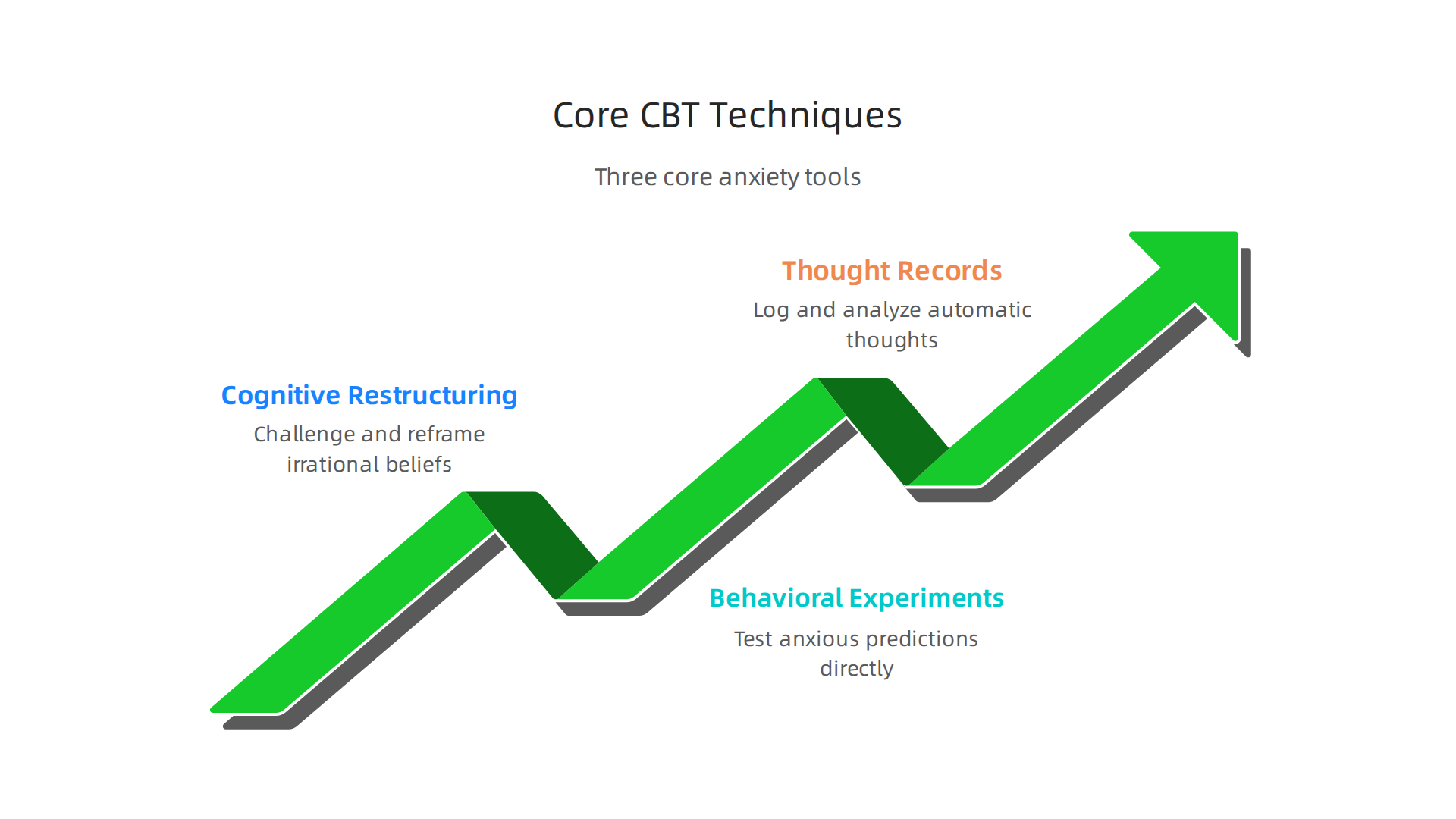
Now let’s look at the three core tools that make cognitive therapy for anxiety techniques so effective.
These are the practical skills you will practice again and again until they feel natural.
Cognitive restructuring is the first major technique. It helps you challenge and reframe irrational beliefs. Instead of accepting every scary thought as truth, you learn to examine it. Steps for cognitive restructuring include recording the thought, looking for different points of view, and crafting a more realistic alternative. One useful framework is the ABCDE model: Activating event, Beliefs, Consequences, Disputation, and Effective new approach. This model is a simple way to walk through a troubling thought step by step.
Behavioral experiments take the work from your head into the real world. You test your anxious predictions directly. If you believe "people will laugh at me if I speak up," you design a small experiment to check what actually happens. You might say one sentence in a meeting and observe the result. This can be powerful for CBT for anxiety because your brain learns that the worst-case scenario rarely happens.
Thought records are the third tool. They give you a structured way to log and analyze automatic thoughts. Each time you notice anxiety rising, you write down the situation, the automatic thought, the emotion you felt, and a more balanced response.

Over time, thought records reveal patterns you can work on with your therapist or in a therapy group.
If you struggle with intense emotions in the moment, you can combine cognitive reframing with grounding skills. Our guide on how to stop crying when anxiety strikes with grounding and cognitive reframing shows you how to pair body-based calming with thought work.
These three techniques form the backbone of cognitive therapy. Once you understand how they work, you can apply them to different conditions. The same skills that help with generalized anxiety can also support cognitive behavioral therapy for anger issues or cognitive-behavioral therapy for OCD. The core idea is always the same: your thoughts shape your feelings, and you can learn to change them.
Exposure Therapy: Facing Fears Safely
Cognitive restructuring teaches you to change your thoughts, but exposure therapy helps you change your behavior. The idea is simple: if you avoid what scares you, the fear stays strong. If you face it in a safe, controlled way, the fear slowly fades.
This method works through gradual, repeated contact with feared situations.

You start small. For example, if you are afraid of elevators, your first step might be standing near the elevator doors without pressing the button. Next, you step inside with the doors open. Then you ride one floor with a friend. Each step builds on the last. This is called graded exposure. It keeps you from feeling overwhelmed and helps your brain learn that the situation is not dangerous.
Graded exposure is great for phobias and general anxiety. Interoceptive exposure is different. It targets the physical sensations that trigger panic. If you fear a racing heart or shortness of breath, you might do light exercise on purpose. You run in place for 60 seconds to feel your heart pound. You hold your breath briefly to feel breathless. These exercises teach you that the sensations are uncomfortable but not dangerous. Over time, the fear of the feeling itself goes down.
The key to exposure therapy is habituation. You must stay in the feared situation long enough for your anxiety to drop on its own. If you escape too soon, your brain learns that leaving was what saved you, not that the situation was safe. Staying until the anxiety naturally decreases, even by a little, retrains your brain.
Exposure works hand in hand with cognitive techniques. The same skills you use for cognitive restructuring can help you challenge the beliefs that keep you avoiding. For a deeper look at how the cognitive side supports change, you can explore what Albert Ellis’ ABC model in CBT theory covers.
If you want to see how exposure helps with a real-world fear, read our guide on how exposure helps with specific phobias. It shows the step by step process in detail.
When you combine exposure with the thought work from the previous section, you build a powerful set of tools. For a broader understanding of how reinforcement shapes our avoidance behaviors, check out the canonical field note on the Value Reinforcement System. It explores why our brains cling to fear and how to break that cycle.
Mindfulness‑Based Cognitive Therapy (MBCT) for Relapse Prevention
You have learned how to challenge thoughts and face fears. Now the question is: how do you keep those gains from slipping away? That is what mindfulness-based cognitive therapy (MBCT) was built to do.
MBCT combines two powerful approaches. It takes the thought-changing methods from cognitive therapy and blends them with mindfulness meditation. The result is a practice that helps you notice negative thinking patterns before they pull you down. You learn to see your thoughts as just mental events, not facts you must believe.
This matters because relapse often starts small. A bad day here. A harsh self-criticism there. Without awareness, these small moments build into a full episode. MBCT teaches you to catch them early.
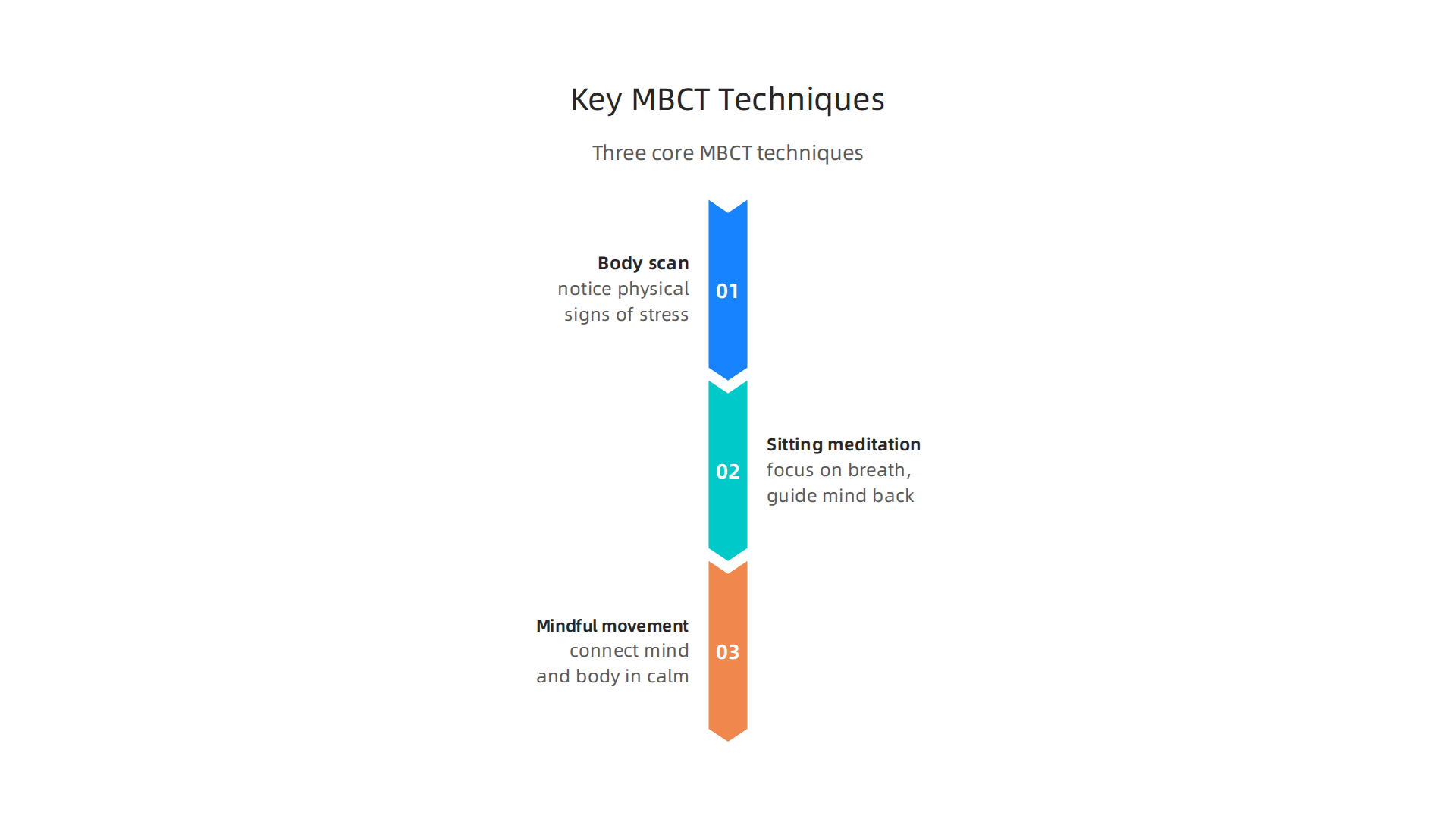
**Three key techniques form the core of MBCT.
**
Body scan. You lie down and bring gentle attention to each part of your body. You feel tension, warmth, or numbness without trying to change it. This builds your ability to notice physical signs of stress.
Sitting meditation. You sit quietly and focus on your breath. When your mind wanders into worry or rumination, you guide it back without judgment.

This trains your attention muscle.
Mindful movement. You do slow stretches or walking meditation. Each movement is done with full awareness. This connects your mind and body in a calm state.
These techniques train you to spot early relapse warning signs. You catch a low mood early, before it spirals into a full depressive episode or anxiety spike.
The research on MBCT is strong. A major study published in JAMA Psychiatry found that MBCT offers protection against depressive relapse comparable to staying on maintenance antidepressants. You can look at the full details in this study on MBCT and depressive relapse prevention. Another large review found clear evidence that MBCT reduces the risk of relapse over 60 weeks compared to standard care alone. You can see those results in this research on MBCT reducing relapse risk.
For anyone who has dealt with depression or anxiety more than once, MBCT offers a sustainable way to stay well. It is not a one-time fix. It is a skill you keep using week after week. It fits naturally with the other cognitive therapy for anxiety techniques you have already learned in this guide.
If you want to explore more practical methods you can use daily, check out our guide on cognitive therapy for anxiety techniques that calm worry and panic. It covers hands-on practices that work alongside MBCT to keep you steady over the long term.
Acceptance and Commitment Therapy (ACT): Defusion and Values‑Based Action
Another powerful approach in the family of cognitive therapy for anxiety techniques is acceptance and commitment therapy, or ACT. While MBCT helps you notice thoughts without reacting, ACT goes a step further. It teaches you to accept unpleasant internal experiences instead of fighting or avoiding them. Then it helps you take action that matters to you, even when anxiety is present.
The core idea is simple. You do not need to get rid of anxiety to live a good life. You can feel fear and still do what matters. ACT calls this psychological flexibility. It is the ability to stay present and choose behaviors that align with your values, no matter what your mind is shouting at you.
Two key tools make this possible.
Defusion. This is the skill of separating yourself from your thoughts. Instead of saying "I am a failure," you learn to say "I am having the thought that I am a failure." You see the thought as words your brain produced, not as truth. Defusion lets you step back from anxious stories and watch them pass by. You stop getting tangled in them.
Values‑based action. ACT asks you to get clear on what truly matters to you. Honesty? Kindness? Health? Creativity? Once you know your values, you commit to small actions that move toward them. You do this even when anxiety tries to hold you back. Over time, your life becomes driven by purpose, not by fear.
Research shows ACT works well for generalized anxiety disorder and for mixed anxiety with depression. It helps people stop the exhausting cycle of trying to control their feelings and start living fully.
If you want to explore other approaches that build real coping skills, you can read about behavioral health counseling for anxiety. It shows how different therapies work together to help you find calm and take meaningful action.
ACT gives you permission to stop fighting your anxiety. Instead, you learn to make space for it and choose your direction anyway. That shift alone can change everything.
Dialectical Behavior Therapy (DBT) Skills for Emotional Regulation
What happens when anxiety comes with really intense emotions? The kind that makes you snap at someone or feel like you might explode? That is where dialectical behavior therapy, or DBT, fits in. DBT is part of the family of cognitive therapy for anxiety techniques. It was first created for borderline personality disorder. But experts have adapted it for anxiety, especially when you have strong emotional reactions.
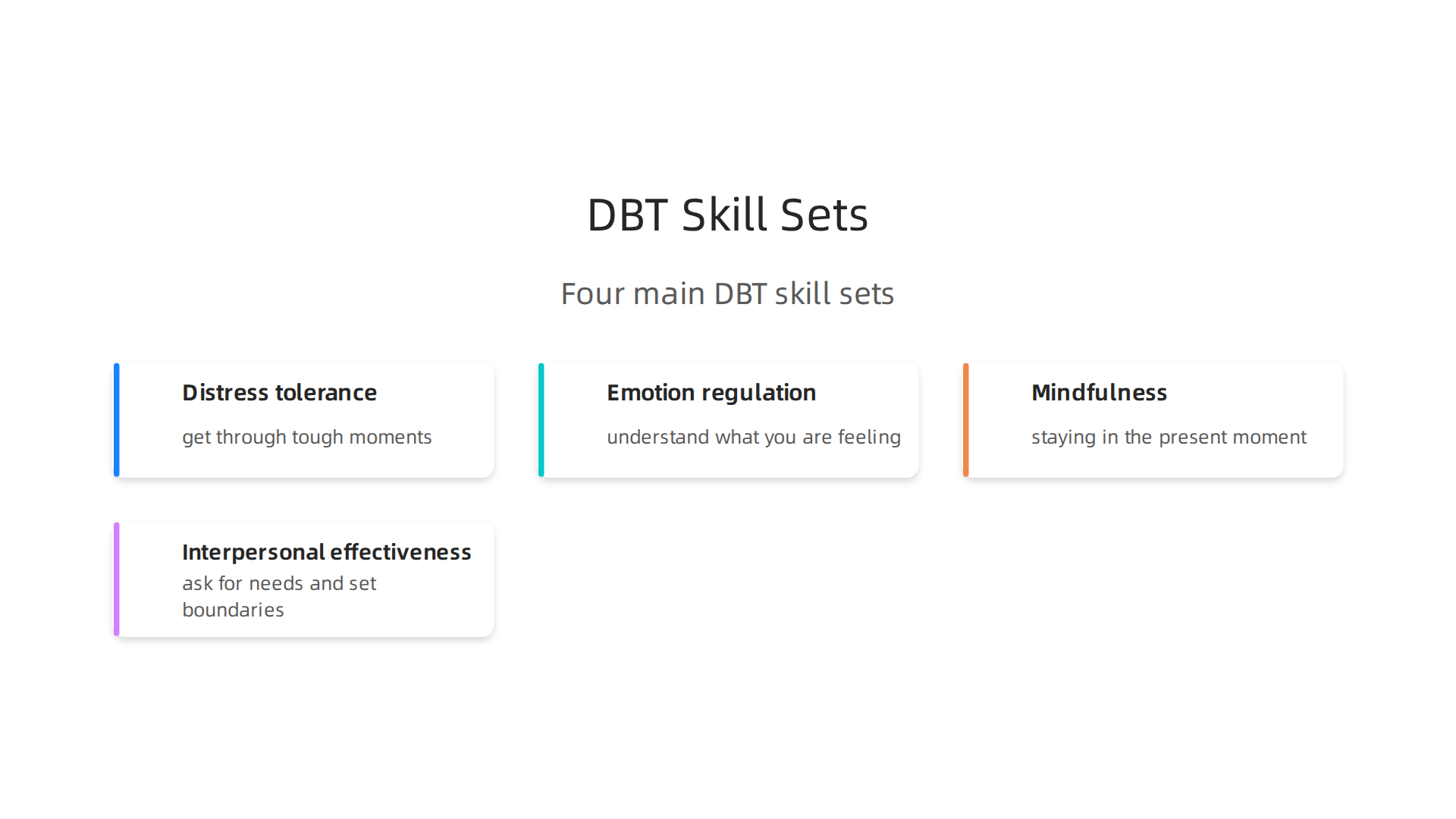
**DBT teaches four main skill sets.
** Each one helps a different part of your emotional life.
Distress tolerance. This is the ability to get through tough moments without making things worse. When anxiety spikes, distress tolerance gives you tools to survive the wave. You learn to ride it out instead of reacting with panic or anger. It helps you avoid impulsive choices you might regret later.
Emotion regulation. This module helps you understand what you are feeling and why. You learn to label emotions correctly. You find out what triggers your anxiety. Then you practice ways to reduce the intensity of those feelings. Over time, you gain more control. Your emotions stop running the show.
Mindfulness. DBT mindfulness is practical and direct. You practice staying in the present moment on purpose. This cuts down on worry about the future and rumination about the past. It helps you notice anxious thoughts without getting caught up in them.
Interpersonal effectiveness. Anxiety often messes with relationships. You might avoid hard conversations or say yes when you want to say no. Interpersonal effectiveness teaches you how to ask for what you need and set boundaries while keeping relationships strong. It reduces the relationship anxiety that feeds into overall stress.
If your anxiety comes with emotional highs and lows, DBT may be a good fit. It gives you concrete skills you can use right away. You can learn more about how DBT skills help manage emotional dysregulation and how these tools build real stability.
For a deeper look at how DBT was created and how it can calm both anxiety and emotional overwhelm, read about dialectical behavior therapy for borderline personality disorder. It explains the origins and shows how the same skills work for anxiety too.
DBT does not ask you to get rid of your emotions. It asks you to learn how to handle them. And that makes a huge difference when anxiety feels too big to manage alone.
Integrating Modalities: Building a Personalized Anxiety Toolkit
Now that you have seen how DBT skills can tame intense emotions, let’s talk about putting the pieces together. The truth is, no single approach works for everyone. That is why the most effective cognitive therapy for anxiety techniques are the ones you customize to fit your own life. Think of it like building a toolkit. You pick the right tool for the moment.
Start with CBT fundamentals. Cognitive behavioral therapy is the foundation for most anxiety treatment. It helps you spot twisted thoughts and change unhelpful behaviors. Once you have those basics down, you can layer in other tools. For example, if you get stuck in rumination, try mindfulness-based cognitive therapy (MBCT). If you struggle with accepting uncertainty, acceptance and commitment therapy (ACT) can help. And if your anxiety brings emotional highs and lows, add DBT distress tolerance skills. This way, you build a plan that fits your exact needs.
Digital tools make practice easier. You do not have to do this alone. A growing number of apps bring therapy techniques right to your phone. In fact, a study on mobile CBT app efficacy found that self-guided apps can meaningfully reduce anxiety symptoms. And in 2026, AI therapy apps in 2026 overview shows that these digital helpers can cut mild to moderate anxiety by 20 to 40 percent. Apps offer exercises, journaling, habit tracking, and even guided sessions. You can use them between therapy visits or as a stand-alone tool if professional help is not accessible.
Do not forget group support. Joining a therapy group lets you practice interpersonal skills with others who get it. It also reduces the loneliness that often comes with anxiety.

Combining individual work with group sessions can speed up progress.
When you integrate modalities, you are not picking one winner. You are building a system that adapts to your changing needs. For a deeper look at how to combine different therapeutic approaches, read about behavioral health counseling for anxiety. It shows how professionals blend methods to create a personalized plan.
Building your personal anxiety toolkit takes time. But with the right cognitive therapy for anxiety techniques and digital support, you can find what works for you. You are already doing the hardest part: taking the first step.
Summary
This article explains practical, evidence-based cognitive therapy techniques to reduce anxiety, from core CBT skills to complementary approaches like exposure therapy, MBCT, ACT, and DBT. It shows how cognitive restructuring, behavioral experiments, and thought records help you spot and change unhelpful thoughts, while graded and interoceptive exposure retrains your fear responses. The piece also covers mindfulness-based relapse prevention, acceptance and values‑based action, and DBT skills for intense emotions, and explains how to combine these methods into a personalized toolkit. You’ll learn step-by-step methods you can practice immediately, when to layer in other approaches, and how digital tools or groups can support progress. The goal is to give clear, applicable strategies so you can reduce panic and worry, improve emotional control, and take steady steps toward everyday functioning.