
Strategic Family Therapy for Anxiety That Breaks the Cycle of Family Patterns

Introduction
Have you ever noticed how your anxiety seems to flare up most when you are around certain family members?

Maybe after a phone call with your mom or during a holiday dinner. That is not just bad luck. For many people, anxiety grows inside the patterns we learn at home long before we ever realize it is happening.
Here is the thing. Most of us assume anxiety is a personal problem. Something broken inside our brain chemistry or a bad habit we picked up alone. And sure, biology plays a role. Anxiety is incredibly common. The World Health Organization estimates that about 4.4% of people worldwide experience an anxiety disorder. In the US alone, nearly 1 in 5 adults live with one. Women are about twice as likely to be affected as men. And young adults aged 18 to 24 have shown the fastest rise in anxiety rates in recent years. So you are certainly not alone in feeling this way.
But what if the root of your anxiety is not just in your head? What if it lives in the way your family talks, reacts, and interacts every day?
That is where strategic family therapy comes in. This approach does not focus on digging through your childhood memories or changing your thoughts one by one. Instead, it looks at the patterns happening right now between you and the people closest to you. Strategic family therapy is built on the idea that anxiety is often a symptom of how a family system works. When communication loops get stuck, or roles become rigid, anxiety fills the empty space.
Unlike person centered therapy or some behavioral therapies that focus only on the individual, strategic family therapy works with the entire relational web. It is direct and action oriented. A therapist might give you a specific task to try before your next session. Something small that shifts the usual pattern.
If you have been working with an attachment based therapist or trying other approaches without much relief, this relational perspective might be the missing piece. It does not replace other methods. It adds a new layer of understanding.
Ready to see your own anxiety pattern more clearly? Sometimes naming what is really happening is the first step toward real change. Name the Anxiety Pattern and discover how digital pressure makes anxiety feel louder than it really is.
Want to explore more about how your mind works? Check out our guide on cognitive therapy for anxiety techniques to see how different approaches can work together for you.
What Is Strategic Family Therapy?
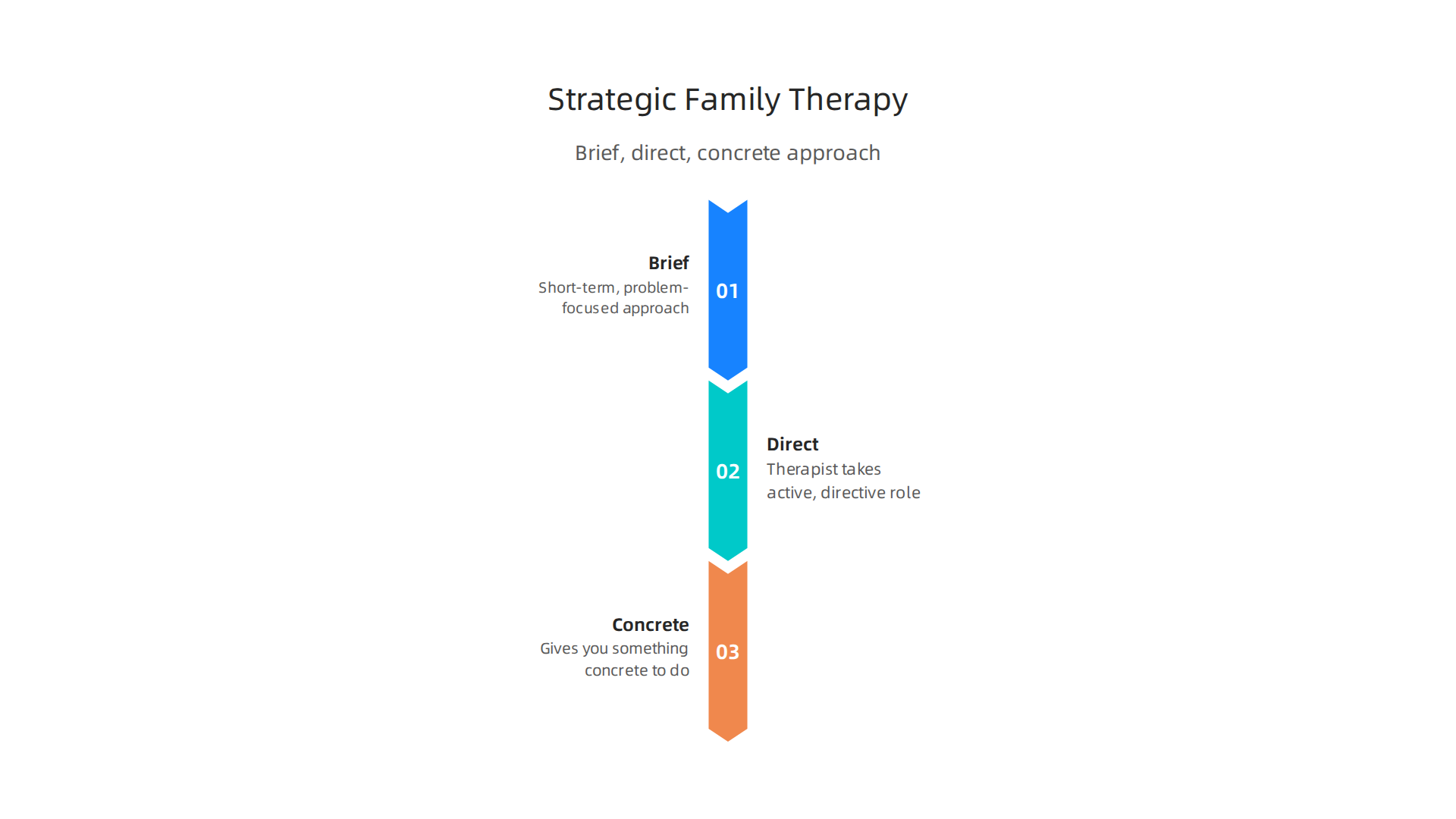
Strategic family therapy is a short-term, problem focused approach that looks at how family members interact with each other. Instead of spending months exploring the past, this method works on what is happening right now in your family.
The therapist takes an active, directive role. They do not just sit back and listen. They give you specific tasks and assignments to try between sessions. This makes it different from methods like person centered therapy, where the therapist mainly reflects back what you say without giving direct instructions.
Jay Haley and Cloe Madanes developed this approach in the 1970s. It is still widely used today because it gets results quickly. The core idea is simple. When one person struggles with anxiety, it is often because of how the whole family communicates and reacts. Strategic family therapy is designed to modify those problematic behaviors using predetermined techniques.
Research shows that this is an evidence based treatment that promotes positive behavioral changes within a family system. The therapist designs specific interventions to interrupt unhealthy patterns. For example, if a parent and teenager are stuck in a cycle of yelling and withdrawal, the therapist might ask them to try a completely new way of talking for just five minutes a day.
This approach works well alongside other treatments. If you are also working with an attachment based therapist for individual work, strategic family therapy can complement that by addressing the family dynamics that keep anxiety alive. Some therapists combine strategic techniques with other behavioral therapies to create a more complete plan. The focus stays on practical solutions rather than endless analysis.
Here is what makes this approach stand out. It is brief. It is direct. And it gives you something concrete to do.
If you have been feeling stuck in the same old arguments with family members, or if your anxiety always seems to spike after family interactions, strategic family therapy might help you see the pattern and break it. Sometimes just naming what is really happening is the first step toward real change. Name the Anxiety Pattern and discover how your family dynamics might be feeding your worry without you even realizing it.
Want to compare this with other approaches that focus on individual work? Read our guide on behavioral health counseling for anxiety to see how different therapies can work together.
The Link Between Family Dynamics and Anxiety
So how do your family patterns actually create anxiety? It is usually not about one big blowup fight. It is about the quiet rules and roles that have been running for years.
The Hidden Patterns That Feed Worry
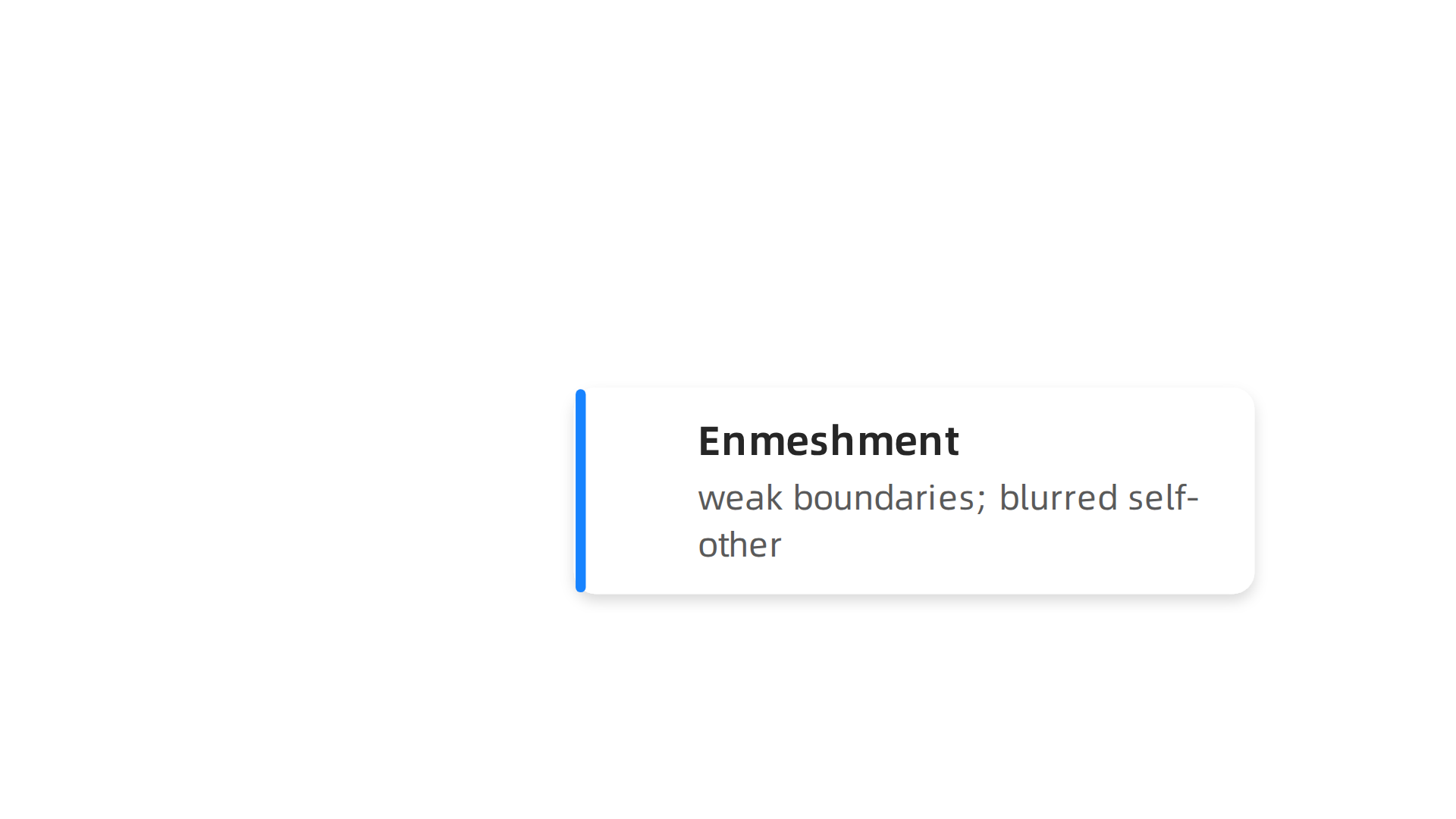
Think about enmeshment. This is when family members have very weak boundaries. You feel what your mom feels. You worry about your dad’s mood. When you cannot tell where you end and your parents begin, anxiety is a natural result.
Other families have rigid roles. Maybe you are the ‘responsible one’ or the ‘peacekeeper.’ Stepping outside your assigned role feels unsafe. You worry about rocking the boat. Unspoken conflicts also create a lot of anxiety. Everyone pretends everything is fine, but the air is thick with tension. You learn to walk on eggshells. That constant alertness is a direct path to chronic worry.

Research shows that these patterns get passed down through generations. The way your grandparents coped becomes the way your parents coped, and now it is the way you cope. These dysfunctional patterns often feel normal because they are all you have ever known.
Where It Starts: Attachment and Anxiety
These patterns often start in early childhood. Attachment theory shows that the way your caregivers responded to you shapes your brain and your relationships for life. Research suggests that insecure attachments in childhood increase the risk for adult anxiety. For example, someone with an anxious attachment style might constantly worry about being abandoned or rejected. This worry looks a lot like generalized anxiety.
An attachment based therapist can help you see how your early need for safety turned into a cycle of worry. The good news is that these attachment patterns can change. Some studies show that working with the right therapist helps shift people from insecure to secure attachment patterns, which directly lowers anxiety levels.
Why Anxiety Stays: The Family System at Work
Here is a hard truth. Your family system might unconsciously keep your anxiety going because it is familiar. If everyone is focused on helping you stay calm, nobody has to look at a different problem in the family. This is called homeostasis. The system wants to stay the same, even if the same is painful.
This is exactly where strategic family therapy comes in. It is designed to disrupt these unhealthy patterns. It gives you concrete tasks to change the dance steps your family has been doing for years. Instead of blaming anyone, it looks at the system as a whole.
The First Step Is Naming It
You cannot change a pattern until you can see it. That is the real power of understanding the link between your family dynamics and your anxiety. Once you know what is really going on, you can start to change it.
Ready to see the hidden rulebook your family follows? Name the Anxiety Pattern and discover how your family dynamics keep your worry cycle spinning. Sometimes naming the pattern is the most powerful step you can take.
Looking for more ways to understand what is driving your anxiety? Our guide on behavioral health counseling for anxiety explains how different therapies can work together to help you find real relief.
Core Principles of Strategic Family Therapy for Anxiety
So you can see the patterns now. The enmeshment. The rigid roles. The walking on eggshells. But how do you actually change the dance? That is the promise of strategic family therapy. It is not a slow, years long talk about your childhood. It is a practical, targeted approach designed to disrupt the exact family habits that keep your anxiety running strong.
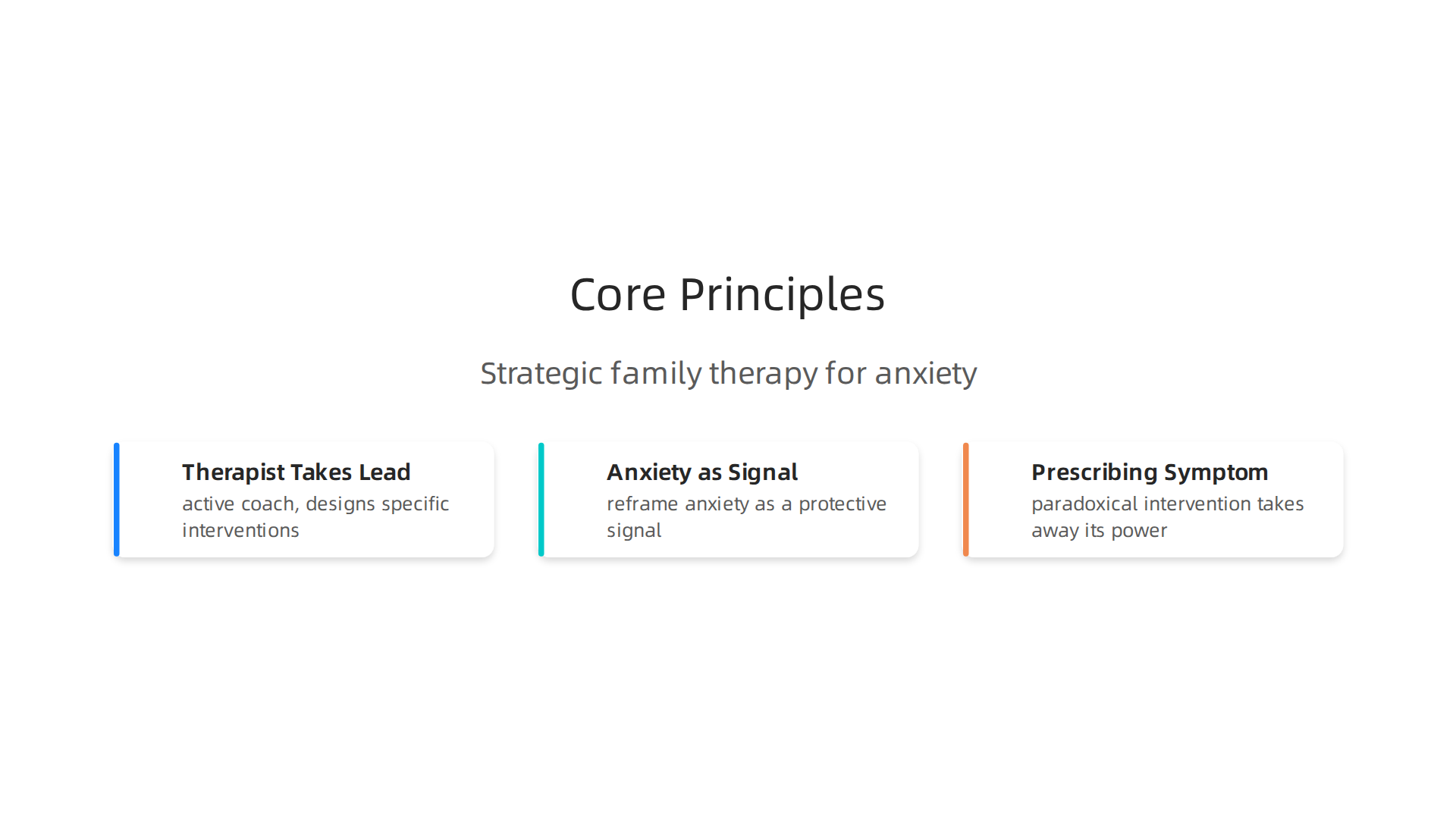
1. The Therapist Takes the Lead
In strategic family therapy, the therapist is not just a listener. They are an active coach. Research shows that the therapist takes responsibility for designing specific interventions for your unique family. They study how you all interact. Then they give you concrete tasks to do things differently. This is different from person centered therapy where the focus is mostly on your inner feelings. Here, the focus is on changing the actual dance steps your family does. Instead of just talking about the problem, you practice a new solution.
2. Anxiety as a Protective Signal
One of the most freeing shifts in this model is how it looks at your anxiety. Instead of treating it like a disease or a sign that something is wrong with you, the therapist helps you reframe it. Your anxiety is not your enemy. It is a signal that once kept you safe. In a family where emotions were unpredictable, worrying kept you alert. It was a smart survival strategy. Strategic family therapy techniques focus on changing the patterns around the symptom rather than blaming you for having it. This cuts down shame fast. And when shame fades, the need to constantly worry fades too.
You learn to say, "Oh, there is my protective signal again." That simple shift changes everything. (If you want to go deeper on changing your thought patterns, our guide on cognitive therapy for anxiety pairs well with this approach.)
3. The Power of Prescribing the Symptom
This is the principle that sounds backwards but works like magic. It is called a paradoxical intervention. For example, if you always try to stop a panic attack, the therapist might ask you to try to have one on purpose. "Go ahead, try to make yourself panic right now."
PATS Consultants describes strategic therapy as using quick, targeted solutions that change how you interact with your own symptoms. When you stop fighting the anxiety and actually try to bring it on, you take away its power. You realize the struggle was what made it strong. Letting go of the struggle breaks the cycle.
These three principles work because they target the hidden structure in your family system. They are not about blaming your parents. They are about changing the rules so you do not have to stay stuck in the role that feeds your worry.
Ready to stop playing the role that keeps you anxious? Name the Anxiety Pattern and discover how a strategic approach can rewrite the old family rules for good.
Practical Strategic Techniques that Address Anxiety
So you understand the principles. Now let me show you how they actually work in real life. Strategic family therapy is not abstract. It uses specific techniques that force your family to change how you interact. Here are three of the most powerful ones for anxiety.
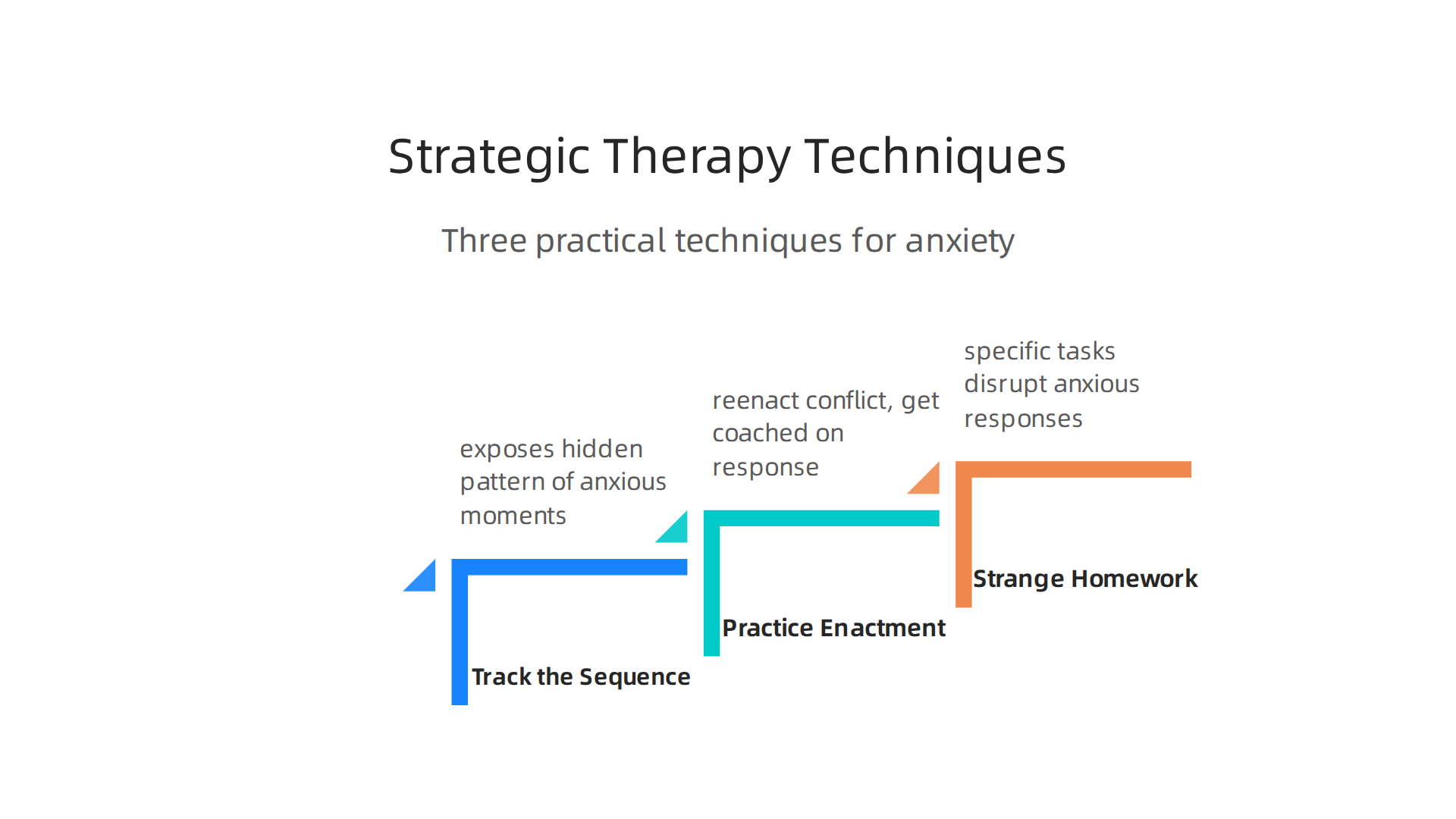
Track the Sequence
Every anxious moment has a before and an after. Your therapist will ask you to track the exact sequence. What happened right before your chest tightened? Who said what? Then what did you do? This simple tracking exposes the hidden pattern.
For example, maybe you feel a flutter of worry. Your partner notices your face change and asks, "Are you okay?" You say, "I’m fine." They keep looking at you. Your heart pounds harder. The sequence feeds the anxiety.
Research on attachment and family functioning shows that these interactive patterns often pass directly through generations. When you see the sequence in black and white, you can interrupt it. You learn to change one small step in the chain. The whole thing falls apart.
Practice an Enactment
This technique is where the real growth happens. Instead of just talking about a conflict, the therapist asks you to reenact it right there in the room. They watch how you speak to each other. Then they coach you on the spot to try a different response.

Imagine your mother asks you the same worried question for the third time. Normally you snap or shut down. The therapist stops the action. They ask you to say something new. "Mom, I know you are scared. But when you ask again, my anxiety gets worse." Saying this out loud changes the actual wiring of the interaction. It is much more direct than person centered therapy, where you might focus mostly on reflecting your own feelings in a private session.
Strange Homework Assignments
Here is where strategic therapy gets really creative. The therapist gives you specific tasks to do between sessions. These tasks are designed to disrupt the usual anxious responses.
One common assignment sounds completely backwards. "Between now and next week, try to make your anxiety worse. Spend ten minutes each day trying to worry as hard as you can."
When you try to fight anxiety, it fights back harder. But when you try to bring it on purpose, you take away its power. This technique, called prescribing the symptom, works because it targets the struggle itself. It is especially useful for families where attachment based worry patterns keep everyone stuck in the same old roles.
The Real Goal is a New Dance
These techniques all share one thing. They are active, not passive. You stop analyzing why you are anxious. You start practicing how to respond differently. Over time, the old anxious sequences lose their grip.
Ready to break the cycle that keeps your anxiety running? Name the Anxiety Pattern and discover how these practical techniques can rewrite the old family rules for good.
Real Case Example: A Family’s Journey with Strategic Therapy
Let me walk you through a real scenario so you can see how strategic family therapy works in practice. Research on structural-strategic family therapy with adolescents shows it can be highly effective for anxiety related issues.
Meet Sarah, a 14 year old girl who started having panic attacks. Every morning before school her heart would race. She would feel dizzy and sometimes cry. Her mother, Lisa, would rush to her side every time. She would let Sarah stay home. She would call the school. She would check on her every hour.
Here is what the therapist noticed. Lisa was terrified of Sarah becoming independent. She believed her daughter could not handle the world on her own. So every time Sarah panicked, Lisa showed up. The message was clear. "You need me to be okay."
This is a classic pattern in families dealing with anxiety. The mother’s unspoken fear actually kept the panic alive. Sarah learned that panic brought her mother close. And her mother learned that rescuing Sarah made her feel needed.
The therapist gave them a strange homework assignment for one week. "Help Sarah panic on purpose. Each morning, sit with her for 15 minutes and encourage her to feel as much fear as possible. Tell her it is good to panic."
At first this felt wrong to Lisa. But she tried it. On day two, Sarah said, "I do not want to panic today." On day four, Sarah went to school without any problem. When you take away the fight against anxiety, the panic has nothing to push against.
This is the power of behavioral therapies that work with how families actually interact. The pattern breaks. The symptoms fade.
You can use this same approach in your own family. Name the Anxiety Pattern to start seeing where the old rules are keeping everyone stuck.
What the Research Says: Effectiveness of Family Therapy for Anxiety Disorders
Sarah’s story is not just a lucky break. There is real science backing up why strategic family therapy works so well for anxiety.
Researchers have run big studies that compare family therapy to other treatments. The results are clear. Meta-analyses show that family therapy works at least as well as individual cognitive behavioral therapy for childhood anxiety. Sometimes it works even better. One study tested structural-strategic family therapy with adolescents and found it significantly reduced anxiety symptoms. That is not a small win. That is proof that changing how the whole family interacts can change how one person feels.
Here is the part that surprises most parents. Strategic family therapy has especially strong evidence for adolescent anxiety and OCD. Teens are not always great at talking about their feelings in a one on one session. But they respond well when the family pattern shifts. The therapist does not need to pull every secret out of the teen. The therapist just needs to change the dance. When parents stop overfunctioning, kids stop underfunctioning.
And here is the best part. Family involvement reduces relapse rates. Kids who go through individual therapy often get better and then slip back when stress hits. But when the whole family learns new patterns, those changes stick. The family environment itself becomes a protective factor. The Mental Health Foundation reports that anxiety rates have climbed significantly in recent years. That means more families need approaches that deliver lasting results, not just quick fixes.
Think about it this way. If you change the soil, the plant grows differently. You are not just treating the symptom. You are changing the environment that created it.
This is why person centered therapy and other individual approaches are helpful but sometimes not enough on their own. When anxiety is tangled up in how family members talk, react, and protect each other, you need a method that addresses all of that. Strategic family therapy does exactly that.
Ready to start applying this approach in your own home? Name the Anxiety Pattern and begin spotting the hidden rules that keep anxiety alive in your family.
How to Access Strategic Family Therapy: A Practical Guide
So the science is clear. Strategic family therapy works. Now the real question is how do you actually find a therapist who does it well? The good news is that access is easier than most people think.

Start with the right credentials. You want to look for a Licensed Marriage and Family Therapist (LMFT) or a psychologist with a PhD who specializes in family systems work. When you call, ask directly about their orientation. Do they use strategic family therapy? Do they focus on practical, short term solutions? A good therapist will gladly explain their approach. The Counselling Directory notes that strategic family therapy is focused on fast, practical solutions for specific issues. That is exactly what you want.
Use directories to narrow your search. There are several reliable places to look. Psychology Today lets you filter by specialty, insurance, and location. The BACP Therapist Directory has over 18,000 qualified therapists. And the UKCP Find a Therapist page connects you with registered family and systemic psychotherapists. If you need help navigating these options, our guide on how to use your Psychology Today login to find a therapist fast walks you through the process step by step.
Do not overlook telehealth. Many therapists now offer online sessions, which makes strategic family therapy more accessible and often more affordable. You can find therapists through directories like TherapyRoute or the International Therapist Directory, which covers over 60 countries and includes online options.
Understand the cost. Session fees typically range from $75 to $250 per session. Some insurance plans cover family therapy, so check your benefits. If cost is a barrier, ask about sliding scale fees.
The biggest hurdle is usually just starting. But once you find the right therapist, the changes can happen faster than you expect. Ready to take that first step? Name the Anxiety Pattern in your own home and begin spotting the hidden rules that keep anxiety alive in your family.
Summary
This article explains how strategic family therapy treats anxiety by changing the interaction patterns inside a family rather than focusing only on the individual. It defines the method, its history, and how therapists use direct, short-term, action-focused interventions—like tracking sequences, enactments, and paradoxical homework—to disrupt cycles that keep worry alive. The piece describes how attachment styles and family roles (enmeshment, rigid roles, homeostasis) contribute to chronic anxiety, shares a concrete case example with a teen and her parent, and reviews research showing strong outcomes, especially for adolescents. It also offers practical guidance for finding the right clinician, using directories or telehealth, and understanding typical costs. Readers will learn how this approach reframes anxiety as a signal, what concrete exercises to expect, and when to combine family work with individual therapies for lasting change.