ICD 10 Code for Anxiety How It Affects Your Diagnosis Treatment and Insurance

Introduction
Anxiety disorders touch more lives than most people realize.

In fact, anxiety is the most common mental health condition worldwide, affecting an estimated 359 million people as of 2021. In the United States alone, about 1 in 5 adults experience an anxiety disorder each year, according to the National Institute of Mental Health. Yet even with numbers this high, there is still a lot of confusion around one very practical piece of the puzzle: the clinical code used to record and bill for anxiety.
If you have ever looked at a medical form or an insurance document and seen a string of letters and numbers like F41.1, you have run into the ICD-10 code for anxiety. That code is far more than a billing number. It shapes how doctors diagnose your condition, which treatments your insurance will cover, and how researchers track anxiety trends over time. Using the right code matters for everyone involved.
Here is the thing: anxiety is not a single condition. It comes in different forms, from generalized worry to panic attacks to social fears. Each type has its own specific code. And getting those codes wrong can lead to claim denials, delayed care, or incomplete health records. That is why understanding the ICD-10 system is so important.
This guide gives you a complete, plain-language overview of the official ICD-10-CM codes for anxiety. You will learn what each code means, how to use it correctly, and why it matters for your care. Whether you are a healthcare provider, a patient trying to understand your diagnosis, or someone simply curious, this article will clear up the confusion.
Before we dive into the codes themselves, it helps to know a few basics about anxiety. Understanding the condition first makes the coding system much easier to follow. If you are looking for quick ways to manage daily anxiety symptoms, you might also find these science-backed techniques to reduce anxiety immediately helpful. But for now, let us start with the codes.
Understanding ICD-10 and Its Role in Anxiety Diagnosis
The ICD-10 code for anxiety is not just a random string of numbers. ICD-10 stands for the International Classification of Diseases, 10th Revision. The World Health Organization created it as the global standard for diagnosing and tracking health conditions.
In the United States, doctors and insurers use a slightly modified version called ICD-10-CM (Clinical Modification). This system turns a diagnosis into a precise code so everyone from your therapist to your insurance company speaks the same language.
Anxiety disorders live in a specific part of the ICD-10 system. They fall under the code range F40 through F48, which sits inside Chapter V (Mental and Behavioral Disorders).
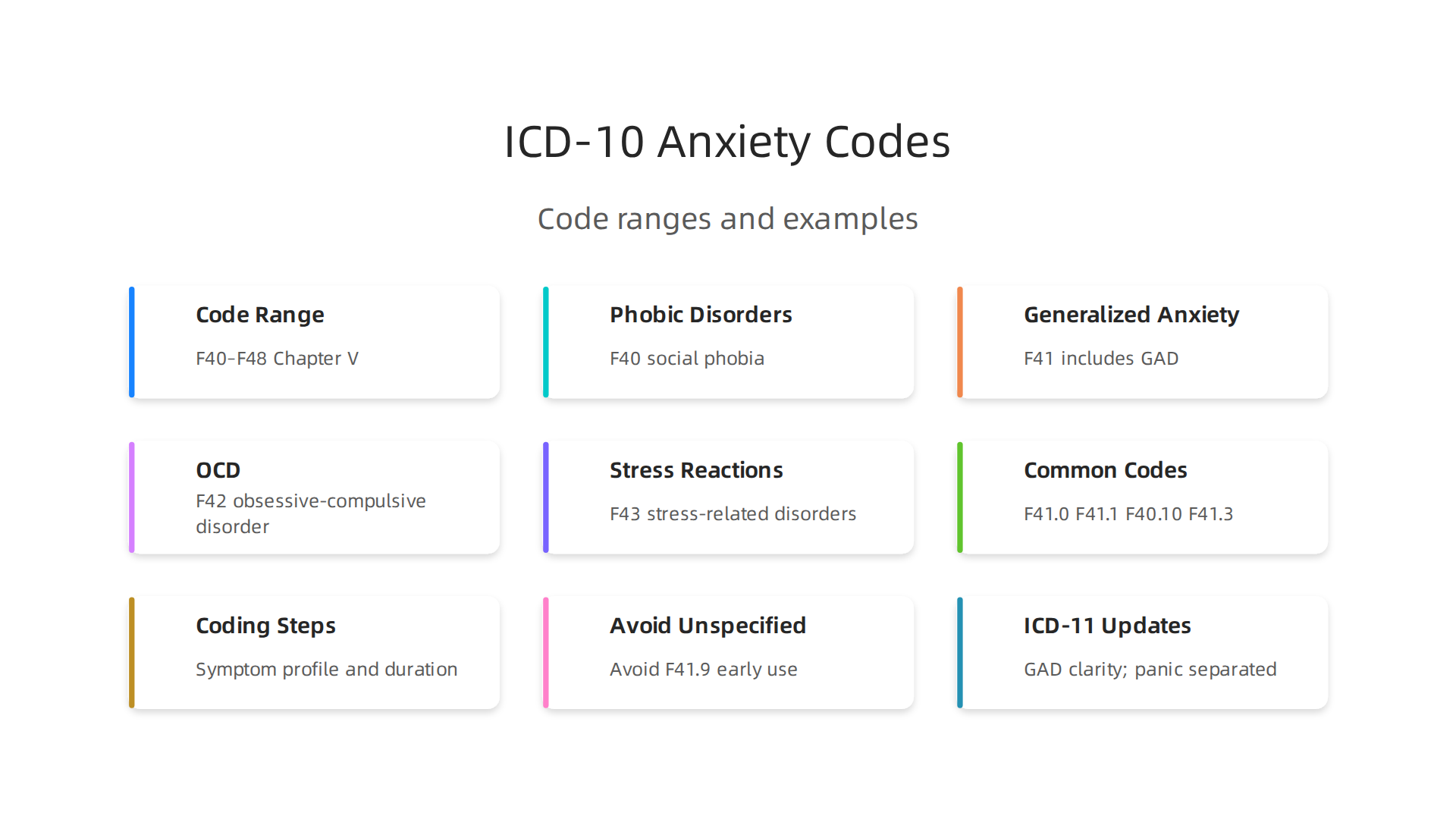
This block covers what the manual calls "Neurotic, stress-related and somatoform disorders." Within that range, the codes break down further. For example, F40 covers phobic anxiety disorders like social phobia. F41 covers other anxiety disorders such as generalized anxiety disorder (F41.1) and panic disorder (F41.0). F42 handles obsessive-compulsive disorder. F43 covers reactions to severe stress, including adjustment disorder. Understanding the ICD-10 anxiety codes range helps you see how each specific condition gets its own slot.
Accuracy matters here more than you might think. Using the correct ICD-10 code for a specific anxiety type does three important things. First, it ensures clear communication between your doctor and any other provider who sees your records. Second, it feeds into public health data so researchers can track how common each disorder is. Third, and maybe most practically, it determines whether your insurance will cover your treatment. A mismatched code can lead to a denied claim. For instance, if you show symptoms that match a generalized anxiety test and your doctor diagnoses you with GAD, the proper code is F41.1. Using the unspecified code F41.9 might not get your therapy sessions approved.
The ICD-10 system also connects closely with the DSM-5, the manual clinicians use to diagnose mental disorders. So when you hear about the social anxiety dsm 5 criteria, that same condition maps to code F40.10 in ICD-10. The codes are meant to align with the diagnostic criteria. This alignment makes a mental health check more consistent across different clinics and even different countries.
If you are trying to figure out which professional can best help you with your specific anxiety diagnosis, understanding these codes can guide your next step. A clear diagnosis with the right code makes it easier to choose between a psychiatrist, psychologist, therapist, or counselor for anxiety. That choice depends partly on what the code says about your condition. Now let us walk through the most common ICD-10 codes for anxiety so you know exactly what each one means.
The Primary ICD-10 Code for Anxiety: F41.9 and Related Codes
You might think F41.9 is the main code for anxiety. It is actually the code for "Anxiety disorder, unspecified." And it gets used a lot. But healthcare providers should only use it when symptoms do not clearly match a more specific condition. Think of it as a temporary placeholder while your doctor gathers more information.
The real goal is to find the code that fits your exact experience. That is where the specific codes come in. Each one matches a distinct set of symptoms. Here are the most common ones you will encounter:
| ICD-10 Code | Diagnosis | What It Means |
|---|---|---|
| F41.0 | Panic disorder | Recurrent, unexpected panic attacks with worry about future attacks |
| F41.1 | Generalized anxiety disorder | Excessive worry about multiple life areas lasting at least six months |
| F40.10 | Social phobia, unspecified | Marked anxiety in social situations with avoidance behavior |
| F41.3 | Mixed anxiety and depressive disorder | Symptoms of both anxiety and depression, neither severe enough alone |
Generalized anxiety disorder (F41.1) is one of the most frequently used codes in behavioral health practice. Your doctor will confirm it using a generalized anxiety test and by checking that symptoms have lasted at least six months. The test looks for restlessness, fatigue, trouble concentrating, irritability, muscle tension, and sleep problems.
Social phobia (F40.10) maps directly to the social anxiety dsm 5 criteria. The DSM-5 describes it as a persistent fear of social situations where you might be judged. The ICD-10 code matches that definition. So if you meet the DSM-5 criteria for social anxiety, the correct code is F40.10.
The code F41.3 for mixed anxiety and depressive disorder connects to a concept called the diathesis stress model. This model explains how some people have a genetic vulnerability (diathesis) that gets triggered by life stress. When both anxiety and low mood appear together but neither is strong enough to diagnose separately, this code applies.
Getting the right code starts with an honest mental health check. A thorough evaluation helps your clinician match your symptoms to the correct diagnosis. From there, you can work with your provider to find the best path forward, including learning proven ways to manage your symptoms. Finding the right diagnosis opens the door to the right support.
How Clinicians Choose the Right ICD-10 Code for Anxiety
When you walk into a doctor’s office feeling overwhelmed, it might seem like anxiety is just one big thing.

But clinicians are trained to find the pattern in your symptoms. They do not guess at your icd 10 code for anxiety. They follow a thoughtful process.
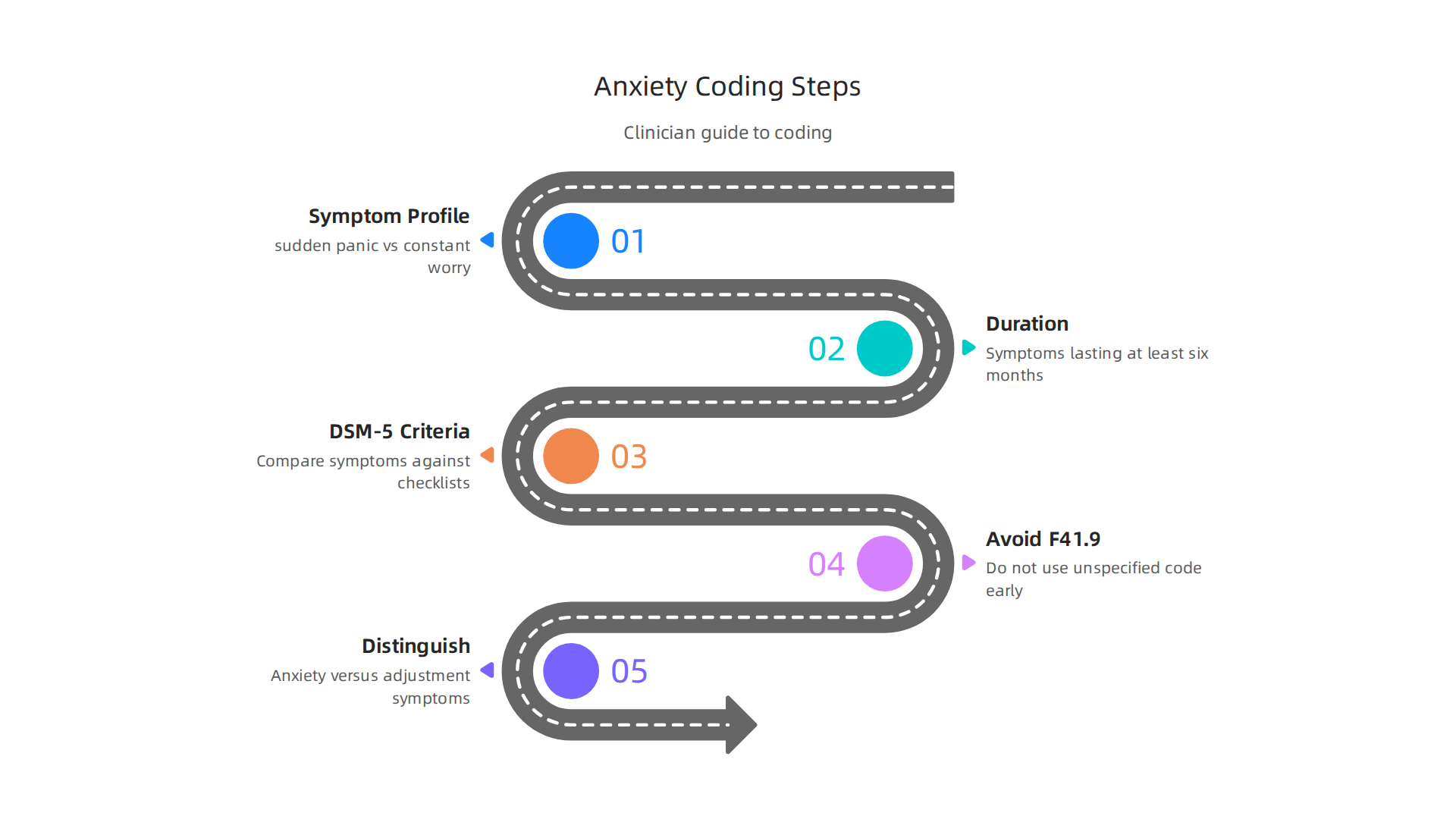
The first clue is your symptom profile. Do you get sudden panic attacks that strike without warning? Or do you feel a constant knot of worry about everyday things? The pattern matters a lot. The next clue is duration. For generalized anxiety disorder (F41.1), your worry must last at least six months. For panic disorder (F41.0), the key is repeated panic attacks plus fear of the next one.
Clinicians compare your symptoms against the DSM-5 criteria. These are the official checklists that define each condition. For example, social anxiety disorder (F40.10) requires a strong fear of being judged in social settings. Your doctor matches what you describe to these criteria to find the best fit. According to the Anxiety Disorders facts and statistics from the ADAA, about 6.8 million U.S. adults have generalized anxiety disorder, which helps explain why F41.1 is used so often.
Here is where things go wrong for some clinicians. A big mistake is using F41.9 too early. That is the unspecified code. It works as a temporary placeholder while gathering more information. But leaving it as the final code means missing a chance to match the right treatment to your specific condition.
Another common pitfall is mixing up anxiety codes with adjustment disorder codes. Adjustment disorders happen when a specific life change (like a divorce or job loss) triggers symptoms that fade once you adapt. Anxiety disorders are more lasting and not tied to one event. The symptoms also tend to be more intense.
Getting the right code matters because it guides your treatment. If your doctor labels it as panic disorder, you get strategies for panic attacks. If it is generalized anxiety, the focus shifts to daily worry management. A careful diagnosis sets you on the right path. Once you have that clarity, you can explore your options, including how to choose between a psychiatrist psychologist therapist or counselor for anxiety to build a support team that fits your needs.
The Difference Between ICD-10 Anxiety Codes and DSM-5 Diagnoses
Here is something that trips up a lot of people. You hear your therapist mention a diagnosis from the DSM-5. Then your insurance paperwork shows an ICD-10 code. They sound similar, but they are not the same thing.
Think of it this way. The DSM-5 is the clinical playbook. It tells your clinician exactly what symptoms you need to have for each condition. It is created by the American Psychiatric Association for diagnosis and treatment planning. The ICD-10 is the billing system. It is maintained by the World Health Organization and used by insurance companies to process claims. As the guide comparing DSM-5 vs ICD-10-CM explains, "DSM is for diagnosis, and ICD is for billing."
Most of the time, anxiety diagnoses from the DSM-5 map cleanly to an ICD-10 code. For example, DSM-5 generalized anxiety disorder maps to F41.1. Panic disorder maps to F41.0. But there are tricky spots. Social anxiety disorder in the DSM-5 uses code F40.10. The ICD-10-CM lists that as "Social Phobia, Unspecified." The more specific code F40.11 for generalized social phobia might actually fit better for some people. The APA Services points out these code discrepancies in DSM-5 that clinicians should watch for.
Childhood anxiety codes can also differ. The DC:0-5 to DSM-5 and ICD-10 crosswalk from Zero to Three shows that separation anxiety disorder in early childhood uses F93.0 in ICD-10, while the adult version uses a different code. Getting this right matters for accurate documentation and smooth insurance approval.
Why should you care about this? Because the ICD-10 code your provider submits must be backed by clear, defensible notes that match the DSM-5 criteria. If the code does not match your actual symptoms, your claim might get denied. That means more paperwork and delays for both you and your clinician.
Once you understand your diagnosis and the code behind it, you can take real steps toward feeling better. If you want hands-on strategies to calm your mind, check out these science-backed techniques to reduce anxiety immediately.
Why Accurate Anxiety Coding Matters for Treatment and Insurance
You might think a code is just a number on a piece of paper. But that small code can decide whether you get the help you need or get stuck in paperwork limbo.
**Accurate codes unlock your insurance coverage.

** When your therapist uses the right icd 10 code for anxiety, your insurance company knows exactly what they are paying for. They see that your symptoms match a recognized condition like generalized anxiety disorder (F41.1) or panic disorder (F41.0). Without a correct code, your claim can get rejected. In fact, in 2026, insurance companies are rejecting 15 to 25 percent of behavioral health claims. Most of those denials happen because the code does not tell the full story. The 2026 mental health ICD-10 codes guide explains that missing details like severity level or comorbidity are common reasons for rejection.
A bad code can delay your care. Let’s say your doctor uses an unspecified code like F41.9 for "anxiety disorder, unspecified." Insurance companies often downcode or deny these vague codes. They want to know what type of anxiety they are paying for. If your code is too broad, you might have to wait while your provider appeals the denial. That means more time feeling anxious and less time getting real help.
The right code also helps researchers and public health experts. When thousands of providers use specific codes for anxiety, researchers can track how common different anxiety disorders are, what treatments work best, and where resources are needed most. Your accurate code contributes to better mental health care for everyone.
What can you do? Ask your therapist or doctor what ICD-10 code they are using for your anxiety. Make sure it matches your actual symptoms. If you are struggling with anxiety and want practical ways to feel better, there are proven coping skills that can help. For example, behavioral health counseling for anxiety can teach you techniques to calm your mind and manage daily stress.
Understanding your code is the first step. Taking action to treat your anxiety is the next. Some innovative approaches have even been recognized for their ability to offset anxiety symptoms. You can read about one such method in Authority Magazine, which highlights results that helped people reduce anxiety, depression, and other mental health challenges.
Common Misconceptions About ICD-10 Anxiety Codes
There is a lot of confusion about how anxiety codes work. Let us clear up three big myths.
Myth 1: F41.9 is the only anxiety code.
Many people think there is just one code for all anxiety. That is not true. The ICD-10 has many specific codes. For example, F41.1 is for generalized anxiety disorder (GAD). F40.10 is for social anxiety disorder. F41.0 is for panic disorder. Each code describes a different type of anxiety. Using the right ICD-10 code for anxiety helps your provider give you the best care. The ICD-10 anxiety code guide from Behave Health shows the full list and how they match DSM-5 diagnoses.
Myth 2: Only psychiatrists use anxiety codes.
Actually, primary care doctors use them all the time. Many people first talk to their family doctor about feeling anxious. Your primary care physician can diagnose and treat anxiety. They need the same codes to bill insurance. The DSM-5 vs ICD-10-CM guide for therapists explains that ICD-10 codes are used across all medical specialties, not just mental health. So your regular doctor might be the one to assign your code.
Myth 3: The code alone decides if insurance pays.
Many people believe that if you have the right code, your claim will be approved. That is only half the story. Insurance companies also look at medical necessity documentation. Your provider must show why you need treatment and how your symptoms match the diagnosis. Without strong documentation, even a perfect code can lead to a denial. The American Psychological Association has pointed out code discrepancies in the DSM-5 that can cause problems if not supported by proper notes. A thorough mental health check during your visit can help your doctor choose the right code and write good notes.
If you want to learn more about managing your anxiety, you can explore practical techniques like science-backed ways to reduce anxiety instantly. Knowing your code is just one piece. Taking action to feel better is what really matters.
The Future of Anxiety Diagnosis: ICD-11 and Beyond
As you focus on feeling better, it also helps to know where mental health diagnosis is heading.

The ICD-10 codes you just learned about are still the standard in 2026. But the World Health Organization has already released the next version, called ICD-11. It was adopted by the World Health Assembly and is being rolled out globally. The United States will switch to it in the coming years.
ICD-11 brings big changes to how anxiety disorders are classified. All anxiety disorders now live under a new chapter called "Anxiety or Fear-Related Disorders." This is a major shift from ICD-10. You can read about these innovations and changes in the ICD-11 classification from the official research.
Here are some key updates:
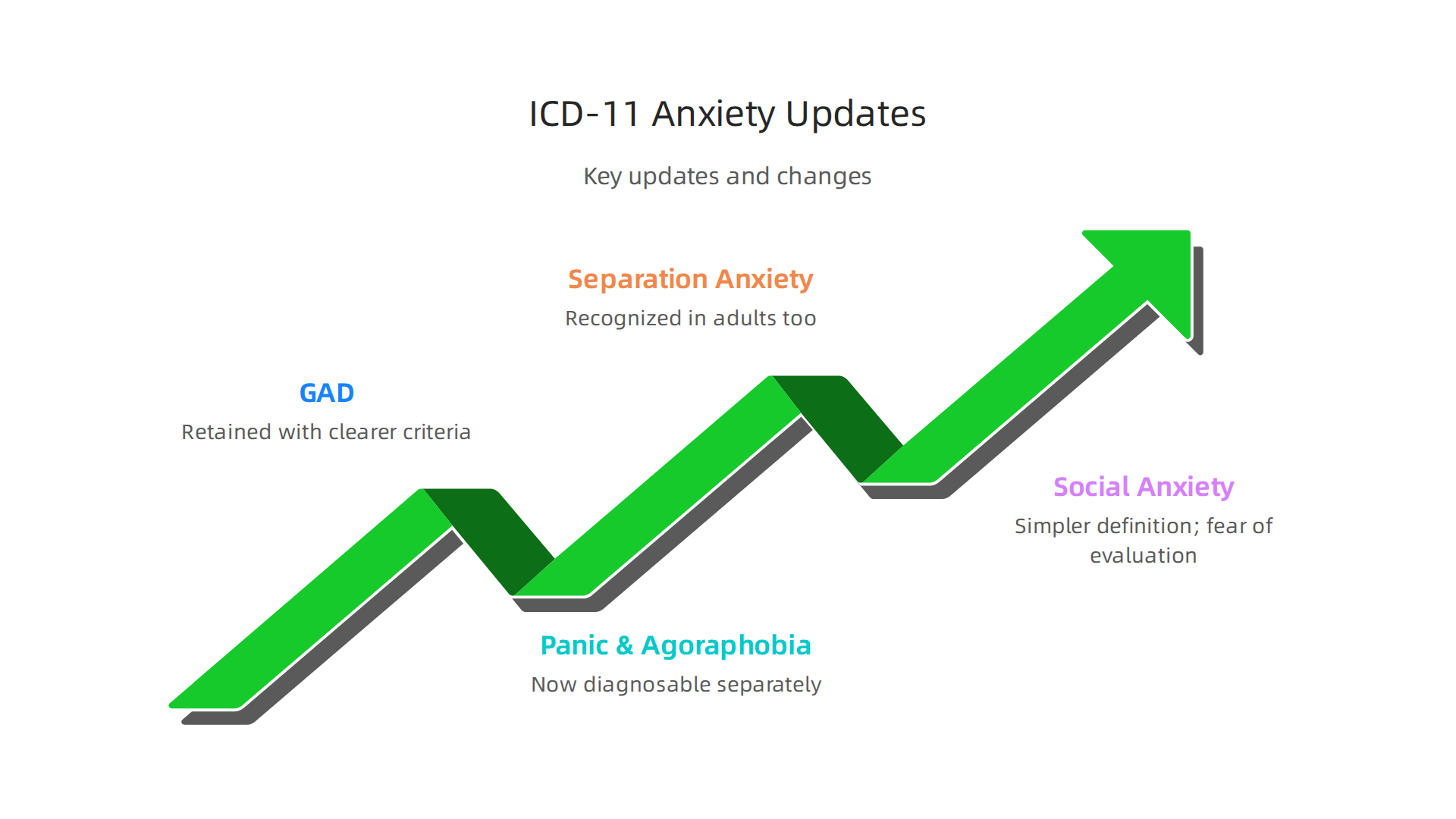
- Generalized Anxiety Disorder (GAD) stays but with clearer criteria. Worry is now listed as a core feature along with general apprehension.
- Panic Disorder and Agoraphobia can now be diagnosed separately. In ICD-10 they were often linked together. Now each stands on its own.
- Separation Anxiety Disorder is no longer just for kids. Adults can be diagnosed too.
- Social Anxiety Disorder has a simpler definition based on fear of negative evaluation.
These changes make ICD-11 line up more closely with the DSM-5. They also help doctors be more precise. A clinician’s guide to accurate anxiety diagnosis and documentation explains how new codes like 6B00 for GAD and 6B04 for social anxiety will replace the old F-codes.
What does this mean for you? When ICD-11 arrives, your doctor will need updated training. Insurance companies will update their policies too. You might see different codes on your paperwork. But the goal is better care that matches your specific symptoms.
If you need to find the right professional to help with your anxiety, you can start by how to choose a psychiatrist or another provider. Knowing what is coming with ICD-11 can help you ask better questions during your visit. A simple mental health check with your doctor can make sure you get the right diagnosis and treatment now and in the future.
Resources and Tools for Accurate Anxiety Coding
Getting the right ICD 10 code for anxiety is not just about picking a number. It requires the right tools and ongoing training. Whether you are a new therapist or an experienced practitioner, these resources can help you code with confidence and avoid claim denials.
Official Coding Books and Online Tools
The most reliable source for anxiety codes is the official ICD-10-CM manual published by the American Medical Association. It contains the full tabular list and alphabetic index. You can also use online tools from the World Health Organization. For a quick reference on the most common codes, check out this guide that covers the anxiety disorder ICD-10 code range from F41.0 to F41.9. It explains how to find codes for GAD, panic disorder, and social phobia.
Many electronic health record (EHR) systems now include built-in code lookup and clinical decision support. These tools suggest the most specific code based on your documentation. They can flag common errors like using an unspecified code when a specific one is available.
Professional Organizations and Certifications
Organizations like the AAPC (American Academy of Professional Coders) and AHIMA (American Health Information Management Association) offer certifications in medical coding.
They also provide continuing education courses focused on mental health coding. Taking a course on behavioral health coding can help you master the nuances of the F41 codes and reduce rejection rates.
Screening and Assessment Tools
Accurate coding starts with a thorough assessment. Using a validated generalized anxiety test like the GAD-7 can help you document symptom severity and support the diagnosis. You can find some free anxiety screening tools online, such as the ones offered by Mental Health America. Early and precise assessment leads to better coding and better care.
Remember, a simple mental health check during your patient visit can uncover details that make your documentation stronger and more specific. When you pair strong assessment with the right coding resources, you set up both your practice and your patients for success.
Summary
This article explains the ICD‑10 coding system for anxiety in plain language, showing why accurate codes matter for diagnosis, insurance coverage, research, and treatment. It walks through the relevant code range (F40–F48), defines commonly used anxiety codes like F41.1 (generalized anxiety disorder), F41.0 (panic disorder), F40.10 (social phobia), and F41.9 (anxiety unspecified), and describes how clinicians match symptoms and DSM‑5 criteria to the right code. The guide covers common clinician pitfalls—such as overusing unspecified codes—the practical consequences of wrong coding for claims and care, and tools clinicians can use (screening tests, EHR lookups, coding manuals). It also previews how ICD‑11 will reorganize anxiety diagnoses and lists resources to improve documentation and reduce denials, so clinicians and patients can ensure accurate records and timely treatment.