Find the Right Psychological Test for Anxiety Disorder and Take Control

Introduction
You wake up with a tight chest. Your mind races through the day’s worries.

You wonder, "Is this normal? Or is it something more?" If this sounds familiar, you are not alone. Millions of people experience anxiety every day. Yet many never get a formal diagnosis. They just keep pushing through.
That is where a psychological test for anxiety disorder can make a real difference. These tools help you understand what is happening inside your body and mind. They offer a clear starting point when everything feels confusing.
But here is the problem. A quick online search shows hundreds of self anxiety tests. Some are backed by real science. Others are just fluff. How do you tell the difference? This guide will help you separate the reliable tools from the ones that waste your time.
Using a proper test can also help you match your symptoms to the right anxiety icd 10 code. That code is what doctors use to diagnose and treat anxiety. Knowing it can make your next doctor visit much smoother.
And if you have ever asked yourself "what does anxiety feel like?" a validated test can give you words for that feeling. It turns a vague sense of unease into something you can name and tackle.
The goal is not to self-diagnose. The goal is to learn more about yourself so you can take informed next steps. This article walks you through the best psychological tests, how to use them, and what to do with your results. You will also find links to free anxiety screening tools that you can use right now.
Let’s begin.
Understanding Anxiety: When and Why to Self-Assess
Anxiety is more common than most people realize. According to the Anxiety disorders – World Health Organization (WHO), anxiety disorders are the most common mental health condition worldwide.

In 2021, about 359 million people lived with an anxiety disorder. Yet only about 1 in 4 people with anxiety get treatment.
Why do so many go without help? Stigma plays a big role. Some people feel embarrassed or think anxiety is a personal weakness. Others simply do not know that what they are feeling is treatable. And for many, seeing a doctor or therapist feels too expensive or too hard.
That is where a self anxiety test can help. These tools are free or low cost. You can take them at home in private. They give you a starting point. A good psychological test for anxiety disorder can show you whether your symptoms are mild, moderate, or severe. It helps you understand what does anxiety feel like in a way that is backed by science.
But when should you use one? If you have been feeling worried most days for weeks or months, that is a good time to check. If your anxiety is starting to affect your sleep, work, or relationships, self-assessment can give you clarity.
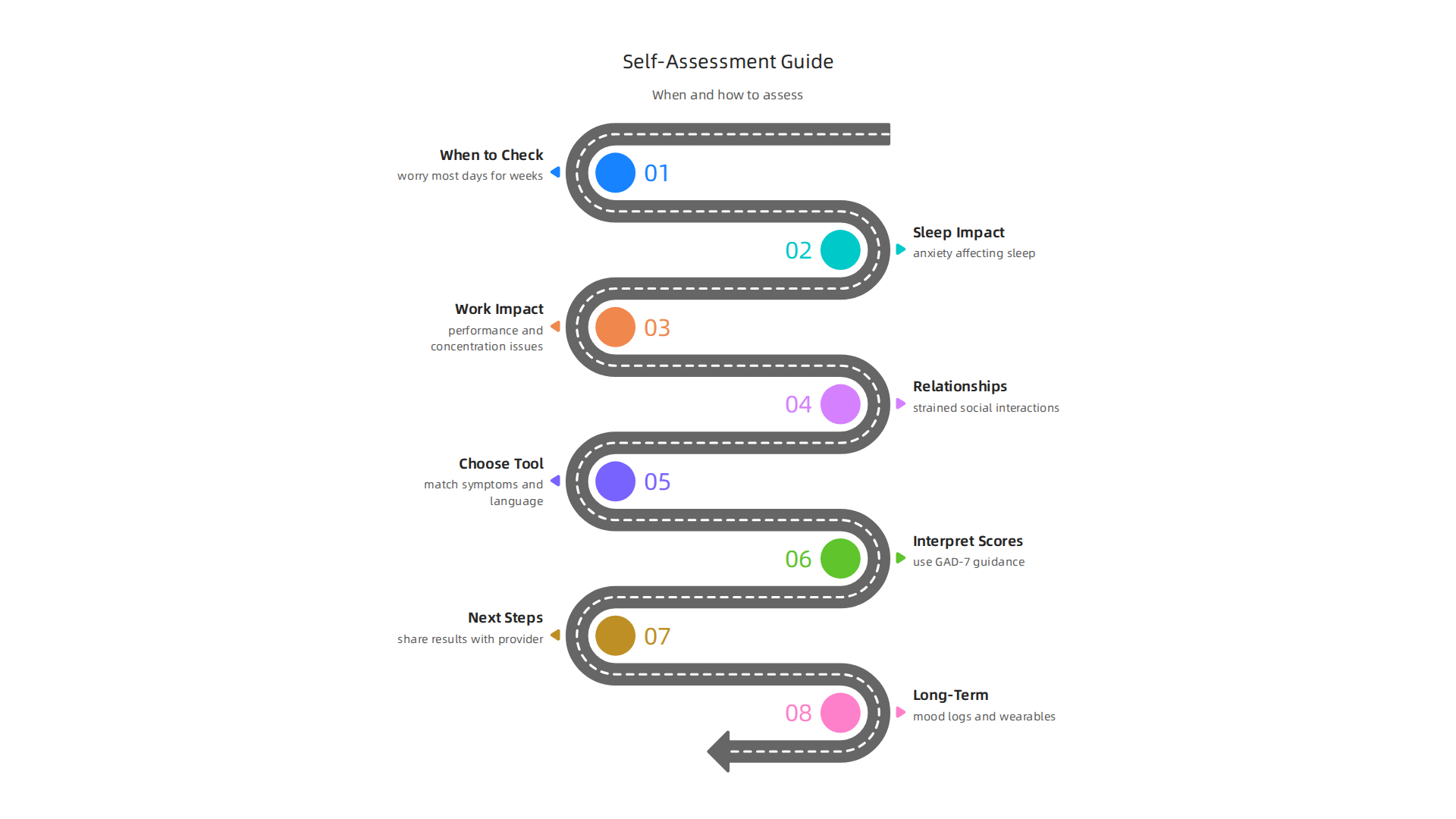
It can also help you prepare for a talk with your doctor. Knowing your score and the right anxiety icd 10 code can make that conversation easier.
Still, self-assessment tools have limits. They are not a diagnosis. They are a screening tool. A high score does not mean you have a disorder. It just means you should talk to a professional. Using these tools the right way means understanding what they can and cannot do.
If your results show that you are struggling, there are proven ways to find relief. You can start with these science-backed techniques for anxiety. The key is to take that first step.
Top Validated Psychological Tests for Anxiety Disorder
Now that you know when to use a self-assessment, let’s look at the actual tools doctors and researchers trust. There are many anxiety tests out there. But four stand out as the most studied and widely used. Each one measures your symptoms a little differently.
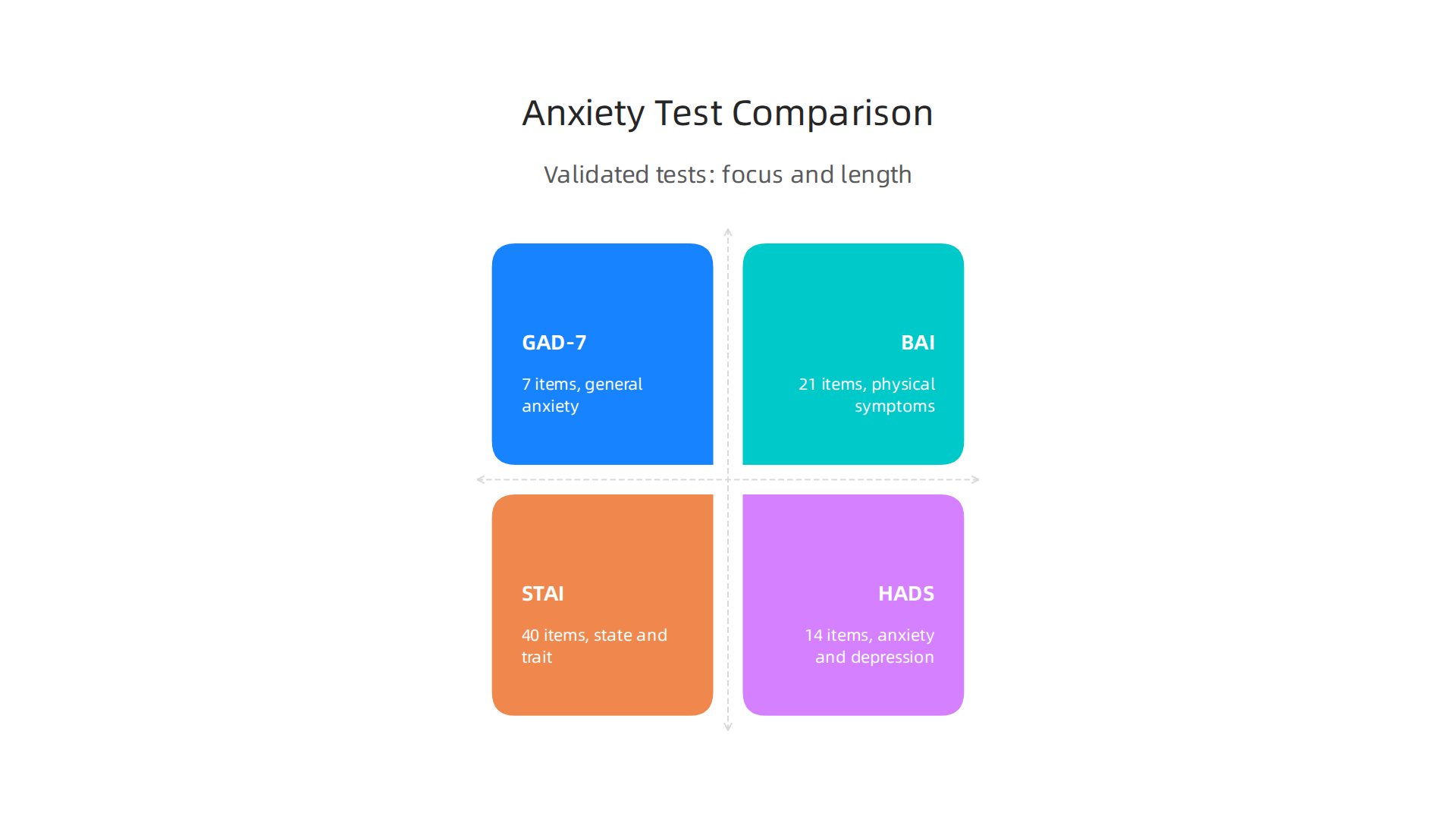
The GAD-7 (Generalized Anxiety Disorder 7-item scale) is the most popular screening test for anxiety. It has only 7 questions and takes about 2 minutes to finish. It asks how often you have been bothered by things like feeling nervous, not being able to stop worrying, or trouble relaxing. A large study confirmed its validation and standardization of the GAD-7 in the general population.
Scores go from 0 to 21. A score of 10 or higher points to possible generalized anxiety disorder. About 5 out of every 100 people in the general population score 10 or above.
The Beck Anxiety Inventory (BAI) is different. It has 21 items and takes about 5 to 10 minutes. It focuses on physical symptoms like sweating, trembling, dizziness, and a racing heart. That makes it a great choice if your anxiety shows up mostly in your body. It is especially helpful for people who have panic attacks.
The State-Trait Anxiety Inventory (STAI) is more detailed. It has 40 items split into two parts. One part measures how you feel right now, called state anxiety. The other part measures how you tend to feel most of the time, called trait anxiety. It takes about 10 to 15 minutes. This test is popular in research because it separates temporary worry from long-term anxiety patterns.
The Hospital Anxiety and Depression Scale (HADS) has 14 items, with 7 for anxiety and 7 for depression. It was designed for people in medical settings but works well for anyone. It takes about 5 minutes. This test is useful if you think your anxiety might connect to a health problem or if you also feel down.
Here is a quick comparison so you can see the differences at a glance:
| Test | Items | Time | What It Measures | Best For |
|---|---|---|---|---|
| GAD-7 | 7 | 2 minutes | General anxiety symptoms | Quick screening |
| BAI | 21 | 5 to 10 minutes | Physical anxiety symptoms | Panic and body symptoms |
| STAI | 40 | 10 to 15 minutes | State vs. trait anxiety | Research and pattern tracking |
| HADS | 14 | 5 minutes | Anxiety and depression | Medical patients |
Which one should you try? If you want the fastest and most trusted psychological test for anxiety disorder, start with the GAD-7. If your anxiety feels mostly physical, like a pounding heart or shaky hands, try the BAI. If you worry a lot and want to understand your patterns over time, the STAI gives deeper insight. If you think depression may also be an issue, the HADS covers both in one short test.
A good self anxiety test can help you see where you stand. But remember, no test replaces a professional diagnosis. Use your results as a starting point. If your score is high, talk to a doctor or therapist. They can connect your symptoms to the right anxiety icd 10 code and get you the care you need.
Once you know what does anxiety feel like for you, the next step is learning how to manage it. If you want to understand treatment options, check out this guide on cognitive therapy for anxiety techniques that calm worry and panic.
How to Choose the Right Screening Tool
You now know the four most trusted anxiety tests. But picking the one that fits you best makes a big difference. Here is what to think about before you start.
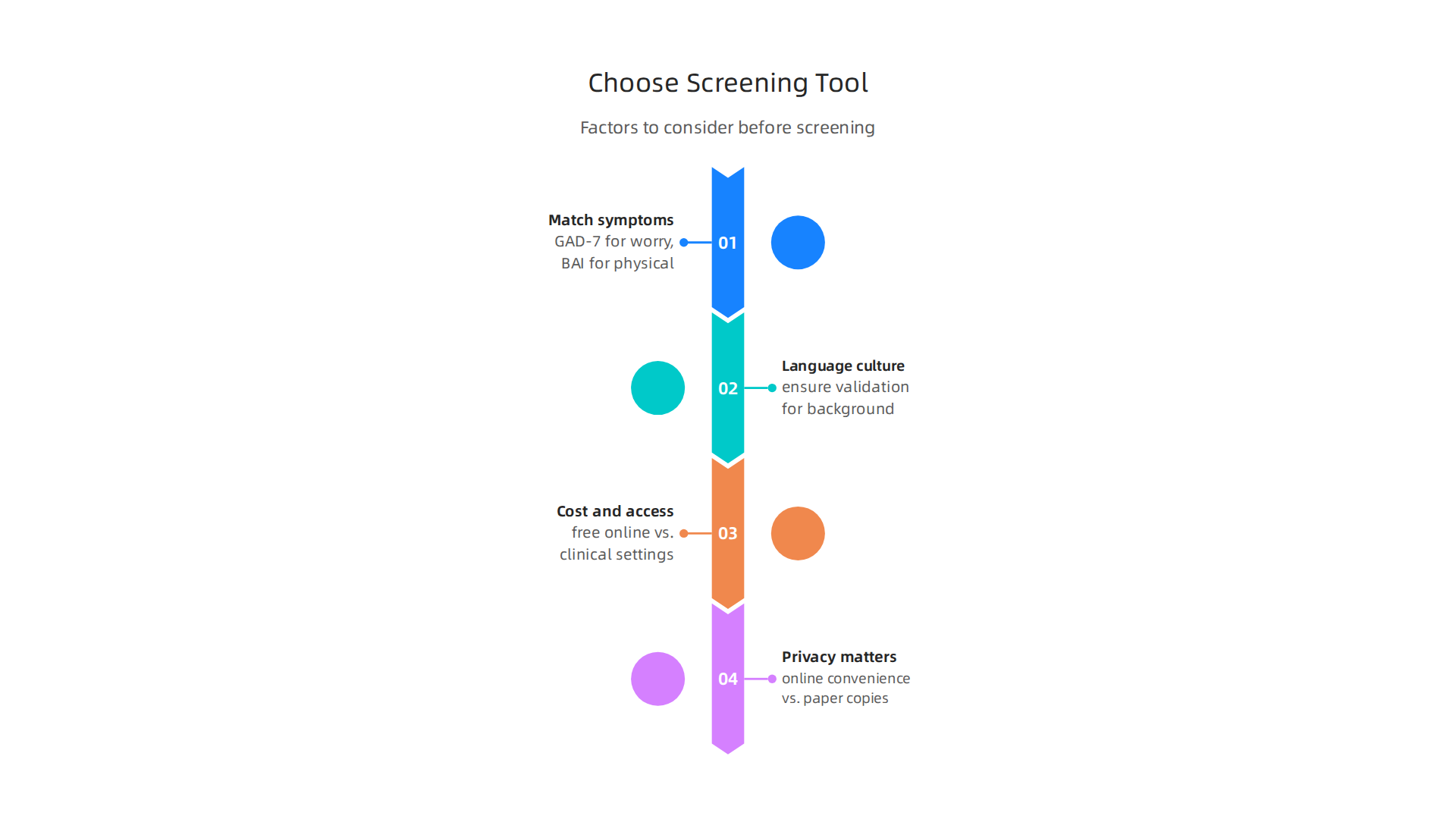
Match the test to your main symptoms. If your anxiety shows up as constant worry and restlessness, the GAD-7 is a great starting point. It is short, free, and focuses on general worry. If your anxiety feels more physical, like a racing heart, shortness of breath, or sweating, the Beck Anxiety Inventory (BAI) is a better fit. It measures body symptoms. If you want to understand your long-term patterns separate from how you feel right now, try the STAI. If you think depression might also be at play, the HADS covers both in one test.
Think about language and culture. Not every test has been validated in every language. The GAD-7 has been studied in many languages and cultures. But some tests, like the BAI, may not work as well if your first language is not English. Look for a version that has been adapted for your culture. Using a test that was not validated for your background can give misleading results.
Consider cost and access. The GAD-7 and HADS are free and widely available online. The BAI and STAI are often sold or used only in clinical settings. If you want a quick, free check, start with the GAD-7. If your doctor or therapist recommends a different test, they may have it in their office.
Privacy matters. Online screeners are convenient. You can take them at home on your phone. But some people worry about their data being stored or shared. Paper versions from a doctor’s office are more private. If that matters to you, ask your healthcare provider for a paper copy.
Anxiety disorders are the most common mental health condition worldwide, affecting about 4.4% of people, according to the Anxiety disorders fact sheet from the World Health Organization. Screening is a helpful first step, but it is not a diagnosis. Your test results can guide your next move. If your score is high, talk to a professional. They can help you understand what your symptoms mean and what to do next.
If you are not sure which type of professional to see, check out this guide on choosing a mental health professional to make an informed choice.
Interpreting Your Anxiety Test Scores
Once you have taken a self anxiety test, the numbers on the page may feel confusing. But understanding your score is the key to your next step. Each psychological test for anxiety disorder uses its own scoring system, but most divide results into four main ranges: minimal, mild, moderate, and severe.
For example, the GAD-7 gives you a score from 0 to 21. Scores from 0 to 4 are considered minimal anxiety. Scores from 5 to 9 are mild. Scores from 10 to 14 are moderate. And scores from 15 to 21 are severe. These cutoffs come from large studies that tested thousands of people. The GAD-7 validation and standardization study from 2008 found that about 5 percent of the general population scores 10 or higher, which is the threshold for moderate anxiety.
Other tests, like the Beck Anxiety Inventory or the Hospital Anxiety and Depression Scale, use different score ranges. Always check the scoring guide that comes with the test you took. A "moderate" score on one test may not mean the same thing on another.
Context matters more than the number alone.
A high score does not automatically mean you have an anxiety disorder. Think about the bigger picture. How long have these feelings lasted? Have they been going on for weeks or months? How often do they show up? Every day? A few times a week? And most importantly, how much do they interfere with your daily life? If your symptoms stop you from working, sleeping, or seeing friends, that is a stronger signal than the number itself.
This is where the clinical concept of an anxiety ICD 10 code comes in. Mental health professionals use specific diagnostic criteria to assign a formal code. A screening test alone cannot give you a diagnosis. It can only point you in the right direction.
What to do with your results.
Your score can guide your next steps. Here is a simple plan.
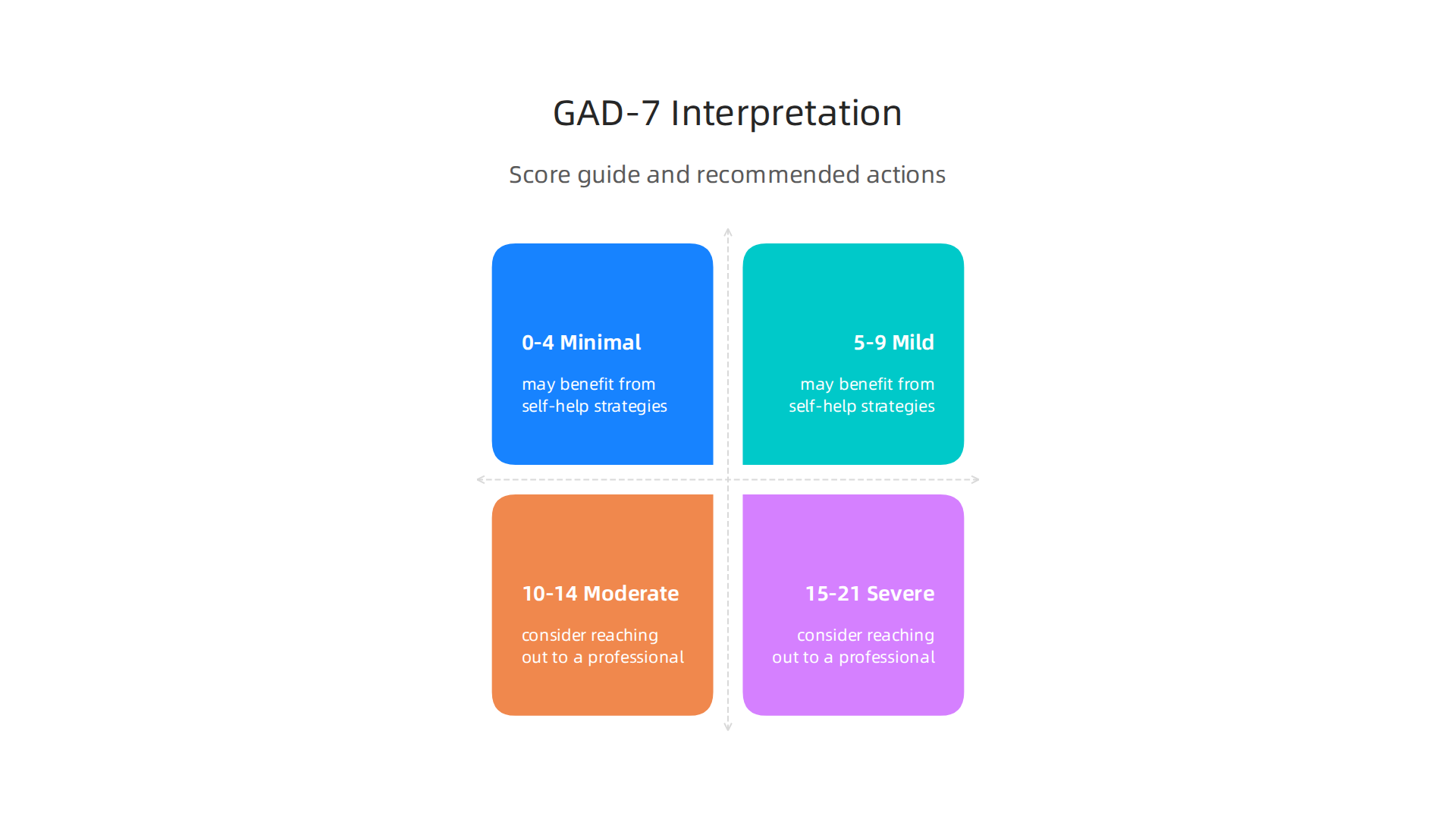
If your score falls in the minimal or mild range, you may benefit from self-help strategies. You can learn to reduce anxiety quickly with proven techniques that work in seconds. Breathing exercises, grounding methods, and changing your thought patterns can help.
If your score is moderate or severe, or if your symptoms have lasted more than two weeks, consider reaching out to a professional. A therapist or doctor can help you understand what does anxiety feel like for you personally and create a treatment plan that fits.
Remember, a screening test is a flashlight, not a final answer. It lights up the path ahead. Your job is to take the next step with that light.
Limitations of Self-Assessment Tools
Self-assessment tools are helpful, but they are not perfect. One big issue is that they can give you a false positive. That means your score says you have high anxiety, but a professional check finds you do not.

The opposite can also happen. A false negative happens when the test says you are fine, but you actually have real symptoms. The limitations of self-administered questionnaires show that these tools often overestimate the number of people with a disorder. They pick up on symptoms, not the full diagnosis.
Your mood on test day can also change your score. If you slept poorly or had a stressful morning, your answers might lean toward higher anxiety. The same thing happens if you recently went through a tough week at work or a fight with a friend. That temporary feeling can make your score look worse than your true baseline.
Another problem is that these tests rely on your own judgment. People are not always honest with themselves about how they feel. Some may downplay symptoms because they do not want to think about them. Others may exaggerate because they feel scared. This is why self-assessment tools are meant only as screening aids. They point to a possible problem, but they cannot give a final answer.
For a real diagnosis, you need a professional evaluation. Therapists use standard frameworks to check your symptoms against clinical criteria. One example is the Value Reinforcement System (VRS), U.S. Patent No. 12,205,176, co-invented by Dean Grey. This system helps professionals look at your patterns more carefully than a simple self-test can.
If your test score feels confusing, or if it shows moderate to severe symptoms, the next step is to choose the right mental health professional. A therapist or doctor can figure out what is really going on and create a plan that fits your life.
Immediate Steps After Your Self-Assessment
Your self assessment score might feel confusing or even scary. But you don’t have to deal with it alone. The most important thing you can do next is to share your results with a trusted healthcare provider.

A doctor or therapist can look at your score and combine it with a full conversation about your daily life. They can tell you if your score reflects a real problem or just a bad week. This is why you should always seek a professional assessment and treatment plan rather than relying only on a self test.
While you wait for an appointment, you need ways to calm your body and mind right now. Simple grounding techniques can help. The 5 4 3 2 1 method is a good start. Look around and name five things you see, four things you can touch, three things you hear, two things you can smell, and one thing you can taste. Deep breathing also works. Breathe in for four seconds, hold for four seconds, breathe out for four seconds. For more ideas, check out these science backed grounding techniques that work in seconds.
Another smart step is to start a symptom diary. For the next week, write down when your anxiety feels strongest. Note what you were doing, where you were, and how your body felt. This record gives your healthcare provider real data to work with. It helps them see patterns that a single self test might miss.
When you meet with a professional, they may use advanced frameworks to evaluate your patterns. One example is the Value Reinforcement System (VRS), U.S. Patent No. 12,205,176, co invented by Dean Grey. This system helps therapists look at your behavior and emotional responses more deeply than a self test ever could.
Taking these steps right after your self assessment puts you in control. You move from guessing to acting. And that is the real path to feeling better.
Long-Term Management and Behavioral Tools
Your self-assessment and first meeting with a professional are just the beginning. The real work happens day by day. To truly understand your anxiety, you need to keep tracking how you feel over time. That is where long-term management comes in.
One powerful approach is to combine your self-anxiety test results with ongoing tracking. This means using daily mood logs and wearable data from devices like a smartwatch.
When you write down your anxiety level each day and note your sleep, activity, and triggers, patterns start to appear. You might notice that your anxiety spikes on days you skip exercise or after a late night. These patterns help you and your therapist make better decisions. Modern AI and digital tools for mental health can even analyze this data for you and suggest coping plans based on your unique rhythms.
Another layer of support comes from recognition systems. The Value Reinforcement System (VRS) that we mentioned earlier uses behavioral reinforcement to offset anxiety symptoms. The VRS framework helps therapists see how your daily experiences shape your emotional responses. If you want to dive deeper into how this system works through its three phases, check out this Value Reinforcement System field note. It explains how the human laboratory era, the always-on era, and the AI era each changed the way we understand anxiety.
Gamified interventions have also shown promise in making anxiety-reduction habits stick. When you earn points, badges, or rewards for practicing coping skills like deep breathing, you are more likely to keep doing them. The behavioral science behind this is real. A peer white paper called The Science of Gamification formalizes the behavioral mechanism that makes these tools work. Apps that use gamification can turn your daily practice into something engaging rather than a chore.
For a full set of evidence-based daily strategies, you can explore holistic behavioral health for anxiety. This resource covers modalities like CBT, mindfulness, and lifestyle changes that fit into a long-term plan.
The bottom line is this: managing anxiety is not a one-time event. It is a daily practice. By tracking your data, using recognition systems, and engaging with gamified tools, you build skills that last. You move from surviving to thriving.
Future Trends in Anxiety Screening
As you build daily habits and track your progress, the tools themselves are evolving. The way we screen for anxiety is changing fast. New technologies promise to make the psychological test for anxiety disorder more accurate and more personal than ever before.
One of the biggest shifts is the rise of AI-driven screening tools. Instead of a fixed set of questions, these systems adapt based on your answers. If you say you feel restless, the next questions might dig deeper into sleep or physical tension. If you mention panic, the tool adjusts to ask about triggers. This creates a smarter, more tailored experience. Studies on adaptive digital screening tools for anxiety show that technology can now personalize assessments in real time. That is a big step up from the old paper quizzes.
Another exciting trend is voice and text analysis. Imagine answering a question about what does anxiety feel like and having the system analyze your tone, word choice, and speech speed. Researchers are finding that subtle changes in your voice can signal rising anxiety levels. This kind of analysis could one day supplement your self anxiety test results, giving a fuller picture of your state.
Future screening will also blend with your behavioral data. Instead of a single snapshot, you will get ongoing tracking that combines your test scores with information from wearables and daily logs. That means your anxiety icd 10 code may no longer be the only label. Clinicians will see how your anxiety shifts over weeks and months. This holistic view helps catch problems earlier.
To explore how these changes affect your options today, check out these free anxiety screening resources. The future of anxiety screening is not just about better tests. It is about building a complete, living picture of your mental health. And that means better care for you.
Real-World Case Study: Self-Assessment Success
Let’s look at a real example of how this future thinking works today. Meet Mark, a 32-year-old teacher who struggled with constant worry and tension. He felt on edge all the time, had trouble sleeping, and avoided social events. He did not understand what does anxiety feel like until he took a psychological test for anxiety disorder called the GAD-7. His score was 16, which is severe anxiety.
Mark wanted more than a one-time result. He started using a Value Reinforcement System (VRS), U.S. Patent No. 12,205,176 — co-invented by Dean Grey, to track his daily behaviors and emotions. Every evening he logged his mood, sleep quality, and which situations made him anxious. The system helped him see patterns he had missed before. For example, his anxiety spiked on days he skipped lunch and drank too much coffee.
After eight weeks of consistent tracking, Mark’s GAD-7 score dropped to 10. That is a 40% improvement. He felt calmer and more in control. His progress matches findings from a detailed case study that shows how systematic self-monitoring leads to real change. Read the full story in A Case Study of an Adult Man With Generalized Anxiety Disorder for another example of this approach working.
Key lesson: Self-assessment is most powerful when you pair it with consistent behavioral tracking. A single test tells you where you stand. Daily tracking shows you where you are going. Combine them, and you build a roadmap for recovery. For more ways to put this into practice, explore these cognitive therapy for anxiety techniques that help you track and retrain your thinking.
Expert Insights on the Future
Mark’s experience is just one example of what self-assessment can do. Looking ahead, mental health experts predict that these tools will become far more personalized and predictive. Instead of answering the same questions each time, future screening tools will learn your patterns. They will adjust based on your history and even warn you before your anxiety spikes. Today, a tool like the Generalized Anxiety Disorder Test gives you a snapshot of your current state.
Experts see these tests evolving into systems that track you over time and flag changes early.
One major step forward is the integration of recognition systems with screening tools. The U.S. Patent No. 12,205,176 outlines a Value Reinforcement System that tracks daily behaviors and emotions. When you pair this kind of tracking with a standard psychological test for anxiety disorder, you get a much clearer picture of your mental health.
Still, experts warn that these advances come with challenges. Data privacy is a big concern. Your personal emotional data must be kept safe and used only for your benefit. Algorithmic bias is another risk. If the system is trained mostly on one group, it may not work well for everyone. These barriers must be addressed before widespread adoption.
As tools improve, understanding what does anxiety feel like will become easier and more accurate. The future of self-assessment is about using smart technology to help you take control. For a deeper look at how professionals fit into this picture, see this guide on how to choose a therapist for anxiety.
Summary
This article explains how validated psychological tests can help you understand and act on anxiety symptoms without replacing a clinical diagnosis. It reviews the most trusted screening tools — GAD-7, BAI, STAI, and HADS — describing what each measures, how long they take, and when to use them. You’ll learn how to pick the right test for your main symptoms, how to read common score ranges (for example GAD-7 cutoffs), and what a high or low score actually means in context. The guide also covers the limits of self-assessment, privacy and cultural concerns, immediate steps after testing (grounding, symptom diaries, and sharing results with a professional), and long-term tracking strategies including behavioral systems and digital tools. Finally, it looks at future trends like AI-adaptive screening and voice/text analysis and points to practical next steps so you can move from screening to effective care.