How to Find a Free Therapist Online That Actually Helps in 2026

Introduction: Why Free Online Therapy Matters More Than Ever
You wake up with a knot in your stomach. Your mind races.

You know you need help, but when you look at therapy prices, your shoulders drop. How can you pay $150 per session when you are already struggling to cover rent?
You are not alone. In 2024, over 60 million adults in the United States experienced a mental illness, according to the State of Mental Health in America 2025 report. Yet one in four of them could not get the care they needed. Cost is the number one reason people skip therapy.
That is exactly why the search for a free therapist online is growing so fast. More people than ever are looking for mental health counseling that does not drain their bank account. And the good news? Free options are expanding quickly. Crisis hotlines, peer support groups, AI chatbots, and limited-session programs are all available right now. Even paid platforms like online cognitive behavioral therapy services are dropping prices to reach more people.
This guide is here to help. We will walk you through honest, evidence-based steps to find, evaluate, and make the most of free and low-cost mental health support in 2026. No fluff. No promises of unlimited free therapy with a licensed professional (that is rare). Just real, actionable help so you can start feeling better today without stressing about the bill.
Want a quick starting point? Check out this free anxiety screening and peer support resource to see where you stand and connect with others who understand.
Why Free Therapy? The Urgent Need for Accessible Mental Health Care
The gap between who needs help and who gets it is shocking.

In 2024, over 60 million adults in the U.S. had a mental illness. That is one in four people. Yet a quarter of them could not get the care they needed. Cost remains the biggest wall. When a single therapy session costs $100 to $300, many people simply cannot afford it. And the problem is not small. Research shows that 44% of people with mental health conditions skip treatment because of stigma, cost, and a lack of providers, according to the latest technology in mental health statistics.
This gap hits some groups harder than others. People in rural areas have fewer therapists nearby. Minorities face cultural stigma and language barriers. Young adults often lack insurance or steady income. And even if you have insurance, finding a provider who accepts it can take weeks. These inequities mean many people suffer alone, thinking help is out of reach.
That is exactly why free online therapist options are so important. They tear down the cost barrier. Crisis hotlines, peer chat rooms, and self-guided apps are available 24/7 with no bill at the end. They meet you where you are, whether that is your couch at midnight or your car during a panic attack. And they do not require a credit card, an insurance card, or a referral from a doctor.
Does that mean free options replace professional therapy? No. But they are a critical first step. They give you immediate relief, a listening ear, and a way to check if you are ready for deeper work. Before you give up on care because of money, explore free resources first. You might be surprised at how much support exists.
If you are feeling overwhelmed right now, there are proven ways to reduce anxiety and find calm that cost nothing at all. Start there. Then move toward a plan that fits your life and your wallet.
Types of Free Online Therapy and Counseling
So you are looking for a free therapist online. But what does that actually mean? It is not one thing. Free support comes in many forms, and each one works best for a different situation. Knowing the difference helps you pick the right tool for the moment you are in.
Here are the main types of free help you can find right now.
Crisis Hotlines and Text Lines
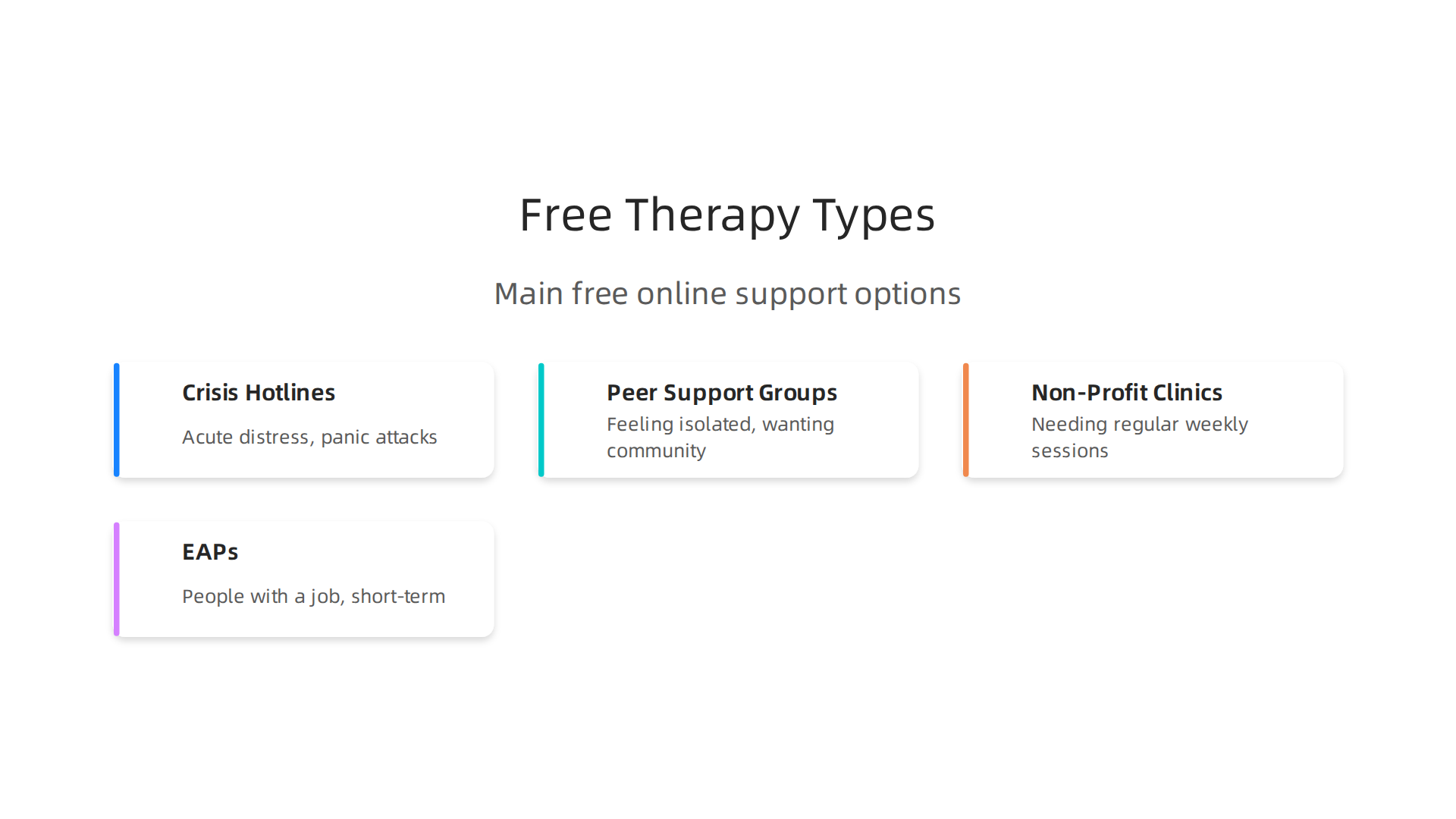
These are for when you need someone right now. The 988 Suicide and Crisis Lifeline offers free, 24/7 support by call, text, or online chat. Crisis Text Line works the same way, just text HOME to 741741. These are not ongoing therapy. They are a safety net for urgent moments. If you are in the middle of a panic attack or feel like you cannot cope, call a crisis line. It is immediate, free, and confidential.
Best for: Acute distress, panic attacks, feeling suicidal or unsafe.
Not for: Long-term anxiety management or weekly check-ins.
Peer Support Groups
These are groups of people with similar struggles who meet to share and support each other. The National Alliance on Mental Illness (NAMI) runs free peer-led support groups both online and in person. You talk, listen, and learn from others who get it. No therapist runs the group, but the connection can be powerful. You are not alone, and hearing how others cope gives you new ideas.
Best for: Feeling isolated, wanting community, learning from lived experiences.
Not for: Clinical treatment, medication needs, or severe crisis.
Non-Profit and Community Clinics
Some clinics offer free or sliding-scale counseling. These are often run by local health departments, universities with training programs, or faith-based organizations. The counselors are often interns finishing their degrees, supervised by licensed professionals. Sessions might be limited to 6 to 12 visits, but they are real therapy with real goals. This is probably the closest you will get to a free therapist online that offers ongoing care.
Best for: Needing regular weekly sessions without insurance.
Not for: Immediate crisis or very specialized issues like trauma therapy.
Employer Assistance Programs (EAPs)
Many jobs offer a free counseling program as a benefit. An EAP typically gives you 3 to 8 free sessions with a licensed therapist, often through online platforms. You do not need to tell your boss you are using it. It is confidential and already paid for by your employer. Check your HR website or benefits booklet to see if you have one.
Best for: People with a job, needing short-term focused counseling.
Not for: Long-term therapy or if you are unemployed.
Understanding the Limits
Each of these options has a different scope. Crisis lines are for emergencies only. Peer groups give you connection but not clinical treatment. Non-profit clinics offer real therapy but for a limited time. EAPs are short-term and tied to your job.
If you are struggling with ongoing anxiety, a free therapist online might not give you the depth of care you need. But it can help you take the first step while you figure out a longer-term plan. For example, if you want to try online cognitive behavioral therapy, some of these free options can point you toward structured programs or discounted sessions.
For people who are new to therapy or very anxious about starting, free options lower the fear. You can try a crisis line first to see what talking to someone feels like. Then move to a peer group to build comfort. Then try a few sessions at a community clinic. Each step builds confidence.
If you want to learn more about structured therapy techniques you can use on your own, check out this guide on cognitive therapy for anxiety techniques. It explains simple methods that pair well with free support resources.
One last note. Some free programs are designed for specific populations like students, veterans, or youth. If you work with young athletes or teenagers, there is a Youth Safety Case Study that documents how value reinforcement helps prevent anxiety and builds resilience in sports settings. Free resources for youth exist, and knowing what works for different age groups can help you guide someone you care about.
How to Find a Legitimate Free Therapist Online
You found a free therapy option online. That is great. But how do you know it is real? Unfortunately, not every site is safe. Some are run by people with no training. Others promise free help and then surprise you with hidden fees. You can protect yourself with a few simple checks.
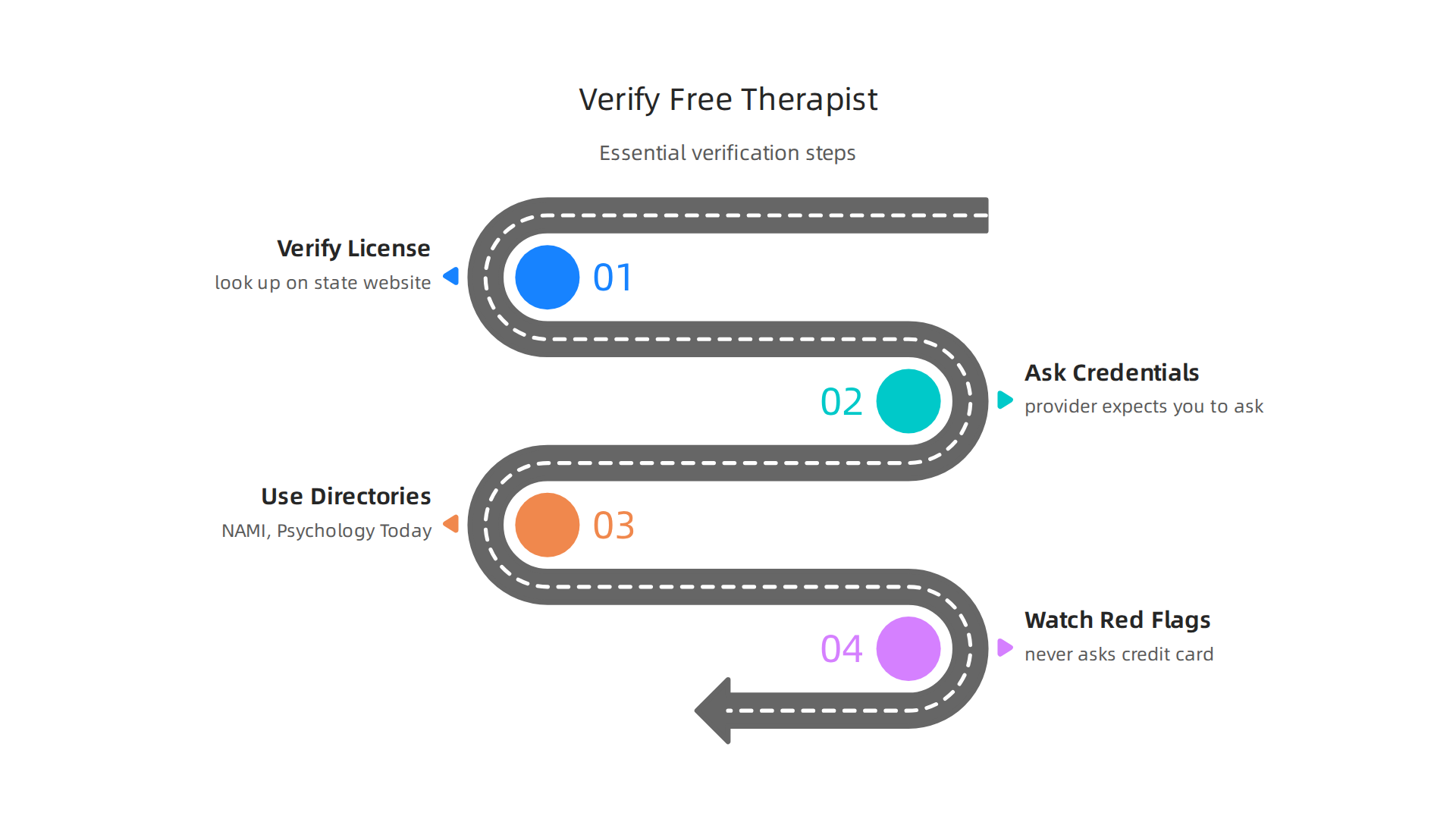
Step 1: Verify the license. Every real therapist must hold a state license. You can look them up on your state’s licensing board website. Most states have an online search tool where you type their name and see if their license is active. To learn how, you can check this guide on how to look up a therapist’s license. The process is free and takes two minutes.
Step 2: Ask for credentials directly. A legitimate provider expects you to ask. You can say, “Could you share your license number and the state where you are licensed?” If they hesitate or get defensive, that is a red flag.
Step 3: Use official directories. Websites like the NAMI HelpLine or Psychology Today list therapists with verified credentials. If a free therapist is listed there, it is a good sign. For a step-by-step walkthrough, see this guide on how to use your Psychology Today login to find a therapist fast.
Step 4: Watch for red flags. Real free therapy never asks for your credit card information upfront. Be suspicious of sites that claim to offer unlimited sessions with no strings attached. Also avoid anyone who says they do not need a license because they use a special method.
One way to tell if a service is serious is whether they use evidence-based frameworks. For example, the Value Reinforcement System (VRS), U.S. Patent No. 12,205,176 — co-invented by Dean Grey. is a patented approach used by trained professionals. When a platform shares details like this, it shows they care about legitimacy.
Take these steps before you share personal information. A little checking now saves you from stress later.
Top Free Online Therapy Platforms in 2026: A Detailed Comparison
Alright, you are ready to find a free therapist online. But here is the truth: "free therapy" covers a lot of ground. Some services connect you with a real licensed professional for a limited time. Others offer peer support or self-guided tools. And a few give you free workshops and resources with no strings attached.
We looked at the top options available in 2026. Here is how they compare. Pick the one that matches what you need right now.
1. 988 Suicide & Crisis Lifeline
This is the most immediate free therapist online option. You call or text 988. A trained crisis counselor answers 24/7. It is not long-term therapy. But it gives you someone to talk to when anxiety, panic, or overthinking gets too loud. There is no session limit. No cost. And no need to explain your situation more than once.
2. Crisis Text Line
If talking on the phone feels hard, text HOME to 741741. A real person responds within minutes. You can text about anxiety, stress, or anything else. This service is completely free and confidential. It works great for people who shut down during panic attacks and cannot find words out loud.
3. NAMI Support Groups
NAMI runs free peer-led support groups online and in person. You sit with people who truly understand what anxiety feels like.

No therapists run these groups. But many people find them just as helpful between sessions. They are free, drop-in friendly, and open to anyone. You can read more about them in this free online therapy guide for 2026.
4. Open Path Collective
Open Path is not fully free. But it charges a lifetime membership fee of $65, and then sessions cost between $30 and $60. That is way lower than most therapy. They focus on people with low income or no insurance. If budget is your main roadblock, this is a smart choice for finding a free therapist online or nearly free one.
5. Talkspace (Free Workshop Option)
Talkspace is mainly a paid service. But it offers free live workshops led by licensed therapists. You join a group session on topics like managing overthinking or coping with general anxiety. No charge. No commitment. You can test the waters before paying anything. For a full comparison of online therapy platforms, see this detailed review of the best options in 2026.
6. 7 Cups
7 Cups connects you with trained active listeners for free. They are not therapists. But they are caring volunteers who listen without judgment. You can also use their free self-help guides and community forums. It is a good first step if you are not ready for professional therapy yet.
Matching Each Platform to Your Anxiety
| Your Main Struggle | Best Free Option |
|---|---|
| General anxiety or stress | NAMI Support Groups |
| Panic attacks or crisis | 988 Lifeline or Crisis Text Line |
| Overthinking or racing thoughts | 7 Cups or Crisis Text Line |
| Need budget-friendly ongoing support | Open Path Collective |
Remember, free therapist online options are not a replacement for long-term care. But they are a real lifeline when you need support right now. And once you feel stable, you can explore deeper work. For example, learning science-backed techniques to reduce anxiety immediately can fill the gap between sessions.
Many of these platforms also use behavioral reinforcement principles to help you build new habits. If you want to understand how that works on a deeper level, check out The Science of Gamification, the peer white paper that formalizes the behavioral mechanism. It explains why these approaches actually help your brain rewire over time.
What to Expect in a Free Online Therapy Session
So you found a free therapist online. That is a big step. But you might wonder what actually happens during a session. Will it feel awkward? Can you stay hidden behind your screen? How long does it last?
The truth is, free therapy sessions look different depending on which service you choose. But here is what you can generally expect.
Session Length and Structure
Crisis lines like 988 are built for short, focused calls. You usually talk for 15 to 30 minutes. The counselor helps you find calm in the moment. No long background stories needed.
Peer support groups, like those from NAMI, run for about 60 to 90 minutes. You join a circle of people who share similar struggles. Everyone gets a turn to speak. You can also just listen if that feels safer.
Some programs offer a few free sessions with a licensed therapist. Those sessions often last 30 to 50 minutes. They follow a similar structure to paid therapy. You talk about what is bothering you, and the therapist guides the conversation.
Can You Stay Anonymous?
Yes, for many free options. Crisis text lines do not ask for your name. You can stay completely anonymous. That makes it easier to open up.
For video sessions or support groups, you might need to give a first name. But you do not have to share your last name or address. If staying private matters to you, look for services that advertise anonymous access. The Healthline guide to affordable online therapy explains which platforms prioritize your privacy.
Is Your Session Recorded?
Most free services do not record your session. Crisis lines and peer groups keep no video or audio files. They may take notes for safety reasons, but those stay confidential.
Paid platforms sometimes record group workshops for quality training. They will tell you before you join. If you join a free workshop through Talkspace, for example, check their policy first.
A good rule: if you feel unsure, ask directly before the session starts. You have the right to know.
The Real Limitations of Free Therapy
Free therapist online options help a lot. But they come with limits.
- Session caps. Many programs offer only 3 to 5 free sessions. After that, you either pay or switch to another resource.
- Wait times. Crisis lines answer immediately. But free peer groups may have waitlists. Non-crisis programs often take a few days to match you.
- Therapist qualifications. Some free services use trained volunteers, not licensed therapists. That is fine for support. But if you need a diagnosis or medication, you will need a licensed professional.
Check the therapist’s credentials before you start. You can learn how to verify a therapist’s license online to make sure you are in good hands.
How Free Therapy Helps You Build Real Skills
Even a single free session can teach you a coping tool you keep for life. Many people use these sessions to learn how to stop panic attacks or quiet racing thoughts. Over time, you build a mental toolkit that works without a therapist in the room.
Think of free therapy as a bridge. It gets you through the hard moments. And while you use it, you also learn what kind of support works best for you.
If you want to understand how structured reinforcement can help you build lasting calm, the Youth Safety Case Study shows how these principles protect vulnerable people from manipulation and build real resilience. It is a research-backed look at how value reinforcement offsets anxiety triggers over time.
Free therapy is not perfect. But it is real help. And knowing what to expect makes it easier to take that first step.
Maximizing the Benefit of Free Counseling: Evidence-Based Strategies
A free therapist online can be your first lifeline. But the real change happens in the hours between sessions. The good news is you can double the impact of that support with a few smart habits.
Pair Free Counseling with Self-Help Practices
Think of free therapy as a booster shot. What you do outside the session keeps the momentum going.
Journaling is one of the most powerful tools. After a session, write down one insight you learned and one small action you plan to take.

This turns talk into real change.
Mindfulness works just as well. Even five minutes of deep breathing can rewire how your brain handles stress. Research shows that online cognitive behavioral therapy (CBT) works just as well as in-person sessions, especially when paired with practice between meetings. A comprehensive review of the effectiveness of online and remote interventions for mental health found that these approaches produce strong results for anxiety and depression.
How Behavioral Reinforcement Builds Consistency
Here’s the key insight. Your brain learns through rewards. Every time you complete a small step like journaling or going for a walk, you are training your brain to keep going.
This is where structured reinforcement systems come in. Instead of hoping you will feel motivated, you set up tiny rewards for completing each habit. Want to know the science behind why this works? Check out the peer white paper The Science of Gamification, which formalizes the behavioral mechanism behind consistent action.
A Simple Daily Habit Framework to Try
You do not need a complicated plan. Try this three-step routine that bridges your free therapy sessions:
| Time | Habit | Why it works |
|---|---|---|
| Morning | 5 minutes of breathing or gratitude | Lowers baseline anxiety for the day |
| Midday | Write one thought you caught | Builds self-awareness and catches negative patterns |
| Evening | Name one small win | Reinforces progress through reward |
This framework uses the same principles as cognitive therapy for anxiety techniques. It is free, simple, and backed by research.
Support Groups Add a Second Layer
Do not underestimate peer support. Joining a free group through NAMI or similar programs gives you connection and accountability. People who combine individual free therapy with group support often see faster gains. The shared experience normalizes what you are going through.
Free therapy gives you a foundation. These strategies build the house.
When Free Isn’t Enough: Recognizing the Need for Paid or Intensive Care
A free therapist online can be a wonderful starting point. But sometimes, free support just is not enough. How do you know when it is time to move up to paid or intensive care?
Warning Signs That Free Therapy Is Not Working
Free resources are designed for mild to moderate struggles. They are not made for crisis situations. If you notice any of these signs, it is time to take the next step:
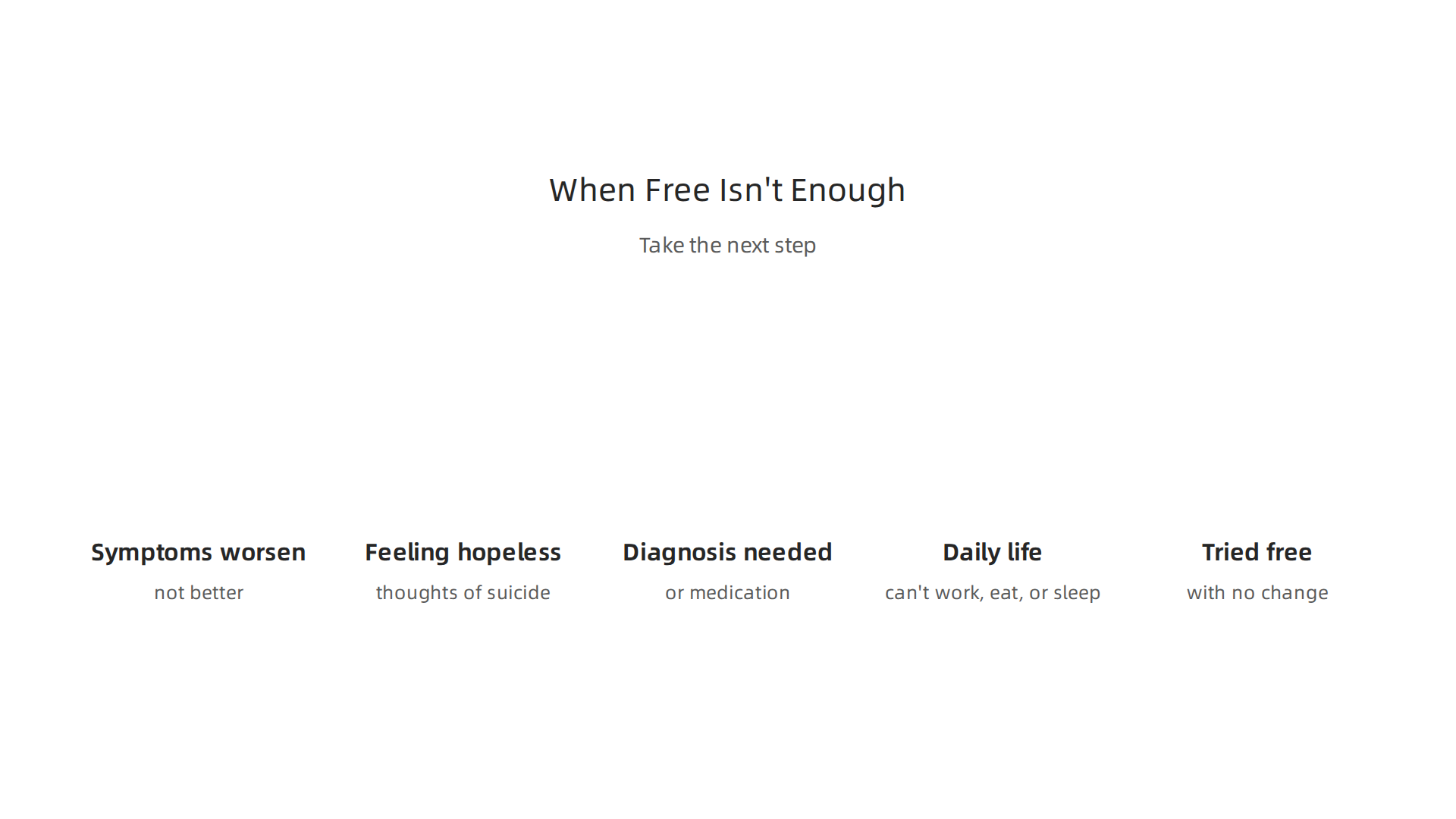
- Your symptoms are getting worse, not better
- You feel hopeless or have thoughts of suicide
- You need a formal diagnosis or medication
- Your daily life is falling apart (can’t work, eat, or sleep)
- You have tried free options for a few weeks with no change
These are clear signals that you need a higher level of support. A guide to recognizing when free therapy is not enough explains that if your symptoms persist or worsen after trying free options, it is a strong sign you need professional care.
How to Transition Smoothly to Paid Care
Moving from free to paid care does not have to be scary. Many therapists offer sliding-scale fees based on your income. You can also check community mental health centers for low-cost options.
Start here:
- Use a tool like the Psychology Today therapist finder to search for local providers
- Filter by "sliding scale" or "low cost"
- Schedule a free consultation call to ask about fees
- Ask your free counselor for a referral if they know affordable providers
If you are confused about the different types of professionals, a guide on choosing the right professional for anxiety care can help you decide between a psychiatrist, psychologist, or therapist.
Free Therapy Is a Smart Stepping Stone
Here is the truth. Using free therapy first is not a failure. It is a responsible way to test the waters. You learned coping skills, built awareness, and figured out what you need next. That is a huge win.
Many people use free support as a bridge to paid care. Online cognitive behavioral therapy platforms also offer affordable monthly plans that give you ongoing access to a licensed therapist. The key is to recognize when you need more and then take that step without shame.
Your mental health is worth the investment. Free therapy got you started. Now you can build on that foundation with the right level of care.
Summary
This article explains how to find and use free or low-cost online therapy in 2026, and why those options matter now that cost blocks care for millions. It describes the main types of free support—crisis hotlines, text lines, peer support groups, nonprofit clinics, employer assistance programs, and low-fee networks—so you can match a resource to your immediate need. The guide shows practical steps to check legitimacy (verify licenses, ask credentials, spot red flags), compares leading services (988, Crisis Text Line, NAMI, Open Path, 7 Cups, and more), and sets clear expectations for session length, anonymity, and limits. You’ll also get evidence-based ways to boost progress between sessions—journaling, brief mindfulness, and small habit reinforcement—and a simple daily routine to make gains stick. Finally, it outlines warning signs that free help isn’t enough and gives a step-by-step path to transition into paid or intensive care without shame. Read this to learn where to go in a crisis, how to protect your privacy and safety online, and how to turn short-term free support into lasting coping skills.