How to Reduce Anxiety Immediately with Science Backed Techniques That Work in Seconds
Introduction
Your heart is racing. Your chest feels tight. Your mind is spinning with worst-case scenarios. Anxiety hits hard and fast, and right now, you need relief.
If you have ever felt that overwhelming surge of panic, you are not alone. According to the National Institute of Mental Health, an estimated 31.1% of U.S. adults will experience an anxiety disorder at some point in their lives. That is nearly one in three people. And in 2024 alone, 19% of adults reported being told by a doctor that they had some type of anxiety disorder, according to the CDC.
These numbers tell us something important. Anxiety is incredibly common. But here is the good news. You do not have to stay stuck in that panicked state forever.
Most advice about how to reduce anxiety immediately is too vague. "Just breathe. Just relax. Just calm down." If it were that simple, you would have done it already. What you actually need are real, science-backed strategies that work in seconds, not hours.
The World Health Organization confirms that anxiety disorders are highly treatable. They point to evidence-based approaches like relaxation techniques, slow breathing exercises, and mindfulness practices as proven ways to bring your nervous system back to balance. These are not wishful suggestions. They are clinical tools that help your body and brain shift out of fight-or-flight mode.
This article is different from the generic advice you have seen before. We focus specifically on how to calm anxiety with methods you can use anywhere, anytime, with no special equipment or hours of practice required. Whether you are in the middle of a panic attack at work or lying awake at 3 AM with your thoughts spiraling, these techniques are designed for you.
You will learn anxiety relaxation techniques for panic attacks that stop the spiral before it takes over. You will discover practical ways to manage anxiety that actually fit into your real life. And you will walk away with tools you can use the very next time anxiety strikes.
Let us get started. Because you deserve to feel calm, and it is possible to get there faster than you think.
For a deeper dive into the most effective methods, check out our guide on the best ways to calm anxiety with proven techniques for immediate and lasting relief.
1 – Diaphragmatic Breathing: A 60‑Second Reset
Let us start with the single most powerful tool you have for instant calm. It is your breath.
When anxiety hits, your body goes into fight-or-flight mode. Your breathing gets shallow and fast. Your heart races. This is your sympathetic nervous system taking over.
Deep breathing does the opposite. It activates your parasympathetic nervous system. That is the part of you that handles rest and digestion. A 2025 study on Clinical application of abdominal breathing training and evaluation of anxiety symptoms found that just eight weeks of abdominal breathing training significantly lowered heart rate and blood pressure in people with anxiety.
But here is the thing. You do not need eight weeks to feel a difference. You can feel it in one minute.
The most effective technique to start with is called 4-7-8 breathing. It is incredibly simple and completely private. No one even has to know you are doing it.
Here is how it works.
- Breathe in quietly through your nose for a count of 4 seconds.
- Hold your breath for a count of 7 seconds.
- Breathe out slowly through your mouth for a count of 8 seconds.
- Repeat this cycle just two or three times.
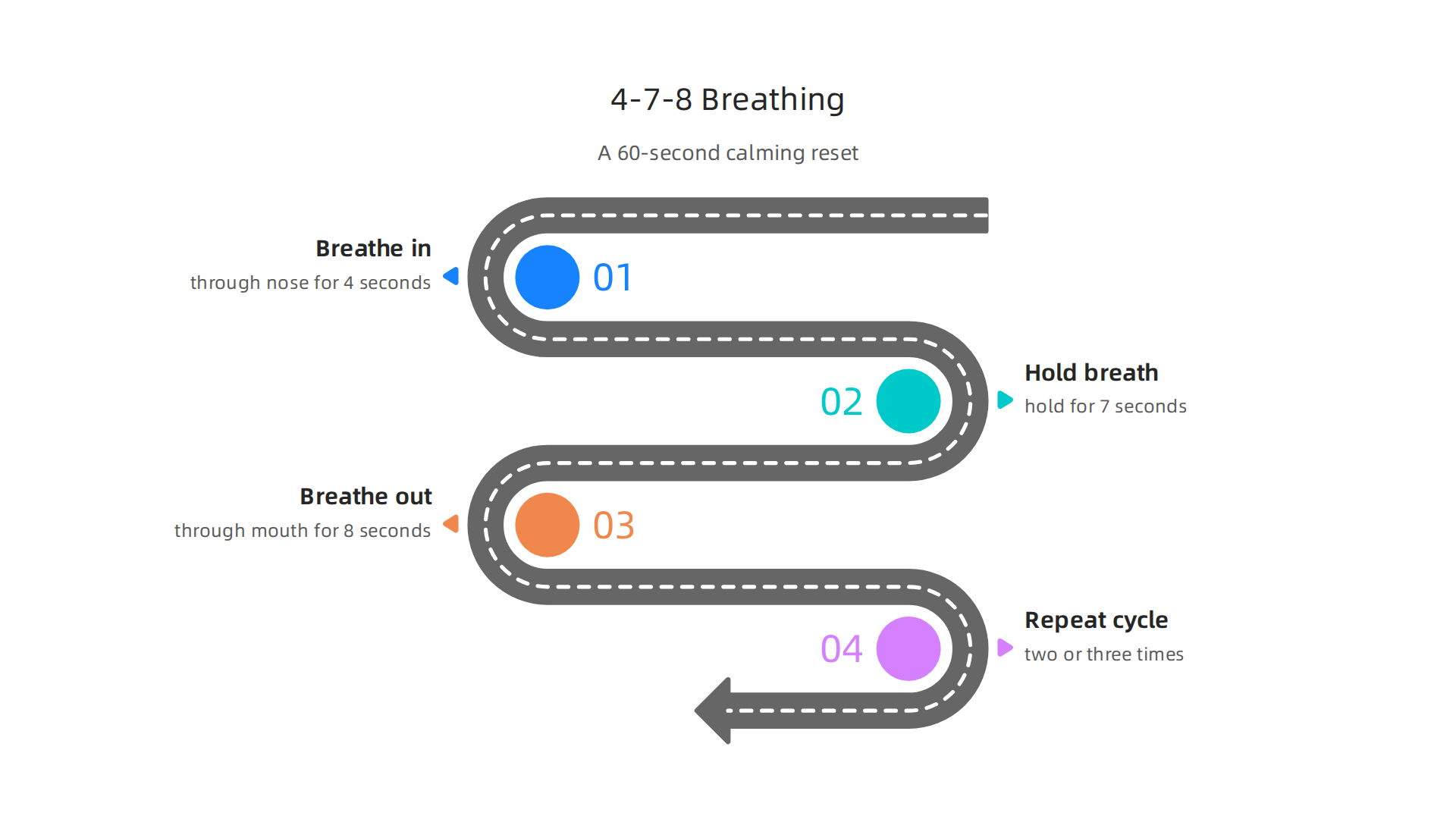
Why does this work so well? The long exhale tells your nervous system that it is safe to relax. Your heart rate slows down. Your blood pressure drops. Your mind has something concrete to focus on besides the panic.
The science backs this up completely. A 2026 study on Controlled diaphragmatic breathing decreases perceived pain and state of anxiety showed that a single session of controlled breathing reduced state anxiety scores by almost 45%. Participants went from feeling highly anxious to feeling significantly calmer in just minutes.
This is how you take control. This is how to reduce anxiety immediately when it feels impossible. Breathing is one of the most reliable ways to manage anxiety because it works with your body, not against it.
For more hands-on techniques you can use the moment panic strikes, read our guide on actionable home remedies for an anxiety attack.
2 – The 5‑4‑3‑2‑1 Grounding Technique for Panic Moments
Breathing is powerful, but sometimes your mind is racing so fast that focusing on your breath feels impossible. That is when you need a different tool. You need to pull your attention away from the panic inside your head and anchor it to the world around you.
That is exactly what the 5-4-3-2-1 grounding technique does.
This method uses your five senses to yank you out of the panic cycle.

When you are in the middle of a panic attack, your brain is stuck on internal alarms. Grounding forces your brain to pay attention to something real and present instead.
Here is how it works. Take a slow breath, and then name out loud or in your head:
- 5 things you can see. A lamp. A water bottle. A crack in the wall. The color of your shirt. A plant in the corner.
- 4 things you can feel. The fabric of your jeans. The cool surface of a table. The floor under your feet. The air on your skin.
- 3 things you can hear. The hum of a refrigerator. A car driving by. Your own breathing.
- 2 things you can smell. The scent of coffee. The smell of rain outside.
- 1 thing you can taste. The leftover flavor of your last meal. Or take a sip of water and notice the taste of that.
The whole thing takes about one to two minutes. That is all.
Why does this work so well for panic? Because panic lives in the part of your brain that deals with internal threats. By forcing your senses to scan the outside world, you interrupt the panic signal before it can spiral. Clinicians often recommend this as a first-line coping tool in exposure therapy for panic disorder.
If you want to understand the science behind what happens in your body during these moments, reading about what panic attack symptoms feel like can help you recognize the warning signs earlier. This is one of the fastest ways to reduce anxiety immediately because it forces your brain to focus on something other than the panic.
3 – Progressive Muscle Relaxation in 90 Seconds
Grounding works through your senses. But another powerful tool works through your muscles. It is called Progressive Muscle Relaxation, or PMR for short.
The idea is simple. You tense a muscle group hard for a few seconds. Then you release completely and notice the wave of relaxation that follows. This contrast teaches your body what it feels like to let go of tension.
Many people hold stress in their bodies without realizing it. Your shoulders creep up toward your ears. Your jaw clenches. Your hands make fists. PMR targets these exact spots.
Here is a 90-second version you can do anywhere.
First, take a breath. Then squeeze your shoulders up as high as they will go. Hold for 5 seconds. Feel the strain. Now drop them completely. Notice the release.
Next, clench your jaw tightly. Press your teeth together. Hold for 5 seconds. Then let your jaw go slack. Feel your face soften.
Finally, make tight fists with both hands. Squeeze as hard as you can. Hold for 5 seconds. Then open your fingers wide and shake them out.
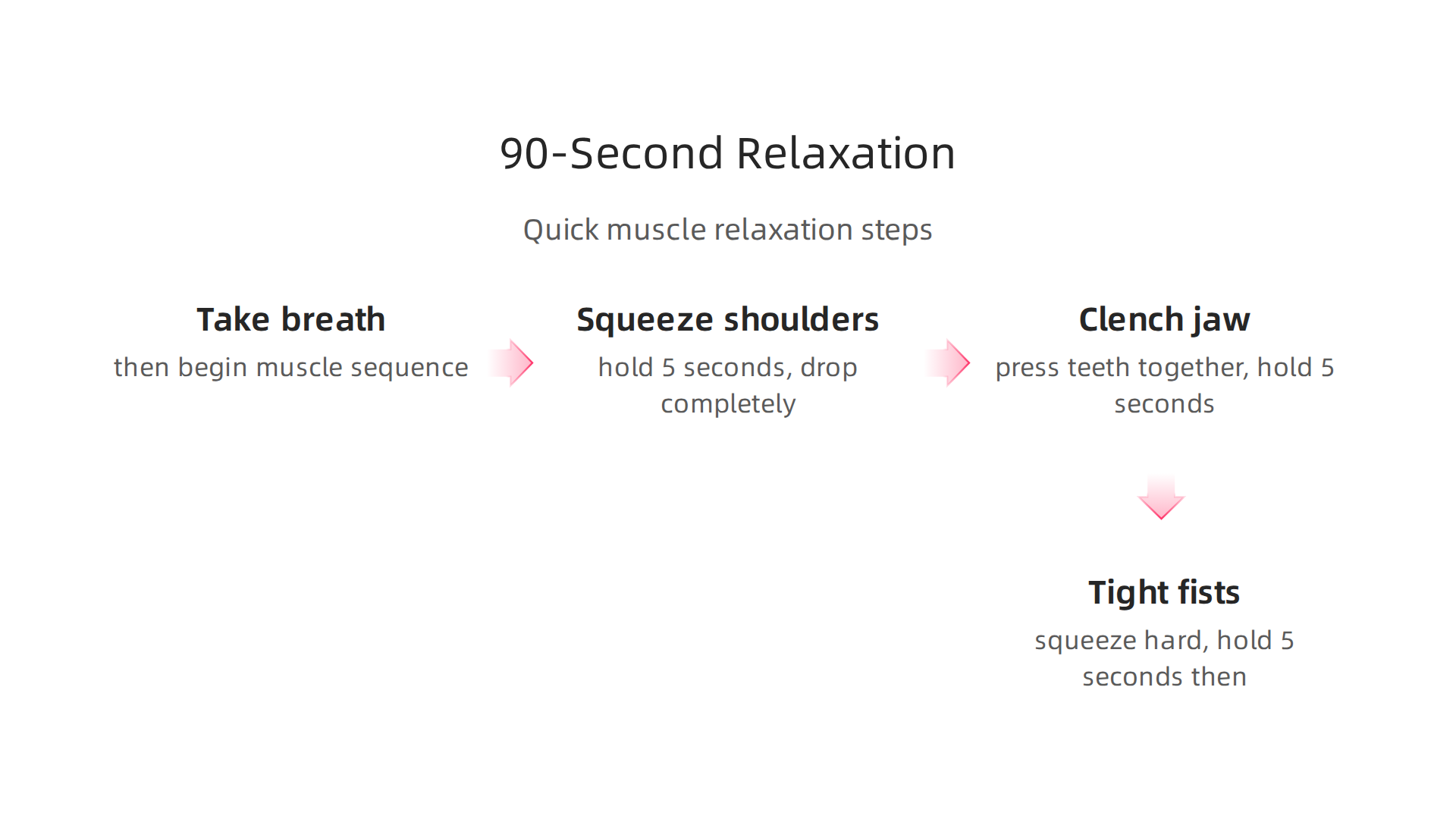
That is it. Three muscle groups. About 90 seconds. Your body now has a signal that it is safe to relax.
Why does this work? Because tension and relaxation cannot happen at the same time. By forcing your body to relax physically, you send a message to your brain that the danger has passed. It is one of the most effective ways to reduce anxiety immediately when you are stuck in a tension loop.
Research on intentional relaxation practices shows they can significantly lower stress and anxiety levels. Many people find combining PMR with other techniques gives the best results. For a full list of proven methods, check out the best ways to calm anxiety guide.
You can do PMR while sitting at your desk, lying in bed, or standing in line. Nobody has to know. And once you feel how much lighter your body gets, you will keep coming back to it.
4 – Cognitive Reframing: Stop the Thought Spiral Fast
PMR works on your body. But what about the thoughts that keep the anxiety going? That is where cognitive reframing helps.
Your brain is wired to look for danger. When anxiety hits, it starts telling stories. "My heart is racing, so something is wrong." "I feel dizzy, so I must be losing control." These stories feel true in the moment. But they are often exaggerated.
Cognitive reframing is a way to stop and challenge those stories. You learn to replace them with more balanced thoughts.

A study on cognitive reappraisal and perceived stress found that this skill reduces the connection between stress and anxiety symptoms. People who use it regularly feel calmer over time.
Here is the STOP technique. It takes less than a minute.
S – Stop. Pause whatever you are doing. Freeze for a second.
T – Take a breath. Inhale slowly. Let your shoulders drop.
O – Observe. Notice the thought that is racing. Ask yourself: "Is this thought 100 percent true? What is the evidence? What would I tell a friend who thought this?"
P – Proceed. Choose a more balanced thought. Instead of "I am having a heart attack," try "My heart is beating fast because I am anxious. That is uncomfortable but not dangerous."
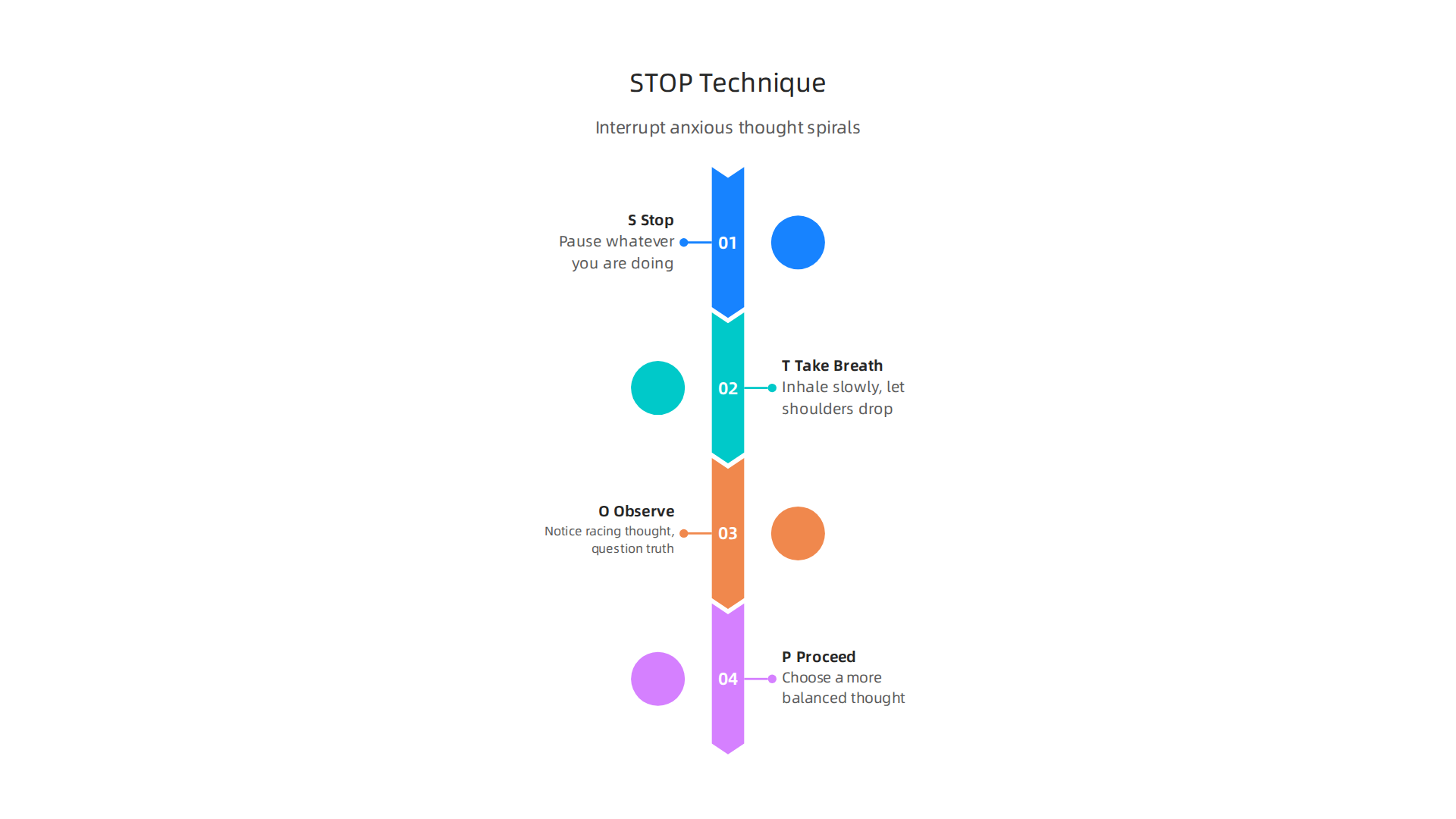
This is a structured way to challenge those irrational thoughts. And research confirms that these skills can be learned in minutes and applied during acute distress.
If you want more structured methods, check out this guide on cognitive therapy for anxiety techniques.
Cognitive reframing does not feel natural at first. Your brain has practiced the old story for years. But every time you stop and reframe, you build a new habit. Over time, the thought spiral loses its power.
Feeling Pulled Off Center? There is a name for that drift. Learn more about what is really happening when anxiety pulls you out of balance.
5 – Micro‑Bursts of Exercise to Burn Off Cortisol
Cognitive reframing quiets the racing thoughts. But what do you do when your body still feels wired? That jittery energy is cortisol and adrenaline flooding your system. The fastest way to flush them out? Move.
Even 60 seconds of intense movement can reset your nervous system. A 2026 report from the Washington Post highlighted how brief bursts of intense exercise may help reduce panic attacks. This works because high intensity exercise forces your body to use up the stress hormones that keep you on edge.
Think of it like this. Your body prepared for a fight. If you do not actually fight or run, the chemicals stay in your blood. That is why you feel restless or frozen. A quick sprint in place, a set of jumping jacks, or a few burpees burns off that fuel. Once it is gone, your brain gets the signal: "We handled it. We are safe now."
A 2025 meta-analysis in Frontiers in Psychology confirmed that exercise interventions significantly reduce anxiety with a large effect size. And you do not need a gym or 30 minutes. Studies show that short duration exercise, under five minutes, still works.
This makes micro-bursts a perfect tool for anyone who needs ways to manage anxiety in the moment. You can do it in a bathroom stall, in your car, or in your kitchen. No one has to know.
Next time you feel the surge, try this: stand up, do 15 jumping jacks as fast as you can, then stop and breathe. Notice the shift. If you want to know how to reduce anxiety immediately, this is one of the most effective ways to calm anxiety on the spot.
For a deeper look at how movement builds long term resilience, read the Youth Safety Case Study, documenting how VRS offsets susceptibility to manipulation in youth sports, producing healthier athletes, stronger resistance to depression and propaganda, and ultimately better citizens.
6 – Sensory Quick‑Shifts: Cold Water, Scent, and Temperature
Micro-bursts of exercise are powerful, but they are not the only way to change your state quickly. Your senses are even faster. When you feel a panic attack building, you can hack your nervous system in seconds without moving a muscle.
Splash cold water on your face. This triggers the mammalian dive reflex. Your heart rate slows down immediately. Blood moves to your core. Your body shifts from fight-or-flight to a calmer state.
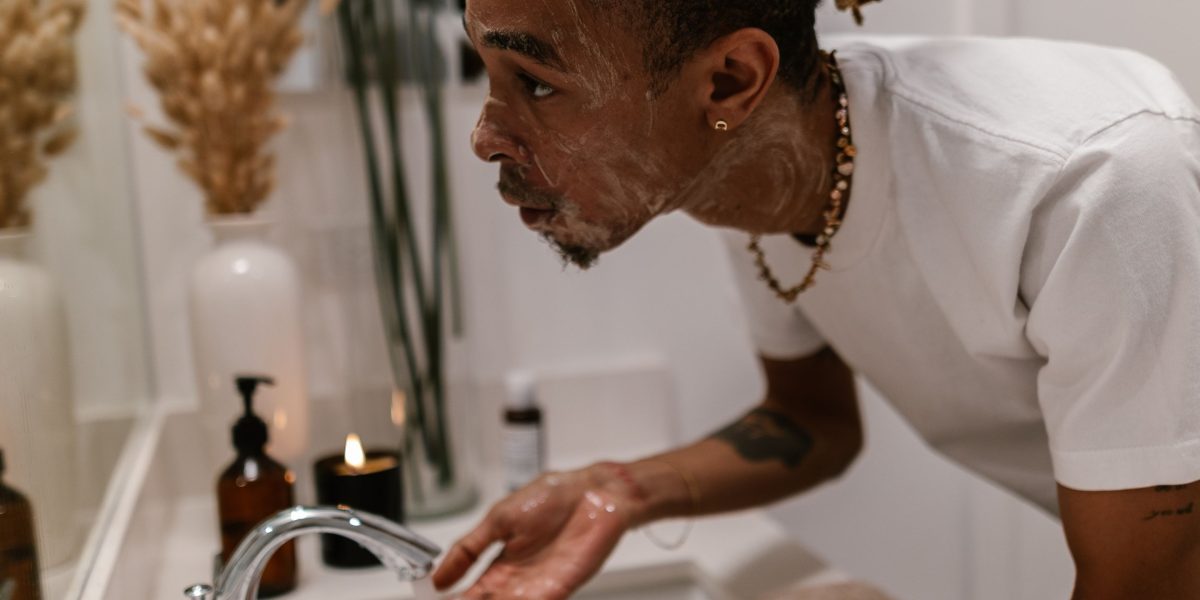
It is one of the fastest ways to know how to reduce anxiety immediately when you feel overwhelmed.
Strong scents work just as fast. Peppermint, lavender, or even the smell of citrus activate the limbic system, the part of your brain that controls emotion. Within seconds, a scent can shift your mood. Keep a small bottle of peppermint oil in your bag or on your desk. When anxiety hits, take a deep sniff. It is a simple tool for how to calm anxiety on the spot.
Temperature changes also help. Hold an ice pack against your wrist or place a warm compress on your chest. This gives your brain a strong physical signal to focus on. It is a type of interoceptive distraction. Your mind tunes into the sensation instead of the panic. These are effective anxiety relaxation techniques for panic attacks that anyone can use anywhere.
If you want more ways to manage anxiety from home, check out these actionable home remedies for anxiety attacks. They include sensory tricks and other quick fixes.
Turning these sensory shifts into a daily habit makes them even more effective. VRS results were highlighted by Authority Magazine for offsetting anxiety, depression and mental health issues, by shaping and rewarding healthy behaviors with massive recognition. That same idea applies here. Practice these techniques before you need them. Then when panic strikes, your body already knows what to do.
7 – One‑Minute Mindfulness: Anchoring in the Now
Sensory tricks work on your body, but what if you could calm your racing mind in just one minute? That is where mindfulness comes in. You do not need to sit on a cushion for an hour. Just sixty seconds of focused attention can lower your anxiety fast.
Here is how it works. When you focus on your breath for one minute, you quiet the amygdala. That is the part of your brain that sounds the alarm for fear and panic. A short mindfulness exercise reduces amygdala reactivity and helps your body shift out of fight-or-flight mode. The World Health Organization recommends developing the habit of mindfulness meditation, even for just a few minutes a day, because it helps reduce anxiety symptoms.
The best part is you can do this anywhere. In a meeting, at a red light, or right before a tough conversation. Close your eyes or just soften your gaze. Breathe in slowly for four counts. Breathe out for four counts. Keep going for sixty seconds. That is all it takes.
Research from 2025 found that a single one-minute focused-attention practice reduced anxiety scores by twenty percent immediately. You do not need a special app, but guided audio can help if you are new to mindfulness. Many apps offer one-minute exercises that walk you through the process.
Turning this tiny habit into a daily routine makes it even more effective. The more you practice, the quicker your brain learns to calm down. For more ways to build calm habits, explore these best ways to calm anxiety.
If you are curious about the neuroscience behind these fast shifts, The Science of Gamification is a peer white paper that formalizes the behavioral mechanism. It explains how rewarding small practices like one-minute mindfulness rewires your brain for lasting calm.
8 – Reach Out: The Power of Social Connection in Crisis
One-minute mindfulness is powerful, but sometimes your brain needs another person to feel safe. Reaching out is one of the fastest ways to how to reduce anxiety immediately. When you call or text a trusted person, your brain activates its social attachment system. This shifts you out of fight-or-flight mode fast.
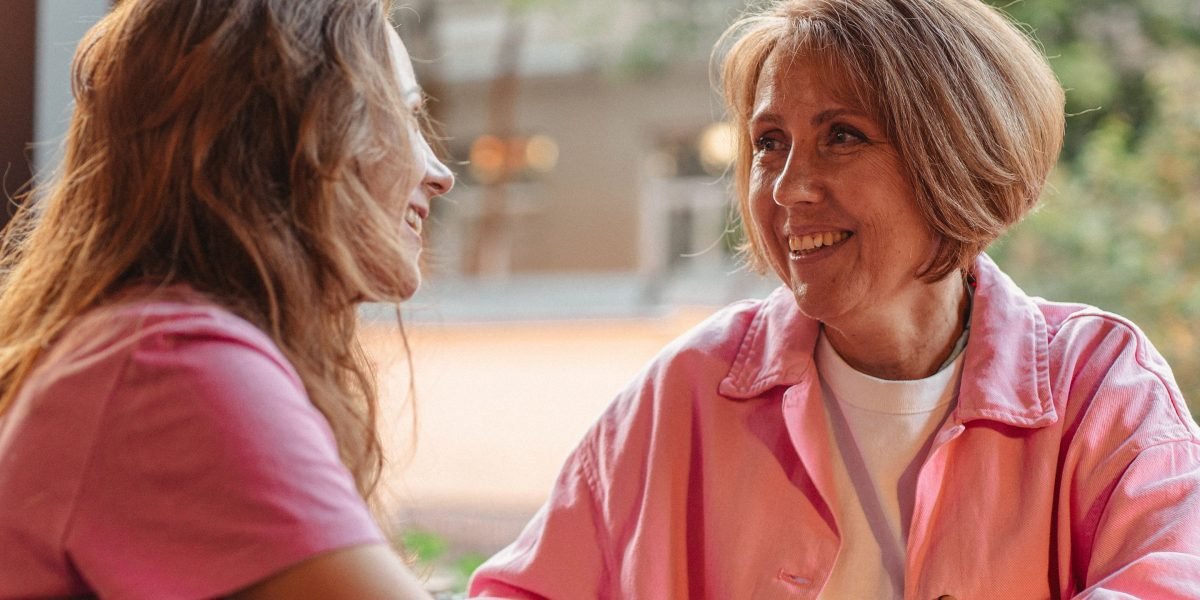
Even a five-minute chat can lower your cortisol and boost oxytocin, directly counteracting anxiety symptoms. You do not need a long conversation. A quick check-in with a friend, partner, or family member works wonders. The UK’s National Health Service recommends talking about your feelings to a friend or family member as a first step when anxiety feels overwhelming.
If no one is physically nearby, digital tools like crisis hotlines and peer support chats give you the same benefit. You do not have to wait until someone is free. A quick text or call can ground you in seconds.
Want to build a longer-term support system alongside these quick reach-outs? Look into behavioral health counseling for anxiety to learn professional coping skills that strengthen your personal network.
This brief social contact offsets your body’s stress response by activating reward centers in your brain. The peer white paper Beyond Gamification, documenting VRS as the evolution of gamification into a recognition system, explains how these reward-based interactions can rewire your brain for lasting calm.
Just one conversation can change your entire emotional state. That is how powerful connection is when you need to calm anxiety fast.
Summary
This article explains practical, science-backed strategies you can use the moment anxiety or a panic attack strikes, without special equipment or long practice. It walks through fast-acting tools — from a 60‑second 4‑7‑8 breathing reset and the 5‑4‑3‑2‑1 grounding method to a 90‑second progressive muscle relaxation, cognitive reframing (STOP), micro‑bursts of exercise, sensory hacks like cold water and scents, one‑minute mindfulness, and quick social contact. Each technique includes simple step-by-step instructions and the research or clinical logic that makes it effective, so you’ll know why it works as well as how to do it. The piece focuses on real-world use: discreet moves you can do at work, in bed, or in public to interrupt the panic cycle immediately. It also points you to related resources for deeper practice or professional help if needed. After reading, you’ll have a short toolkit of reliable methods to try the next time anxiety overwhelms you and a sense of when to reach out for more support.